Westerbork Girls – From left to right: Catharina Frank, Hannelore Cahn, Beatrice Lissauer, Ulla Gross, Lotte Heider-Lehmann and Ruth Pagener. (Source : Westerbork Memorial)
The documentary ‘Westerbork Girl’ (2007), directed by Steffie van den Oord, tells the story of Hannelore Cahn (later Eisinger-Cahn), a Jewish woman imprisoned in Camp Westerbork for more than two years during World War II. She performed as a dancer in the camp revue, attracting the attention of many, including camp commander Gemmeker and Jewish camp policeman Hans Eisinger, member of the Jewish Order Service—also known as “the Jewish SS”.
Westerbork Girl (VPRO 2007)
Hannelore had earlier met actor and resistance fighter Rob de Vries, with whom she was close. Rob smuggled her out of Westerbork by disguising himself as a train stoker and taking her to Amsterdam, where she briefly went into hiding. Hans Eisinger manages to track her down and one week after her escape Hannelore voluntarily accompanies him back to the camp…possibly due to loneliness, Rob’s existing relationship, or pressure from the Order Service to prevent others being deported to Auschwitz. Shortly thereafter, Hannelore and Hans get married in Westerbork.
Hannelore survived the war and avoided punishment after her return. The film reconstructs her story through interviews, archival footage, and music, presenting it as one of survival, love, and the difficult choices faced under Nazi persecution.
Hannelore sings and is still intensely sung about by Louis de Wijze, who witnessed her escape and remembered the revue songs from Westerbork: Ich hab es bei Nacht den Sternen erzählt, Ich liebe Dich.
Powerful documentary—this story, with close-ups of this Westerbork Girl, that resonate with me. Beautiful surprise while researching the use of the Westerborkfilm. Review by Michel van der Burg , editor Settela.Com
Citation info : Westerbork Girl • 20250916 | Michel van der Burg | Settela•Com | ISSN 2949-9313 | URL https://settela.com/2025/09/16
Summary — October 1948 Dutch cinema news on the departure of the first Jewish ship – the SS Negbah – in Amsterdam, bound for Haifa, Israel, with immigrants, including the circa 500 Jewish Children from Eastern Europe after their one year stay in the Children’s Village Ilaniah in Holland, where they were trained for their future task in Palestine.
500 Jewish Children – Series
Episode #1 — In the first episode the arrival of 500 Jewish Children in Holland by steam train from the Dutch National Cinema newsreel of Sep 22, 1947 was reported. Displaced children from Eastern Europe, many of whom lost their parents in the Nazi camps. Travelling from Romania to their destination in the Netherlands, the Children’s Village “ILANIAH”, where they would stay for one to two years, to be trained for a mission in Palestine. The children were then between six and fourteen years old (Note 1).
Episode #2 — The second episode of this short series on these 500 Jewish Children, documented their stay and education in this Children’s Village Ilaniah in Apeldoorn (Netherlands), from their arrival Sep 1947 untill the closing of Ilaniah , October 6, 1948, the day the children started their journey to Israel (Note 2).
Episode #3 — Here the third , and final, episode , with the Dutch National Cinema Newsreel of October 1948, documenting the departure of the children of Ilaniah on the first Jewish ship – the SS Negbah (Hebrew for southbound) – in Amsterdam for their journey to Haifa, Israel. This was one of the first ships to transport legal immigrants to Israel.
The SS Negbah – at the quay in Amsterdam, Oktober 1948 (frame video 20250820). Miracles•Media • 20250820_2
In October 1948, in the port of Amsterdam, the Netherlands, the ship Negbah is ceremonially handed over to the Israeli Shipping Company of Haifa. The Israeli national anthem is sung, the flag is raised, and the chairman of the Dutch Zionist League, Professor S. Kleerekoper, delivers a speech. A Torah scroll is carried on board on behalf of the board of the Netherlands – Israelite Main Synagogue and received by the captain.
The Ilaniah children embark on the Negbah in Amsterdam, 6 Oktober 1948. Source : Dutch National Archive (Photo by Ben Merk | Anefo) | Miracles•Media • 20250819_9
The SS NEGBAH starts its first voyage October 6, 1948 with about 600 passengers from Amsterdam to Haifa, including over 400 of the mainly Romanian Jewish children, after their one year stay in the Children’s Village Ilaniah in Holland, where they had been trained for their future task in Palestine.
The Ilaniah children embark on the Negbah (frame video 20250820). Miracles•Media • 20250820_1
Notes
1. 500 Jewish Children • Arrival in Holland • 20250811 | Michel van der Burg | Miracles•Media | Settela•Com | ISSN 2949-9313 | TakeNode 5c6e966b-5b45-47ef-ba01-17650007ae20 | URL https://settela.com/2025/08/11/
Now it has been purchased by the Israeli shipping company, and symbolically transferred in Amsterdam.
Professor Kleerekoper outlines the importance of this Jewish ship for immigration in Israel. And ends his speech with the assurance that he
‘wants to wish a safe journey. Not only the crew, also the passengers, but also the entire Jewish people, a safe journey in its path, through a difficult economy, in a threatened world , and a great struggle for independence of its own culture.
The board of the Netherlands – Israelite Main Synagogue donates a Torah, which will remain on board as long as the Negbah will transport Jewish emigrants.
The ship’s name is also a slogan: ‘Na Negev’ – To the Negev – a desert area in southern Palestine that Israel claims.
More than a million immigrants can settle here , once this area has been made fertile.
The NEGBAH takes about 600 emigrants on its first voyage, including a number of stateless people, and almost 500 mainly Romanian children, who were temporarily housed in Apeldoorn.
May the passengers find a happy home in their new fatherland. Shalom.
4. NL – Transcript (dutch , original)
Dit schip werd hier jaren geleden gebouwd. Het voer onder verschillende vlaggen.
Nu werd het aangekocht door de Israëlische scheepvaartmaatschappij en in Amsterdam symbolisch overgedragen.
Professor Kleerekoper schetst het belang van dit Joodse schip voor de immigratie in Israël. En eindigt zijn rede met de verzekering dat hij : ‘een behouden vaart wil wensen…niet alleen de bemanning, ook de passagiers, maar ook het gehele joodse volk, een behouden vaart in zijn weg de moeilijke economie in een bedreigde wereld en een grote strijd om zelfstandigheid van de eigen cultuur.’
Het bestuur van de Nederlands-Israelitische Hoofd Synagoge schenkt een wetsrol, die zo lang aan boord zal blijven als de Negbah joodse emigranten zal vervoeren.
De naam van het schip is tevens een leuze, ‘Na Negev’ – Naar de Negev – een woestijnstreek in het zuiden van Palestina, waarop Israël aanspraak maakt.
Meer dan 1 miljoen immigranten zal dit gebied kunnen opnemen, wanneer het eenmaal vruchtbaar zal zijn gemaakt.
De Negbah neemt op zijn eerste reis ongeveer 600 landverhuizers mee, onder wie een aantal statenlozen en bijna 500 in hoofdzaak Roemeense kinderen, die voorlopig in Apeldoorn waren ondergebracht.
Mogen de opvarenden in hun nieuwe vaderland een gelukkig tehuis vinden. Shalom.
Film source: Dutch cinema news Polygoon Hollands Nieuws (Producer | Oct 1948) courtesy of Netherlands Institute for Sound and Vision (Open Images).
Citation info : 500 Jewish Children • SS Negbah to Israel • 20250820 | Michel van der Burg | Miracles•Media | Settela•Com | ISSN 2949-9313 | TakeNode 2b1da26e-a39c-4d9d-960a-c1ef669d1509 | URL https://settela.com/2025/08/20/
Summary — September 1947 Dutch cinema news on circa 500 Jewish children , displaced children from East Europe, who many of them lost parents in the Nazi camps, arriving from Prague by train in the Netherlands, where they will stay for up to 3 years, and trained for their future task in Palestine.
Dutch cinema news reports the arrival of a steam train carrying approximately 500 Jewish children in Holland, Monday, September 22, 1947 — filmed here during a stopover at Nijmegen station. Displaced children from Eastern Europe, many of whom lost their parents in the Nazi camps. Through collaboration with the International Refugee Organization (IRO) and the Joint American Distribution Committee, they were selected in Romania from members of the eight Zionist youth organizations in Romania: Aguda, B’nei Akiba, Gordonja, Dror Igoed, Dror Haboniem, Hanoar Hatzioni, Hashomer Hatzair, and Betar. For orphans who lost both parents, the political preference of the deceased parents was estimated. The children were first concentrated in Prague.
On Saturday evening, September 20, 1947, they began their train journey from Prague (Prague-Bubny), bound for the children’s village “Ilaniah” specially established for them in the “Het Apeldoornse Bos” building complex near Apeldoorn, the Netherlands. They arrived there on Monday evening, September 22, 1947.
Notes
1) Sign on train : Repatriation train • Prague Bubny Station (Repatriačni vlak • (Dílny Praha Bubny)
2) Transcript (translated from dutch)
This train arriving in Nijmegen [Netherlands], brings 450 Jewish children from Eastern Europe to our country, most of whose parents died in the gas chambers of the German concentration camps.
They also lived in camps after the war, together with thousands of others, and most of them show that.
Our government has allowed these children, all between the ages of 6 and 14, to stay in the Netherlands for 3 years, in Apeldoorn, where they will be trained for their future task in Palestine.
Jewish organizations ensure that the children get something to eat and drink after the tiring journey.
And that turns out to be well received.
3) NL – Transcript (dutch , original)
Deze trein die in Nijmegen arriveert, brengt naar ons land 450 Joodse kinderen uit Oost-Europa wier ouders voor het merendeel de dood vonden in de gaskamers der Duitse concentratiekampen.
Ze hebben ook na de oorlog tesamen met nog duizenden anderen in kampen geleefd, en de meesten van hen is dat wel aan te zien.
Onze regering heeft toegestaan dat deze kinderen, allen tussen 6 en 14 jaar, gedurende 3 jaar in Nederland verblijven, in Apeldoorn, waar ze opgeleid zullen worden voor hun toekomstige taak in Palestina.
Joodse organisaties zorgen ervoor, dat de kinderen na de vermoeiende reis wat te eten en te drinken krijgen.
20250818 Minor text edit , with addition : For orphans who lost both parents, the political preference of the deceased parents was estimated.
20250820 correction description text source date (45>47)
Credits
Source: Dutch cinema news Polygoon-Profilti (Producer | 22 September 1947) courtesy of Netherlands Institute for Sound and Vision (Open Images).
Citation info : 500 Jewish Children • Arrival in Holland • 20250811 | Michel van der Burg | Miracles•Media | Settela•Com | ISSN 2949-9313 | TakeNode 5c6e966b-5b45-47ef-ba01-17650007ae20 | URL https://settela.com/2025/08/11/
Dutch cinema news reel from November 1945 reporting on Palestine soldiers of the Jewish Brigade, stationed in the Dutch port city of IJmuiden, and taking a course at the municipal fishing school there, where they learned to navigate and fish, practicing at the Dutch IJsselmeer lake, in order to settle in Palestine as fishermen after completing their service.
Notes
After the German surrender in 1945, soldiers of the Jewish Brigade, the “Jewish Fighting Unit”, a unit of around 5,000 Jewish volunteers from Mandatory Palestine serving in the British Army, were stationed in northwestern Europe, including the Netherlands.
Members of the Jewish Brigade in the Dutch port town IJmuiden (port to Amsterdam) and its surroundings were involved in: guarding German POWs , displaced persons support, and facilitating Jewish refugees’ clandestine departure to Palestine. Seafaring skills were directly relevant to both commercial livelihoods and the clandestine immigration (Aliyah Bet) efforts by sea. The British disbanded the brigade in July 1946.
Credits
Source: Dutch cinema news Polygoon-Profilti (Producer | Nov 1945) courtesy of Netherlands Institute for Sound and Vision (Open Images).
Citation info : Jewish Brigade 1945 • Dutch Seamanship Training | 20250615 | Michel van der Burg | Miracles•Media | Settela•Com | ISSN 2949-9313 | TakeNode a24a6599-dd79-47e3-a106-51289a480995 | URL https://settela.com/2025/06/15/
New evidence of atrocities committed by Nazis on British soil is revealed in the documentary – The Ghosts of Alderney – Hitler’s Island Slaves – to be released by Wild Dog Films during 2025 (1).
The film premiered at a London, UK, press screening earlier this week (2-5).
Ghosts of Alderney is a documentary on the artist Piers Secunda’s research into the use of slave labour on the British Channel island Alderney during World War II. In 1941, Hitler’s forces took over the island. What followed was a brutal occupation.
Workers from across Nazi-occupied Europe were forced to build Hitler’s military defences on the Channel Islands.
Alderney had the worst conditions—prisoners were beaten, starved, shot, and buried in mass graves — a scene compared to Belsen concentration camp in later reports.
The film reveals new evidence of crimes on the island, including firing squads, mass killings, and contests between Nazi officers using prisoners for target practice, aiming repeatedly at body parts, until they died.
It also explores how the British government avoided prosecuting those responsible after the war.
Experts in the film suggest that this was part of a cover-up.
Historian Madeleine Bunting calls it “the biggest mass murder on British soil,” yet many facts are still unclear.
A recent UK inquiry confirmed over 1,100 deaths, though more are missing.
Through testimony and research, the film tries to tell the personal stories behind the numbers.
Secunda says, “These were real people, not just names on a list.”
Ghosts of Alderney: Hitler’s Island Slaves, , a production from Wild Dog, a British independent company, will be released later this year.
April 19, 1945 – today 80 years ago – the Buchenwald band ‘Rhythmus’ gave a jazz concert in the evening in the cinema barracks of the Nazi concentration camp Buchenwald for the survivors, their comrades, and the US soldiers that liberated the camp.
Czech political prisoner Jiří Žák started the Rhythmus jazz orchestra of inmates of the Buchenwald camp. ‘Woke’ music — ‘Entartete’ art , degenerated art, officially in Nazi Germany, the 3rd Reich. The Nazis enthusiastically applauded the “outside” forbidden jazz in the camp, and various SS people took part in the concerts given between August 1943 and December 1944 by this official camp band Rhythmus (1,2,3).
Jiří Žák | 20250419 | Family Archive Goldscheider | Miracles•Media
Jiří Žák sabotaged the transports, as the trusted administrator of the Buchenwald transport department, by setting up a “Transport Reserve C” commando of almost 100 prisoners, thus freed from hard labor, and saved numerous Jews from deportation and death march shortly before liberation of the camp.
The French singer Robert Widerman listed on the April 19,1945 Rhythmus program , was one of these Jewish prisoners saved by Jiří Žák. Band leader Yves Darriet (4) came up with the nickname ‘Clary’ for Robert (from the movie Les Adventures de Désirée Clary). Robert Widerman would become a Hollywood legend, known as Robert Clary (5).
From Buchenwald to Hollywood, The Robert Clary Story • Extended Version (2025)
From Buchenwald to Hollywood, The Robert Clary Story : The Documentary (Extended Version) • 20250419 • A film by Karen and Richard Bloom and Michel van der Burg
Robert Clary’s story is told in our documentary : From Buchenwald to Hollywood – the Story of Robert Clary • A film by Karen and Richard Bloom and Michel van der Burg. The original film premiered in 2018 at the Fort Lauderdale International Film Festival (FLIFF) in Hollywood (Florida, USA) , and after screening at other film festivals, premiered online March 1, 2022 on the occasion of Robert’s 96th birthday (6,7).
We today present the 2025 extended version of the documentary (8) , now featuring also Robert Clary’s desire that Jiri Zák be nominated as a Righteous Among the Nations at Yad Vashem.
8. From Buchenwald to Hollywood, The Robert Clary Story : The Documentary (Extended Version) • 20250419 • A film by Karen and Richard Bloom and Michel van der Burg . URL https://youtu.be/xwECq2KPdz4
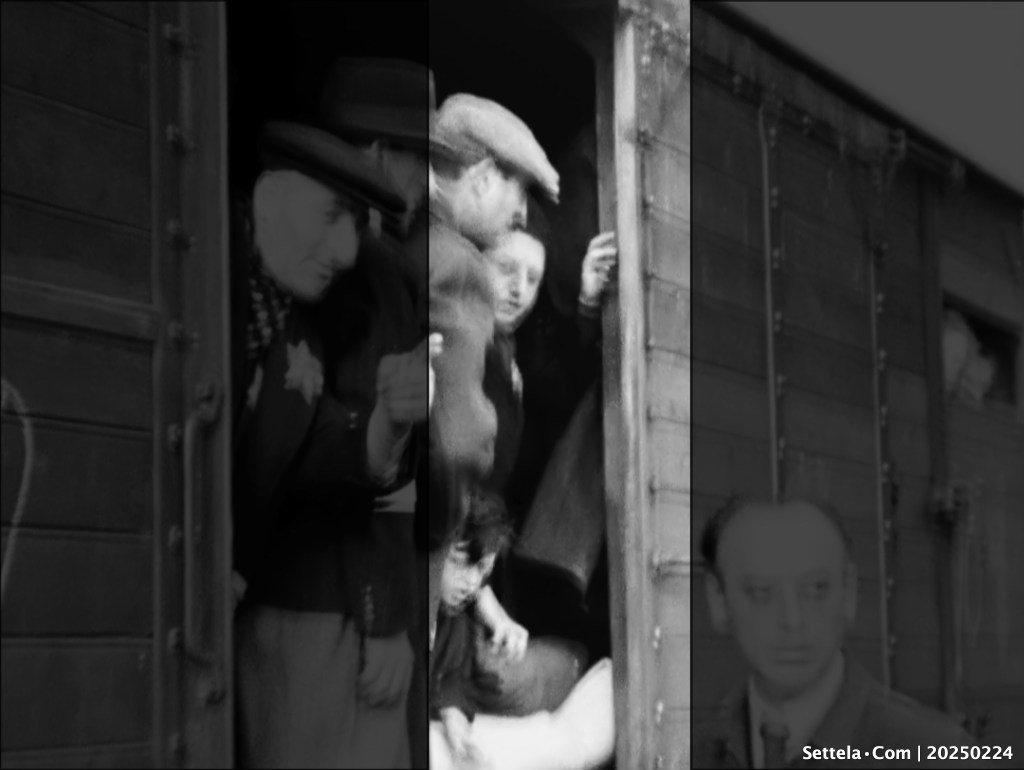
Almost certainly, three Jewish people have been recognized in the unique Westerbork film from 1944 (1). This time it concerns the 9-year-old boy Israël Wijnschenk, his father Max Wijnschenk, and his grandmother Betje Kokernoot-van Furth, who all lived in Utrecht (Holland).
Last week, the Dutch public broadcaster NOS (2) reported the news from the Utrecht (Dutch) news site Nieuws030 (3) that it is very likely that three people were recognized again in this film made by the Jewish prisoner and filmmaker Rudolf Breslauer showing the deportation of Jews, Roma and Sinti by train in Camp Westerbork on May 19, 1944.
Image researcher Koen Hulsbos — who previously identified an Amsterdam couple in this deportation train (4) — thought he recognized the young Israël Wijnschenk, a pupil at the time of the Joodse (Jewish) School Utrecht, and presented this to Victor Frederik, researcher of the Joodse School (5,6). The boy, the man, and the woman seem to belong together, and were recognized from family photos, also by family members.
It is certain that Max and his wife Chel (not in the images) returned to Utrecht after the war, their children Israël and his sister Kitty were murdered. Grandma Betje was also gassed in Auschwitz.
A portrait of Israël Wijnschenk is shown at the site of Joods Monument (7).
According to the transport list, there were two other children in that wagon, Joseph Beugeltas (11 years old) and Manfred Studzinsky (7 years old). Joseph Beugeltas appeared to have blond hair, and could not have been it (6). To be completely sure, the researchers are still looking for a photo of Manfred Studzinsky, for comparison…