Dutch cinema news reel from November 1945 reporting on Palestine soldiers of the Jewish Brigade, stationed in the Dutch port city of IJmuiden, and taking a course at the municipal fishing school there, where they learned to navigate and fish, practicing at the Dutch IJsselmeer lake, in order to settle in Palestine as fishermen after completing their service.
Notes
After the German surrender in 1945, soldiers of the Jewish Brigade, the “Jewish Fighting Unit”, a unit of around 5,000 Jewish volunteers from Mandatory Palestine serving in the British Army, were stationed in northwestern Europe, including the Netherlands.
Members of the Jewish Brigade in the Dutch port town IJmuiden (port to Amsterdam) and its surroundings were involved in: guarding German POWs , displaced persons support, and facilitating Jewish refugees’ clandestine departure to Palestine. Seafaring skills were directly relevant to both commercial livelihoods and the clandestine immigration (Aliyah Bet) efforts by sea. The British disbanded the brigade in July 1946.
Credits
Source: Dutch cinema news Polygoon-Profilti (Producer | Nov 1945) courtesy of Netherlands Institute for Sound and Vision (Open Images).
Citation info : Jewish Brigade 1945 • Dutch Seamanship Training | 20250615 | Michel van der Burg | Miracles•Media | Settela•Com | ISSN 2949-9313 | TakeNode a24a6599-dd79-47e3-a106-51289a480995 | URL https://settela.com/2025/06/15/
New evidence of atrocities committed by Nazis on British soil is revealed in the documentary – The Ghosts of Alderney – Hitler’s Island Slaves – to be released by Wild Dog Films during 2025 (1).
The film premiered at a London, UK, press screening earlier this week (2-5).
Ghosts of Alderney is a documentary on the artist Piers Secunda’s research into the use of slave labour on the British Channel island Alderney during World War II. In 1941, Hitler’s forces took over the island. What followed was a brutal occupation.
Workers from across Nazi-occupied Europe were forced to build Hitler’s military defences on the Channel Islands.
Alderney had the worst conditions—prisoners were beaten, starved, shot, and buried in mass graves — a scene compared to Belsen concentration camp in later reports.
The film reveals new evidence of crimes on the island, including firing squads, mass killings, and contests between Nazi officers using prisoners for target practice, aiming repeatedly at body parts, until they died.
It also explores how the British government avoided prosecuting those responsible after the war.
Experts in the film suggest that this was part of a cover-up.
Historian Madeleine Bunting calls it “the biggest mass murder on British soil,” yet many facts are still unclear.
A recent UK inquiry confirmed over 1,100 deaths, though more are missing.
Through testimony and research, the film tries to tell the personal stories behind the numbers.
Secunda says, “These were real people, not just names on a list.”
Ghosts of Alderney: Hitler’s Island Slaves, , a production from Wild Dog, a British independent company, will be released later this year.
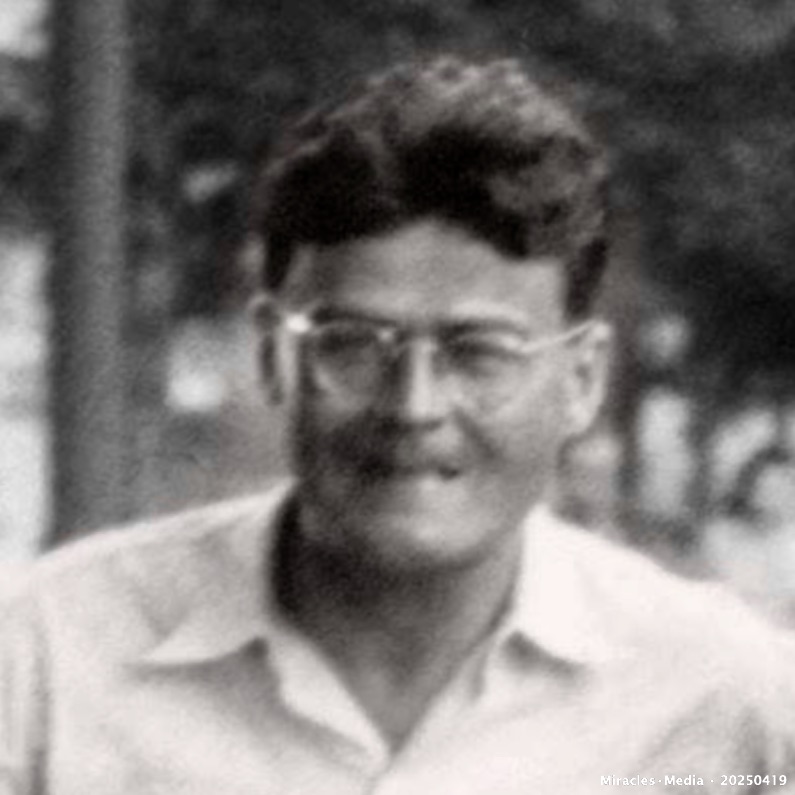
April 19, 1945 – today 80 years ago – the Buchenwald band ‘Rhythmus’ gave a jazz concert in the evening in the cinema barracks of the Nazi concentration camp Buchenwald for the survivors, their comrades, and the US soldiers that liberated the camp.
Czech political prisoner Jiří Žák started the Rhythmus jazz orchestra of inmates of the Buchenwald camp. ‘Woke’ music — ‘Entartete’ art , degenerated art, officially in Nazi Germany, the 3rd Reich. The Nazis enthusiastically applauded the “outside” forbidden jazz in the camp, and various SS people took part in the concerts given between August 1943 and December 1944 by this official camp band Rhythmus (1,2,3).
Jiří Žák | 20250419 | Family Archive Goldscheider | Miracles•Media
Jiří Žák sabotaged the transports, as the trusted administrator of the Buchenwald transport department, by setting up a “Transport Reserve C” commando of almost 100 prisoners, thus freed from hard labor, and saved numerous Jews from deportation and death march shortly before liberation of the camp.
The French singer Robert Widerman listed on the April 19,1945 Rhythmus program , was one of these Jewish prisoners saved by Jiří Žák. Band leader Yves Darriet (4) came up with the nickname ‘Clary’ for Robert (from the movie Les Adventures de Désirée Clary). Robert Widerman would become a Hollywood legend, known as Robert Clary (5).
From Buchenwald to Hollywood, The Robert Clary Story • Extended Version (2025)
From Buchenwald to Hollywood, The Robert Clary Story : The Documentary (Extended Version) • 20250419 • A film by Karen and Richard Bloom and Michel van der Burg
Robert Clary’s story is told in our documentary : From Buchenwald to Hollywood – the Story of Robert Clary • A film by Karen and Richard Bloom and Michel van der Burg. The original film premiered in 2018 at the Fort Lauderdale International Film Festival (FLIFF) in Hollywood (Florida, USA) , and after screening at other film festivals, premiered online March 1, 2022 on the occasion of Robert’s 96th birthday (6,7).
We today present the 2025 extended version of the documentary (8) , now featuring also Robert Clary’s desire that Jiri Zák be nominated as a Righteous Among the Nations at Yad Vashem.
8. From Buchenwald to Hollywood, The Robert Clary Story : The Documentary (Extended Version) • 20250419 • A film by Karen and Richard Bloom and Michel van der Burg . URL https://youtu.be/xwECq2KPdz4
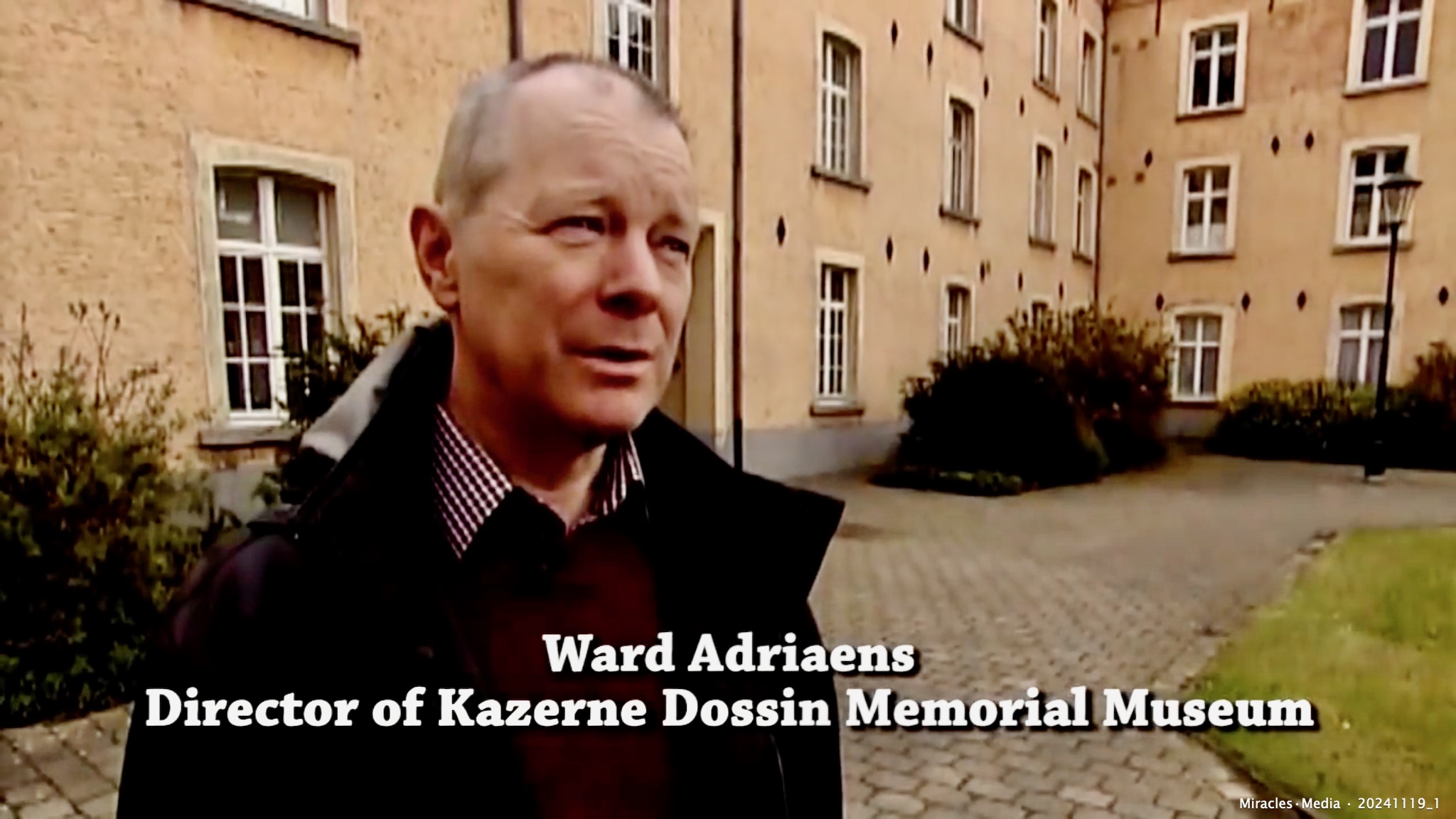
Ward Adriaens (Mechelen, Belgium) passed away suddenly on the evening of November 15th, 2024. A wonderful man, a freethinker, author, with a passion for living history, especially the resistance, partisans, in World War II, and the founding director in 1995 of the Jewish Museum of Deportation and Resistance (JMDR) that opened its doors in 1996. In 2012 the JMDR became the Kazerne Dossin museum, with Ward Adriaens as honorary curator. In 2005 Ward Adriaens launched the Give Them a Face archival project. The portraits of all Jewish, Roma and Sinti deportees which passed through the SS-Sammellager Mecheln (Dossin barracks, transit camp, Mechelen) in 1942-1944, were scanned to create the “Give Them a Face” portrait collection. All around 20,000 photos in the Give Them a Face portrait collection are now part of the commemoration wall – a permanent exhibition – at the Kazerne Dossin museum.
In 2009 , I first encountered the Transport XX installation in Brussels, and met Ward Adriaens’ team of the Give Them a Face project in the Jewish Museum of Deportation and Resistance in Mechelen, Belgium (1,2).
Next , Ward Adriaens participated in our 2012 documentary Transport XX to Auschwitz (3).
Recently, May 2024, Ward Adriaens’ opening speech at the TRANSPORT XX installation in Mechelen in 2007, was posted in the ‘Miracles’ project at Miracles•Media (4).
Quote
“…Let us clearly understand that this is the fundamental basis of racism: persecuted because we have a mother. We all have parents and many amongst us have children. In order to protect them it is essential that we do not give an inch to racism. Everyone of us will come under threat should the policy makers be influenced by racism…”
3. Ward Adriaens’ interview by the dutch reporters Piet de Blaauw & Aart Zeeman (Dutch NCRV-Netwerk broadcast, 13 April 2005, NL1) from the documentary ‘Transport XX to Auschwitz’ – a film by Karen Lynne & Richard Bloom and Michel van der Burg • In : Documentary film “Transport XX to Auschwitz” • Miracles•Media • 20130419 • URL (retrieved 20241119) https://michelvanderburg.com/2013/04/19/transport-xx-to-auschwitz/
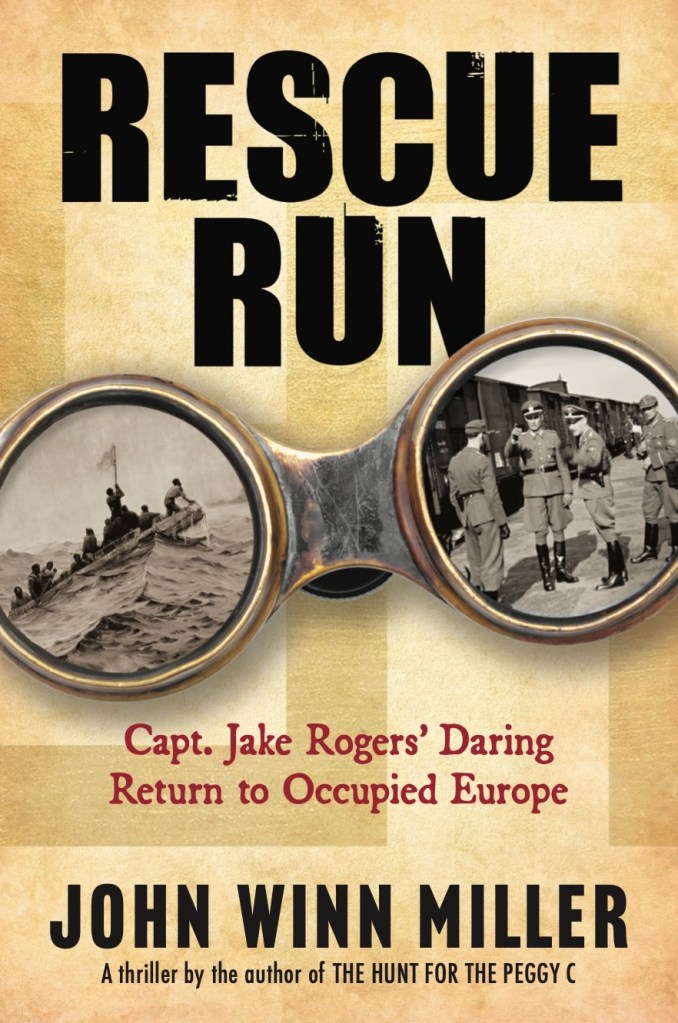
RESCUE RUN : Capt. Jake Rogers’ Daring Return to Occupied Europe • John Winn Miller
After escaping the treacherous waters of WWII, Captain Jake Rogers leads his crew on a daring mission across Nazi-occupied Europe to rescue the father of his beloved, entangled in a web of espionage, betrayal, and relentless pursuit.
Review of John Winn Miller’s novel ‘Rescue Run’
John Winn Miller, a veteran of investigative journalism for decades, masterfully weaves historical detail into his World War II novel Rescue Run. The story follows American ship’s captain Jake Rogers, who, after his U.S. Liberty ship carrying war supplies is wrecked in the North Atlantic, first lands in Ireland. He then sets out with a few of his loyal men on a perilous mission to rescue the father of Miriam Maduro, the love of his life, from the Westerbork transit camp in Nazi-occupied Holland.
A gruelling journey follows from Amsterdam across Nazi-occupied Europe to Spain – on foot, by train, and by boat – via a long series of hiding places, historical locations and events, aided by well-known and lesser-known resistance organisations and historical figures, besieged by con men, double agents, gangsters and pursued by a ruthless Dutch bounty hunter.
As a non-native English speaker, I initially struggled a bit with the first few chapters, particularly the maritime terms and rich language used in the sea adventure with the Liberty ship, besides the introduction of the many characters. However, once past those pages, the novel became a true page-turner. The gripping, almost cinematic narrative had me finishing the book in just two or three days, despite also spending some time online searching for even more historical context, for example when Rogers is helped by the Dutch resistance group ‘Groep 2000’ led by Jacoba van Tongeren, and when characters like Etty Hillesum and Audrey Hepburn appear in the story.
Blending Fiction and Nonfiction
I rarely read fiction these days — almost exclusively occupied with non-fiction — but John Miller’s work intrigued me. I was curious to see how he managed to incorporate the reality of Nazi-occupied Europe, and in particular the Westerbork transit camp, into fiction. The result is exceptional. The blend of fiction and nonfiction strengthens the narrative, bringing the past vividly to life. Miller also provides an extensive set of notes at the end of the book, offering in-depth background information on the events and historical figures featured in the story, detailing also what happened to them after the events of the novel.
I especially appreciate how John Winn Miller brings the wartime past to life in Rescue Run, with accuracy and rich detail, from multiple perspectives. His cinematic storytelling draws readers into a narrative that inspires further exploration of this history.
Michel van der Burg, filmmaker, editor of Settela•Com
Notes
Additional Information:
Title:Rescue Run: Capt. Jake Rogers’ Daring Return to Occupied Europe
John Winn Miller is an award-winning investigative reporter, foreign correspondent, editor, publisher, screenwriter, indie movie producer and novelist. | Photo Bancroft Press. | More info at Miller’s website URL https://www.johnwinnmiller.com
John Winn Miller
Though Rescue Run is a sequel to Miller’s first novel, The Hunt for the Peggy C, no prior knowledge of the first book is required. A summary of the prequel is included for new readers or those needing a refresher.
Westerbork Film Frame
This review was prompted by my contribution of a still (image below) from the Westerbork film for Rescue Run’s book jacket , in collaboration with designer Christine Van Bree and author John Winn Miller. John kindly provided me with a link for a free download of the Advance Reader Copy on the BookSirens’ platform. Since I’m documenting the Westerbork film through the online magazine Settela•Com, I happily accepted BookSiren’s invitation to join the review team.
Deportation | 20240225 | Settela•Com | Commander Albert Gemmeker oversees the deportation of Jews, Sinti, and Roma from the Westerbork transit camp May 19, 1944 | Frame 7426 from Deportation Westerbork Film | 20210719 | Settela•Com | ISSN 2949 9313
News
A gripping, almost cinematic narrative that blends fiction and non-fiction . By Michel van der Burg, filmmaker, editor of Settela•Com • RESCUE RUN Reviews. By John Winn Miller (Retrieved 20250606) URL https://www.johnwinnmiller.com/copy-of-readers-favorite
‘Entartete Art’ 1935 – Coleman Hawkins & Leo de la Fuente in Holland
American saxophonist Coleman Hawkins announces and plays – accompanied by Leo de la Fuente on piano – on his tenor saxophone ‘I wished that I were twins’.
In 1934, Coleman Hawkins left the Fletcher Henderson Orchestra and Amerika, moved to Europe, and joined the Jack Hylton Orchestra in England. Hylton and his band made regular ‘continental’ tours, and started another European tour January 1935 accompanied by Coleman Hawkins in Holland. At the end of January 1935 Hawkins joins the dutch band The Rambers … for 8 days … because Hawkins was denied entry to Germany because of his race, while Hylton and his band continued their tour without him and play for eight days at the Berlin Philharmonic Hall.
To end this special week with Hawkins well, the bandleader of The Ramblers – Theo Uden Masman – arranged with Decca for recordings 4 february 1935 in Pulchri Studio in The Hague, Holland, including this : I wish I were twins…that was also recorded on film by Polygoon (Polygoontoon) for the dutch cinema news for next week .
Coleman Hawkins is accomponied here on film by the dutch jazz pioneer Leo de la Fuente on piano , playing ‘I wished that I were twins’ . After the recordings, Hawkins moves further into Europe.
Leo – Leonard Henriques – de la Fuente, who was born Jewish in Amsterdam 28 March 1902, was deported by the nazi’s to Auschwitz on 2 November 1942, and died 30 April 1944 ‘somewhere in Mid Europe’.
Citation : ‘Entartete Art’ 1935 – Coleman Hawkins & Leo de la Fuente in Holland | 20231123 | Settela•Com | ISSN 2949-9313 | TakeNode 4f388407-5ccc-4816-aef6-6064fcee35b2
Silent film — Towards the end of World War I – in the summer 1918 , after the Allies defeated the Germans in the Second Battle of the Marne – large groups of Belgians and French refugees flee in front of the retreating enemy force to the neutral Netherlands.
The Dutch army and Red Cross prepared to receive a possible 100,000 evacuees in the border towns in the south of the Netherlands.
After wandering weeks in the north of France , and next crossing Belgium on foot, the first group of French refugees arrived at the Dutch border October 20, completely exhausted.
At the gate in the electric wire fence at the border to the Netherlands – the so-called ‘Death Wire’ (dutch : Dodendraad ) Dutch soldiers took them over from German escorts.
Some refugees had travelled by tram part of the route crossing Belgium to the belgian border town Molenbeersel.
At the dutch border the refugees were welcomed and ladies from relief committees provide the refugees with food and drinks on the road to Stramproy in the Netherlands.
Within days , thousands of French refugees arrive in the village of Stramproy and are transferred to the city of Weert .
On arrival in the city center of Weert the dutch army registered people and handed out soup and bread.
The weak, the sick, and maternity women were cared for by the Red Cross and taken to an aid post for further care.
The refugees were sheltered the night in buildings like convents and schools in Weert, before being housed elsewhere in the country the following days.
References
Source (video footage) : Belgische vluchtelingen 1e Wereldoorlog. Open Images | Beeld & Geluid (Sound &Vision).
Weert en het einde van W.O.-I. | Jan Henkens | Stichting Historisch Onderzoek Weert | URL http://www.showeert.nl