
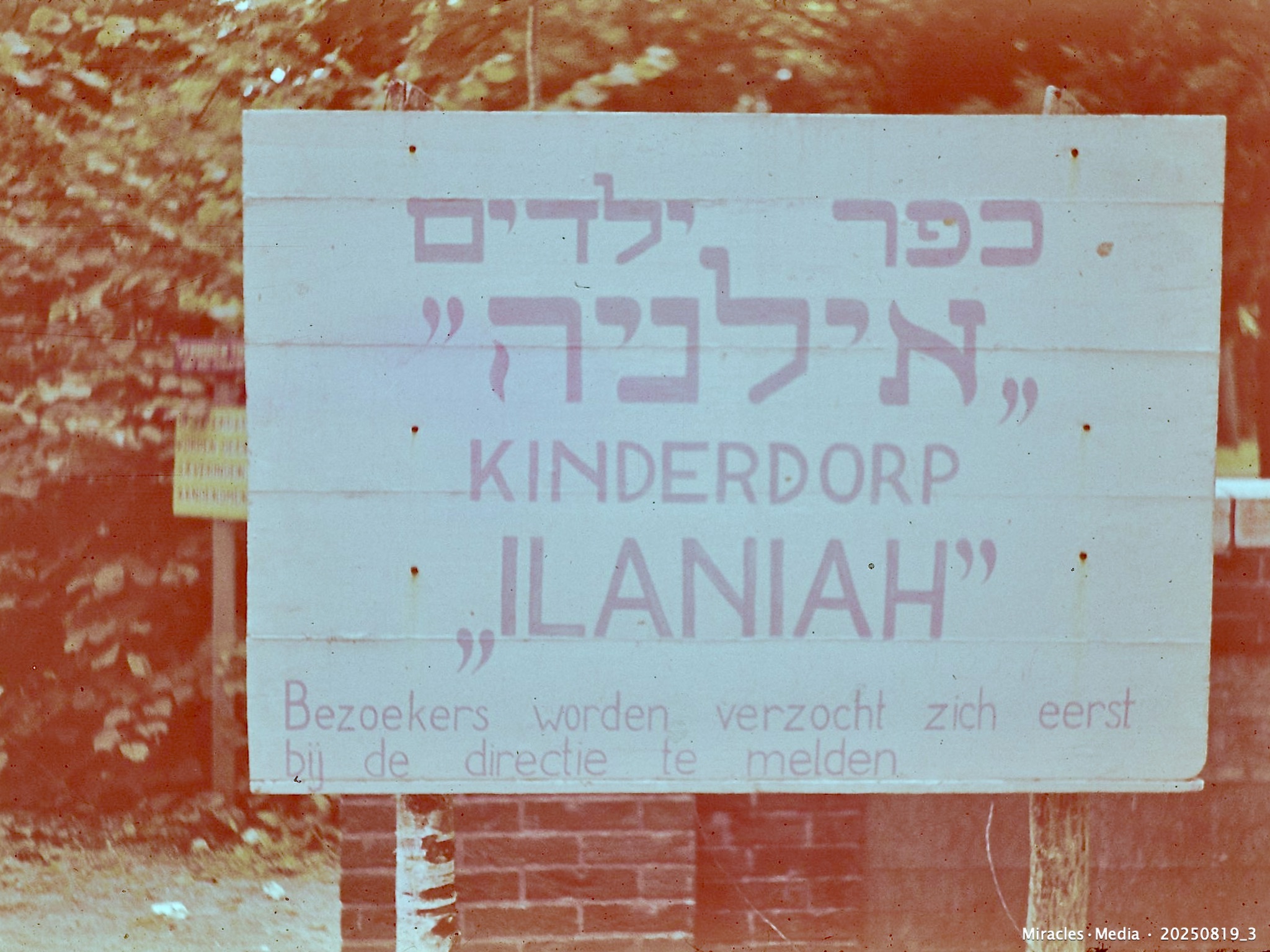
Summary — After World War II, many Jewish children in Eastern Europe were left without parents and living in displaced persons (DP) camps. In 1947, the Dutch government, together with Jewish organizations, decided to temporarily take in 500 Jewish children from Romania.
They were housed in a special Children’s Village called Ilaniah near Apeldoorn, the Netherlands. There, from September 1947, the children (aged 6–14) received schooling in Hebrew, history, and general subjects, as well as training in manual skills like woodworking and sewing, in preparation for life in Palestine. They lived in groups linked to different Zionist youth movements.
Ilaniah also had cultural activities, including a choir that performed in Amsterdam in May 1948 during celebrations of the creation of the State of Israel.
In October 1948, Ilaniah was closed, and most of the children departed on the ship Negbah to Haifa, Israel. The youngest children who couldn’t travel were cared for elsewhere in the Netherlands.
Displaced Persons (DP)
Two years after the end of World War II in Europe, still around a million people lived in displaced person (DP) camps across Europe, primarily refugees from Eastern Europe and former inmates of the Nazi German concentration camps.
Resettlement 500 Jewish Children
For the resettlement of DPs, the Dutch government had decided in 1947 to accept as many DPs as could find a place in the labor market.
In addition, on January 7, 1947, the Dutch government granted a request — a request from Dutch Jewish authorities , officially submitted on December 31, 1946) — to also accommodate 500 children from the camps in the Netherlands, for a period of up to 3 years (Note 1).
Foundation “Five Hundred Jewish Children”
In the first months of 1947, staff was recruited and trained, and the “Five Hundred Jewish Children” Foundation (dutch: Stichting “Vijfhonderd Joodse kinderen”) was established to organize a stay of five hundred Jewish children from Eastern Europe for 1 to 2 years, with an education focused on Palestine (Note 2).
Romania
When it became clear that only a few of the Jewish orphans in German DP camps wanted to come to the Netherlands, it was decided in consultation between the Jewish organizations and the Dutch government that 500 children from Romania would be allowed to come to the Netherlands temporarily. Displaced children from Eastern Europe, many of whom lost their parents in the Nazi camps.
Initially, in July 1947, temporary shelter was arranged in Barneveld (labour camp “De Biezen”) for a small group of 40 displaced children from Eastern Europe.
For the eventual reception — also for a new transport of 450 children — work was still being done on the Children’s Village ‘ILANIAH’, specially set up for them, in the building complex “Het Apeldoornse bos” near Apeldoorn, the Netherlands.
Through collaboration with the International Refugee Organization (IRO) and the Joint American Distribution Committee, the 500 children were selected in Romania from members of the eight Zionist youth organizations in Romania, from far-right to far-left: Aguda, B’nei Akiba, Gordonja, Dror Igoed, Dror Haboniem, Hanoar Hatzioni, Hashomer Hatzair, and Betar. For orphans who lost both parents, the political preference of the deceased parents was investigated. The children were first concentrated in Prague.
On Saturday evening, September 20, 1947, they finally left Prague (Prague-Bubny station) by steam train to the Netherlands.
Children’s Village ‘Ilaniah’
On Monday evening, September 22, 1947, the group of approximately 500 Jewish children arrived in Apeldoorn by steam train from Prague. Their destination was the Children’s Village “ILANIAH” (Hebrew for “My Tree/Wood”), where they would stay for one to two years, to be trained for a mission in Palestine. The children were then between six and fourteen years old.
Earlier that day, the Dutch cinema news made a report of their arrival in the Netherlands at a stopover at Nijmegen station just before Apeldoorn (4).
Play, Work and Learn in Ilaniah
Ilaniah is headed by a pedagogical leader, Benjamin Sussmann, who came over from Palestine. There is a dedicated school with teachers from Romania and the Holy Land, as well as a dedicated pediatrician and nurses.
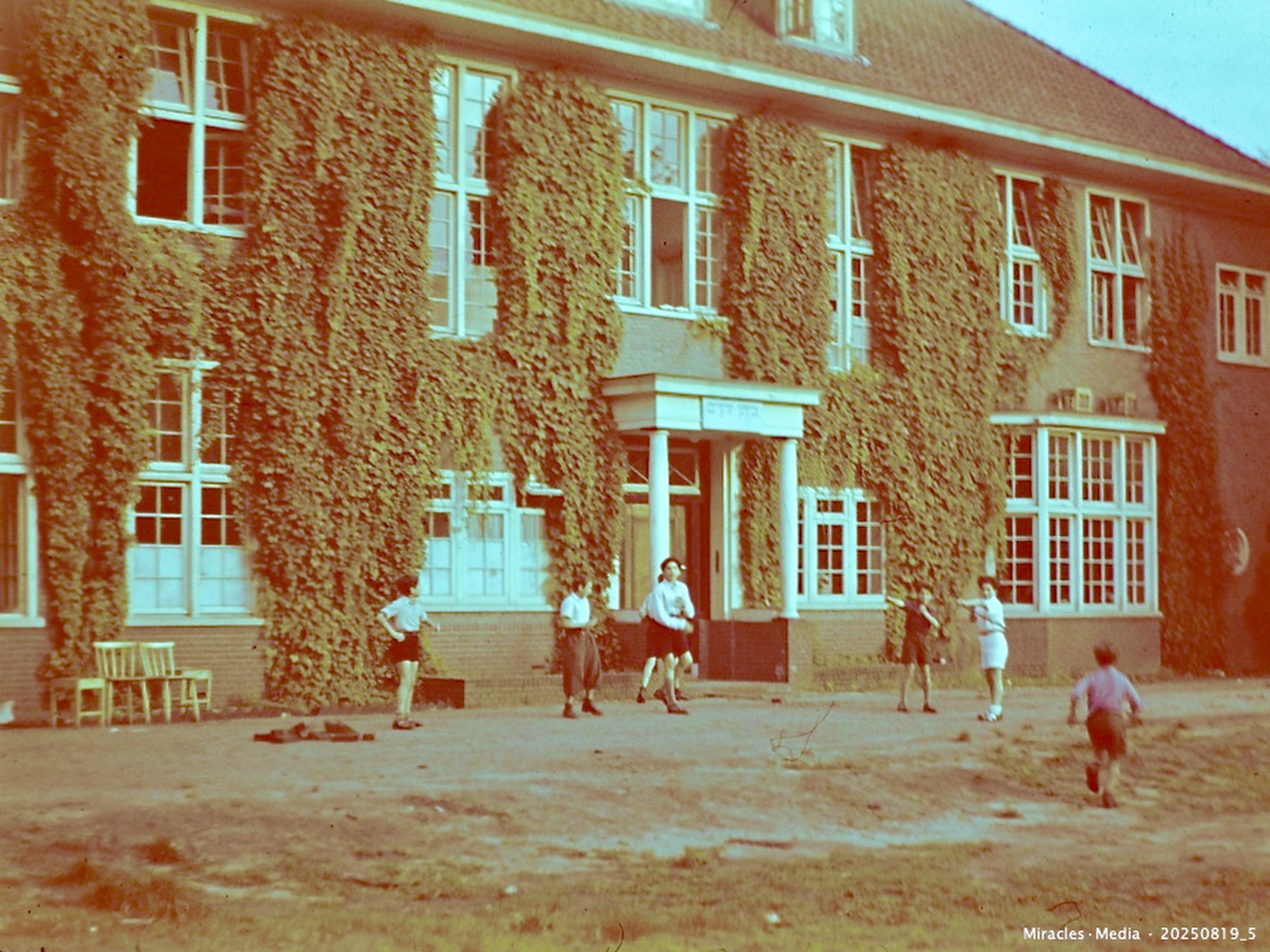
Hebrew, math, geography, physics, and both general and Jewish history are taught. The children are staying there in eight groups with their own leaders: Aguda, B’nei Akiba, Gordonja, Dror Igoed, Dror Haboniem, Hanoar Hatzioni, Hashomer Hatzair, and Betar, reflecting the future country’s political parties (Note 5).

Soon, manual labor training was started under the supervision of the Dutch branch of the O.R.T. Union (Organisation for Rehabilitation through Training) — the Jewish global education network.
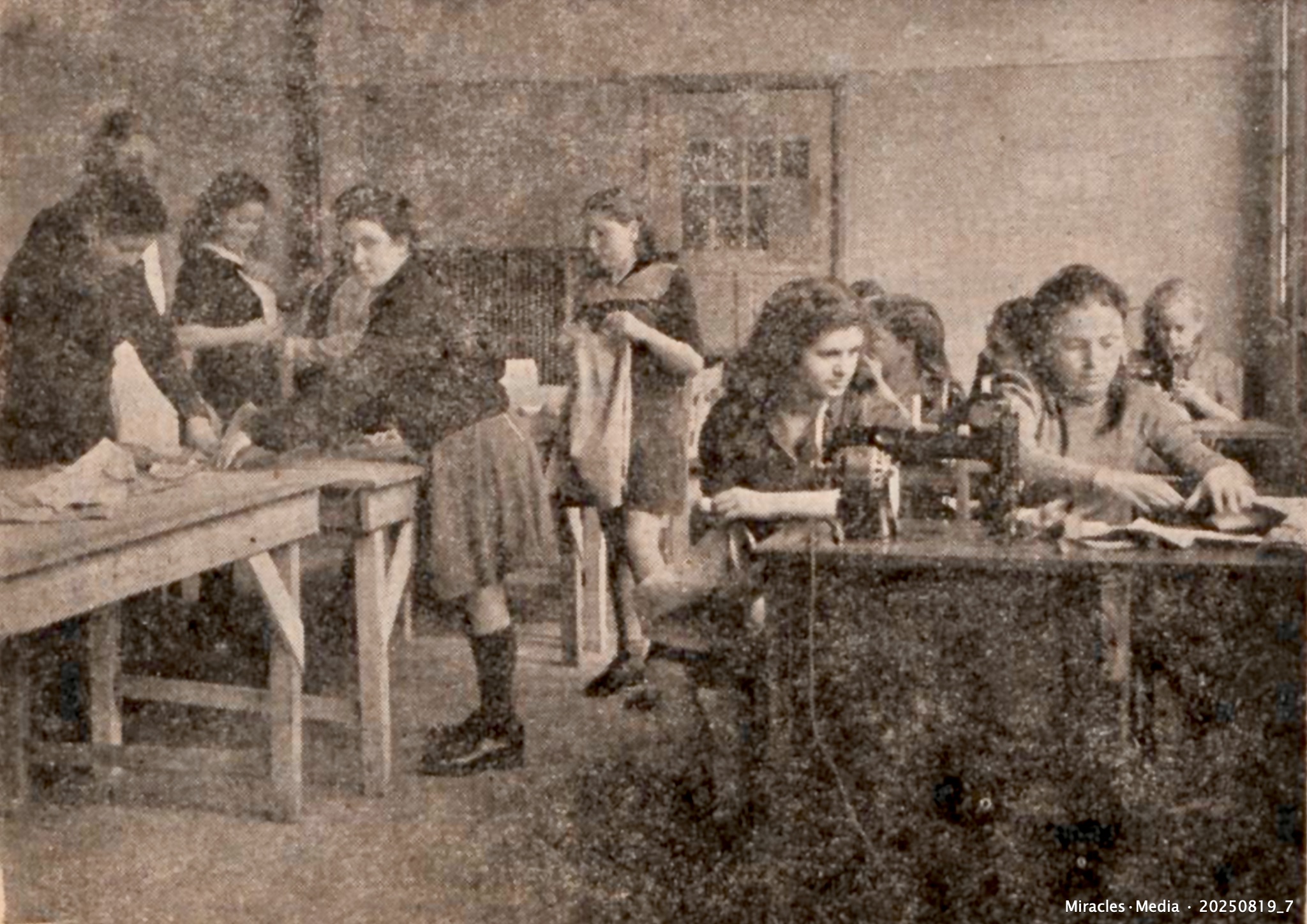
The ORT organization reported that as early as November 1947, the Dutch ORT was training approximately 400 of the 500 Jewish youth in the children’s village in new workshops for woodwork, cardboard work, bookbinding, and cutting and sewing (Note 9).
Children’s choir Ilaniah performs at the proclamation of the Jewish state
There are also music and singing lessons, and a choir has been formed.
On the occasion of the proclamation of the State of Israel on May 14, 1948, the Dutch Zionist League organized a national meeting on May 16, 1948 in the Amsterdam Concertgebouw, with a performance by the choir of the Children’s Village “Ilaniah”.

Closing Ilaniah and Departure to Israel
A year after the opening of the Children’s Village Ilaniah, Ilaniah was closed again, when on October 6, 1948 the children embarked on the first Jewish ship – the Negbah – in Amsterdam for the journey to Haifa, Israel.

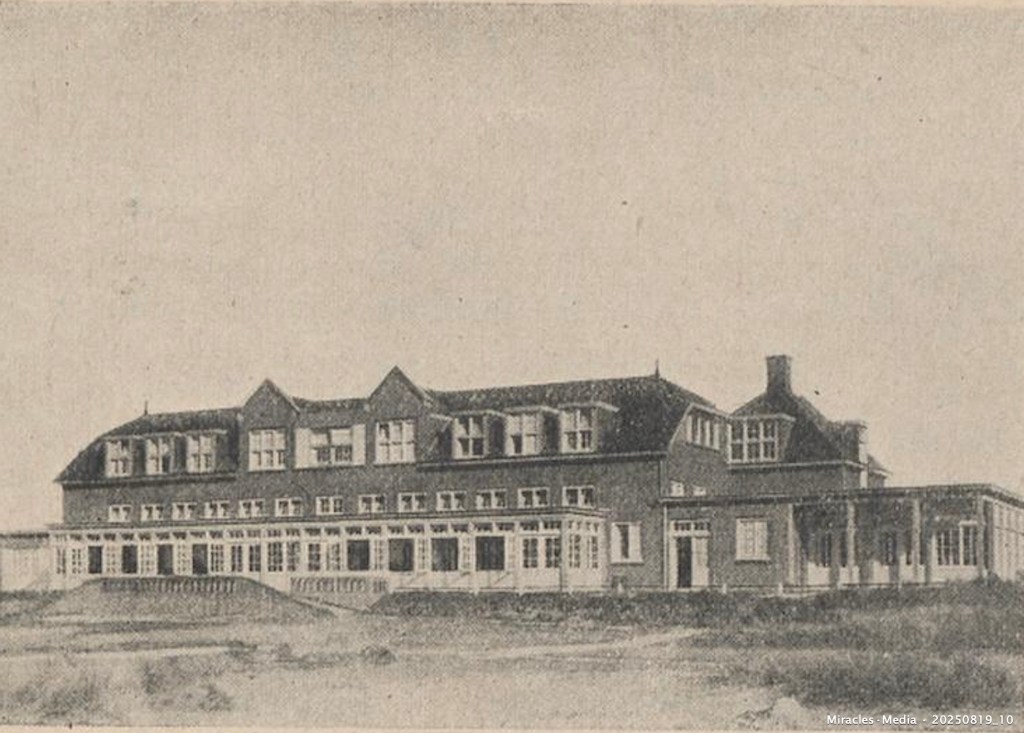
The youngest children who could not travel were accommodated in Zandvoort in the Clara Foundation building on the North Sea coast.
Notes

1. 500 Jewish children from camps to the Netherlands. Letter (dutch) Jan 7, 1947 Dutch Government to Dutch Jewish Organizations. Miracles•Media • 20250819_1 | Source : Nieuw Israelietisch Weekblad, Jan 17, 1947 / Delpher URL https://resolver.kb.nl/resolve?urn=ddd:010873395:mpeg21:a0005

2. Stichting “Vijfhonderd Joodse kinderen” (Clip). Miracles•Media • 20250819_2 | Source : Nieuw Israelietisch Weekblad, April 11, 1947 / Delpher URL https://resolver.kb.nl/resolve?urn=ddd:010873407:mpeg21:a0020
3. Sign in both Hebrew and Dutch at the entrance to Children’s Village Ilaniah in Apeldoorn, ca 1948. Miracles•Media • 20250819_3 | Source : United States Holocaust Memorial Museum, courtesy of Elinor Rosenstein Gabriel
4. Dutch cinema news reports the arrival of 500 Jewish children in Holland, Sep 22, 1947. Miracles•Media • 20250819_4. Source: 500 Jewish Children • Arrival in Holland • 20250811 | Michel van der Burg | Miracles•Media | Settela•Com | ISSN 2949-9313 | TakeNode 5c6e966b-5b45-47ef-ba01-17650007ae20 | URL https://settela.com/2025/08/11/
5. ILANIAH. Source : Nieuw Israelietisch Weekblad, Sep 17, 1948 / Delpher URL https://resolver.kb.nl/resolve?urn=ddd:010872060:mpeg21:p007
6. Children play in Children’s Village Ilaniah in Apeldoorn, ca 1948. Miracles•Media • 20250819_5 | Source : United States Holocaust Memorial Museum, courtesy of Elinor Rosenstein Gabriel
7. Carpentry Room of Ilaniah Children’s Village: A boy shows the teacher his work, 1948. Miracles•Media • 20250819_6 | Photo probably by Boris Kowadlo . Source : ORT and the Displaced Person Camps URL https://dpcamps.ort.org/photos/netherlands/
8. Sewing room of Ilaniah Children’s Village, 1948 (Clip). Miracles•Media • 20250819_7 | Source : Nieuw Israelietisch Weekblad, Sep 17, 1948 / Delpher URL https://resolver.kb.nl/resolve?urn=ddd:010872060:mpeg21:p007
9. Report on ORT Activities in the Netherlands, July-November 1947 . The attached report was submitted to the meeting to the executive of the World ORT Union in Zurich in November 1947. (ort netherlands report.pdf) URL https://dpcamps.ort.org/fileadmin/image_archive/reports/ort%20netherlands%20report.pdf
10. Performance choir Ilaniah Children’s Village during National Meeting Dutch Zionist League – Proclamation of the Jewish State , Concertgebouw Amsterdam, Sunday 16 May 1948 . Miracles•Media • 20250819_8 . Source : Collection Jewish Historical Museum, Amsterdam, JHM 02368-02 | https://joodsecanon.nl/n4z/1948-Viering-Israel-in-Concertgebouw/
11. Children embark for the journey to Haifa, Israel, on the first Jewish ship – the Negbah – at the quay in Amsterdam, 6 Oktober 1948. Miracles•Media • 20250819_9 . Source : Dutch National Archive (Photo by Ben Merk | Anefo). URL http://hdl.handle.net/10648/a8be2e80-d0b4-102d-bcf8-003048976d84
12. Clara-Stichting, Zandvoort, c. 1921. Miracles•Media • 20250819_10 . Source : De geïllustreerde joodsche post. 3 maart 1921. Delpher URL https://resolver.kb.nl/resolve?urn=MMUBA16:021070011:00016
Tags #Resettlement #Ilaniah #village #children #Jewish #displaced #DP #orphan #Palestine #Aliyah #Holland #Netherlands #Romania #Apeldoorn #school #zionism #training #education #emigration #holocaust #news #history #ww2 #ORT #state #Negbah
Citation info : 500 Jewish Children • Ilaniah • 20250819 | Michel van der Burg | Miracles•Media | Settela•Com | ISSN 2949-9313 | URL https://settela.com/2025/08/19/


