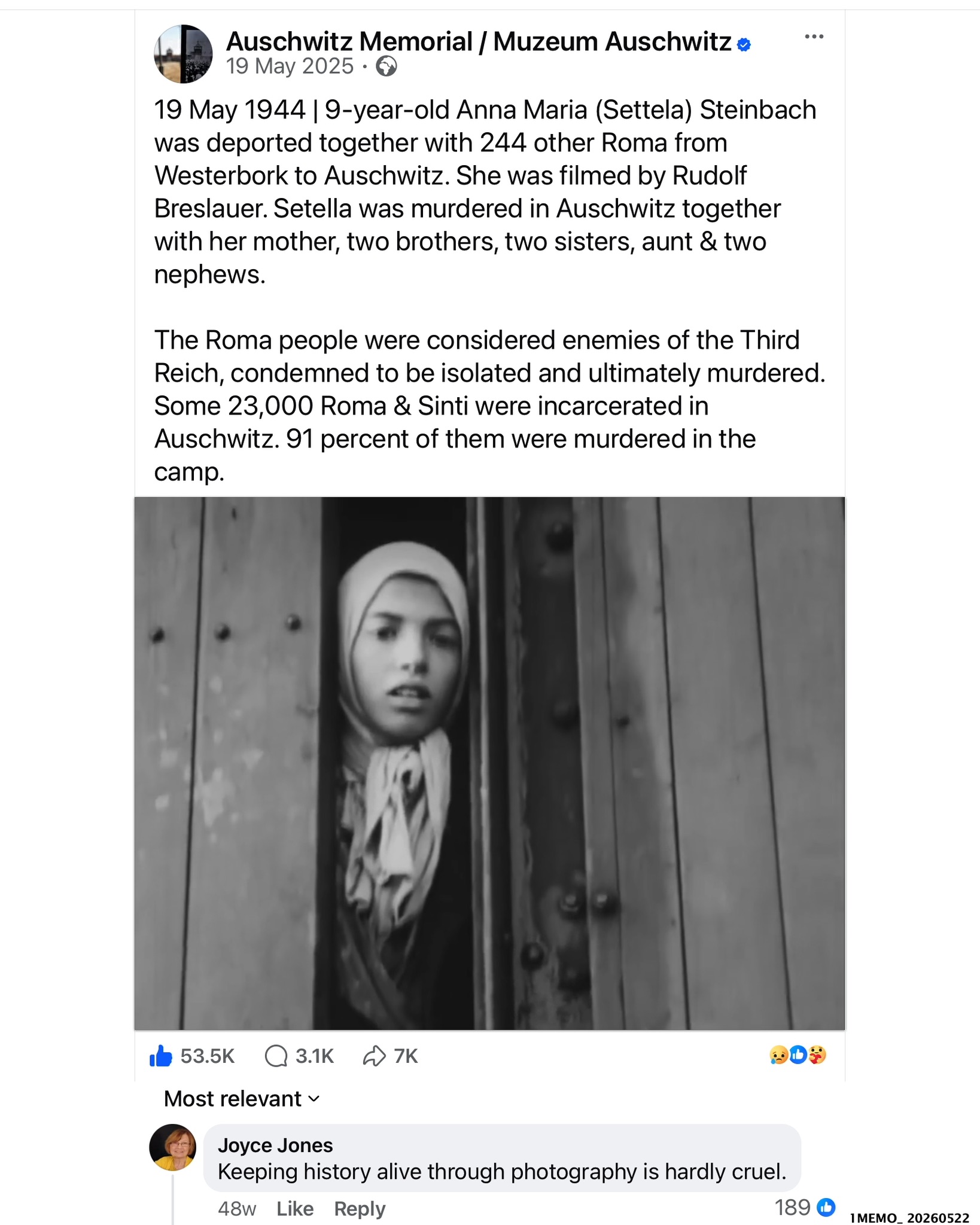
Deportation of Dutch Roma to Auschwitz – 19 May 1944 • 9-year-old Anna Maria (Settela) Steinbach was deported together with 244 other Roma from Westerbork to Auschwitz (1,2) • Source : Settela•Com • Collection Auschwitz Museum • URL https://fb.watch/Hgg5lusc-8/
The Auschwitz Museum acquired the short film ‘Settela’ from Settela•Com (1) in the Auschwitz Memorial Collection (3), and is succesfully screening the film each year since 2019 on the 19th May at the Auschwitz Memorial / Muzeum Auschwitz facebook page .
Last year’s post of the film ‘Settela’ , 19th May 2025 at the Auschwitz Memorial / Muzeum Auschwitz facebook page, accumulated by now one million views, and over 3000 comments (Image 1MEMO_20260522).
The film was created in an attempt to keep the scene on screen longer on the one hand, and to preserve the natural and historical original on the other. Thus a compilation was created, showing the same scene twice. The film ends with the original 3 seconds clip selected from the Westerbork film footage shot by Jewish prisoner Rudolf Breslauer (4), and the film starts with that same clip , digitally slowed down 10× in post-production.
This film was created and first online in 2017 (5) , and published (antedated) as the first post (1) shortly after the start May 19, 2019, of the online journal Settela•Communications — short Settela•Com (6).
More on the Roma in Auschwitz , online at the Auschwitz Museum (7).
Citation info : Settela Film Auschwitz Museum • 20260522 | Michel van der Burg | Settela•Com | ISSN 2949-9313 | CC BY 4.0 | URL https://settela.com/2026/05/22
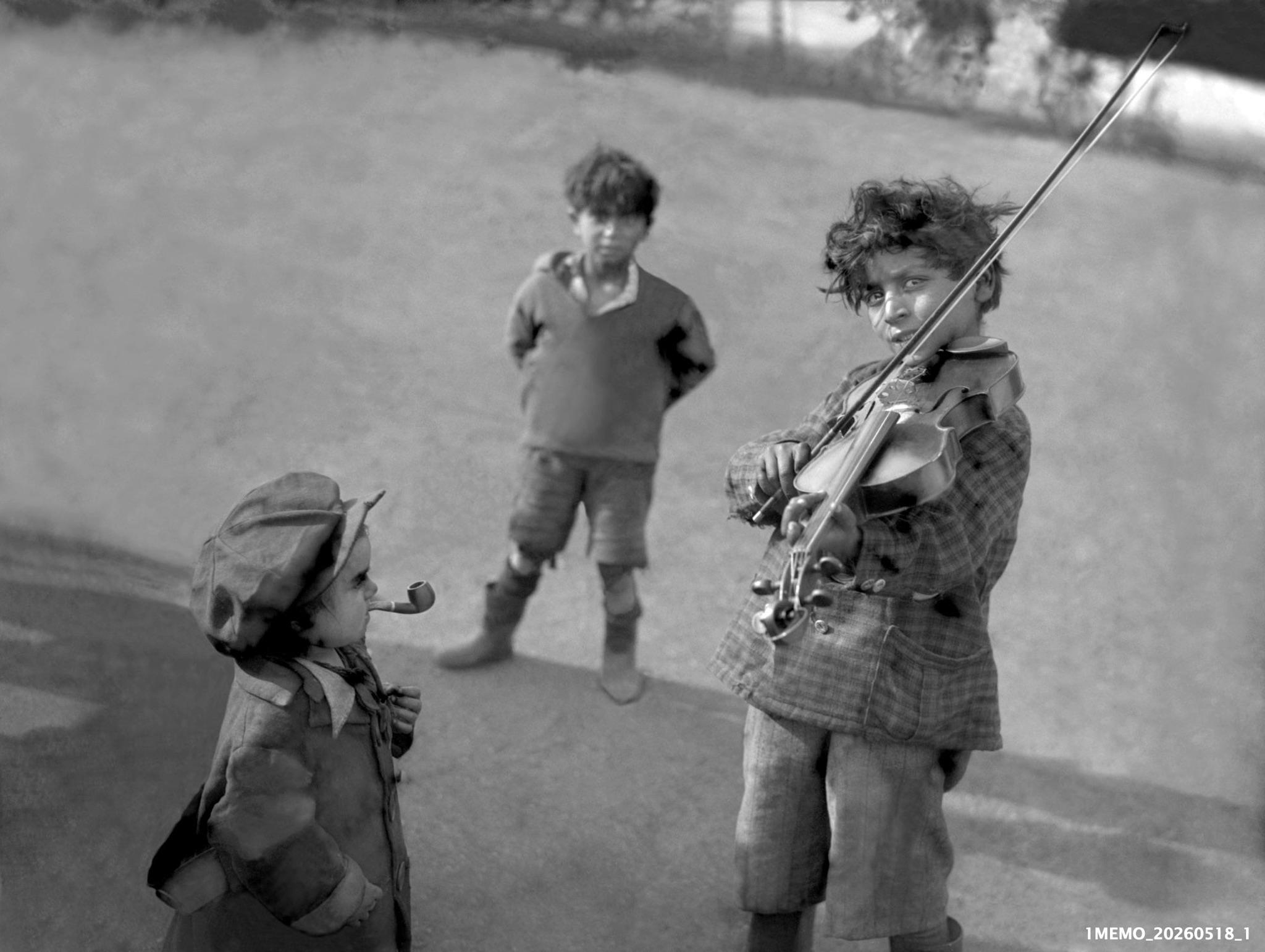
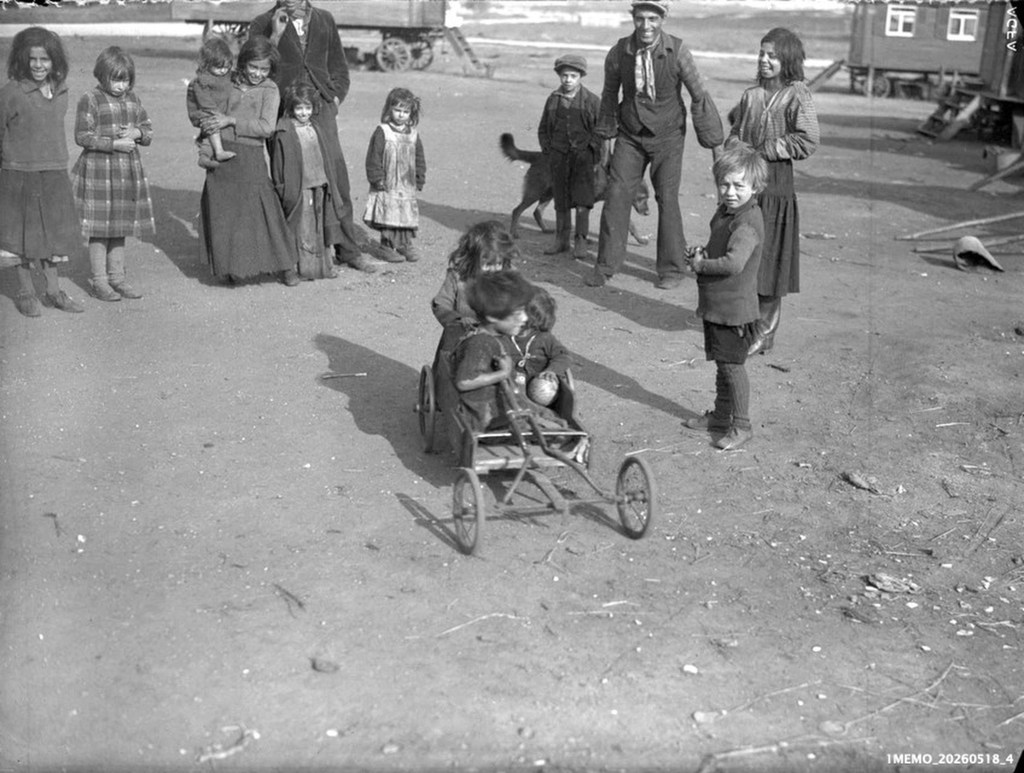
Willy Steinbach plays the violin at the Sinti caravan site Heksenberg in 1935 • Photo Jan de Jong • 1MEMO_20260518_1
In 1935 the nomadic Sinti families Steinbach — musicians — were photographed by Dutch photographer Jan de Jong at their caravan pitch on the heath around the Heksenberg hill in Brunssum, Limburg, Netherlands (1).
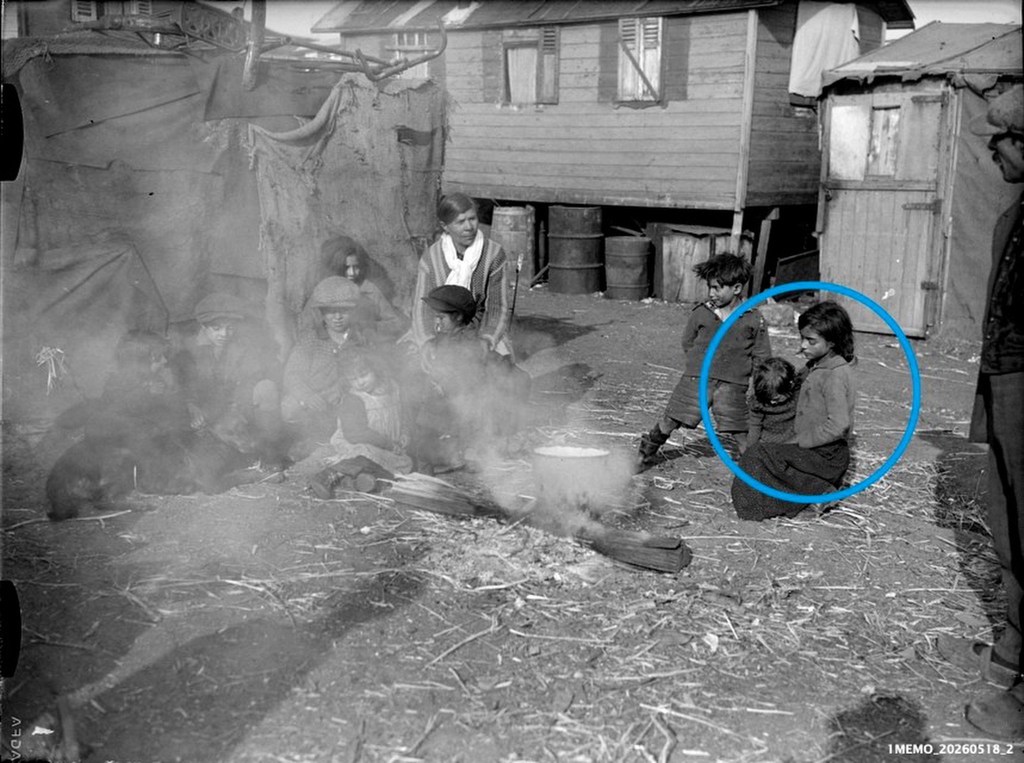
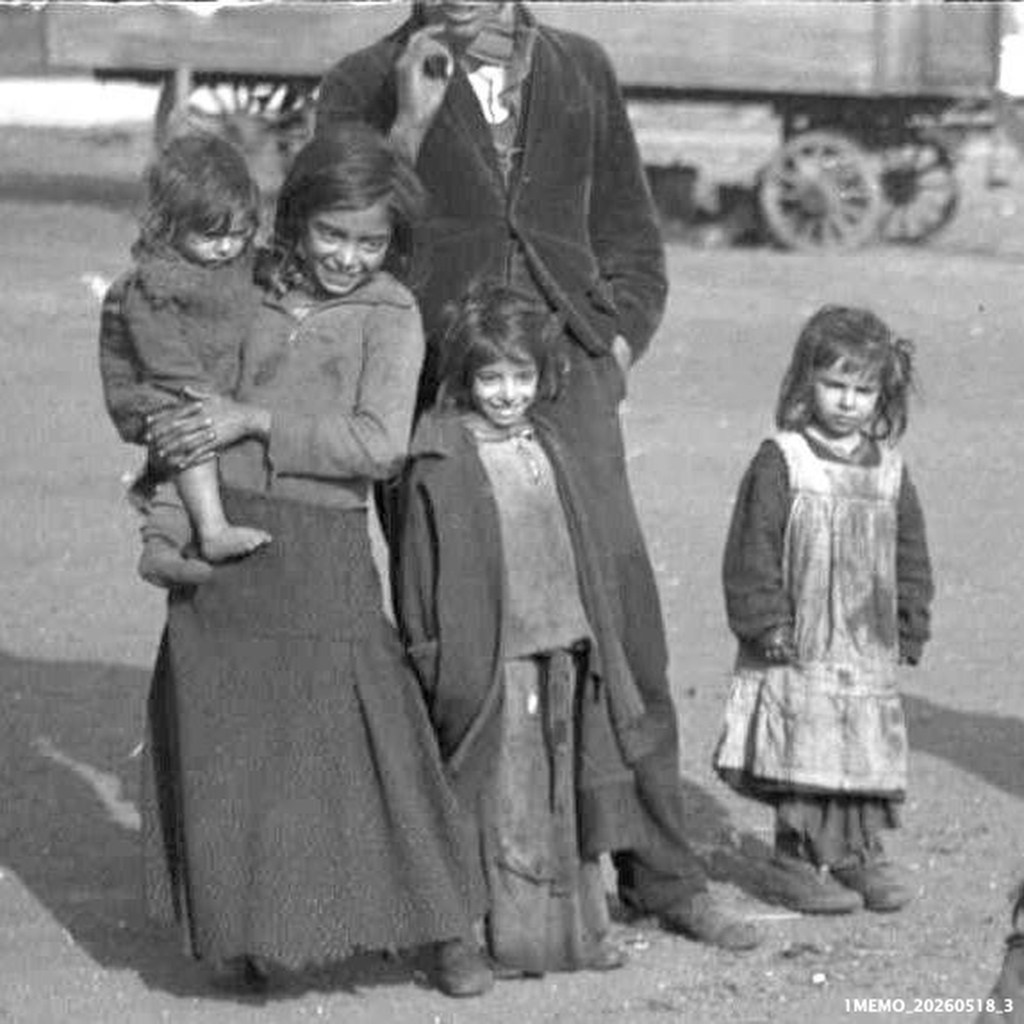
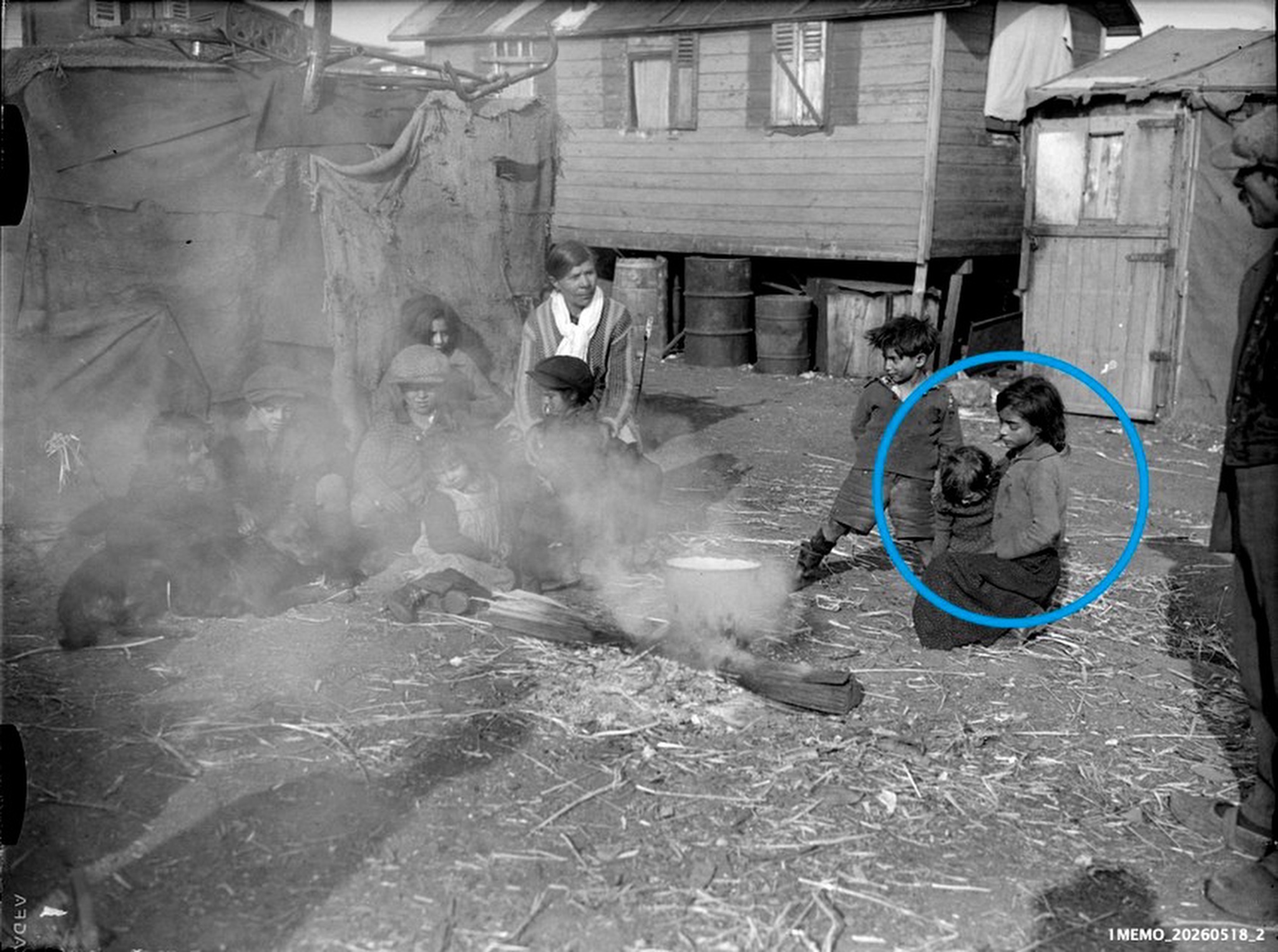
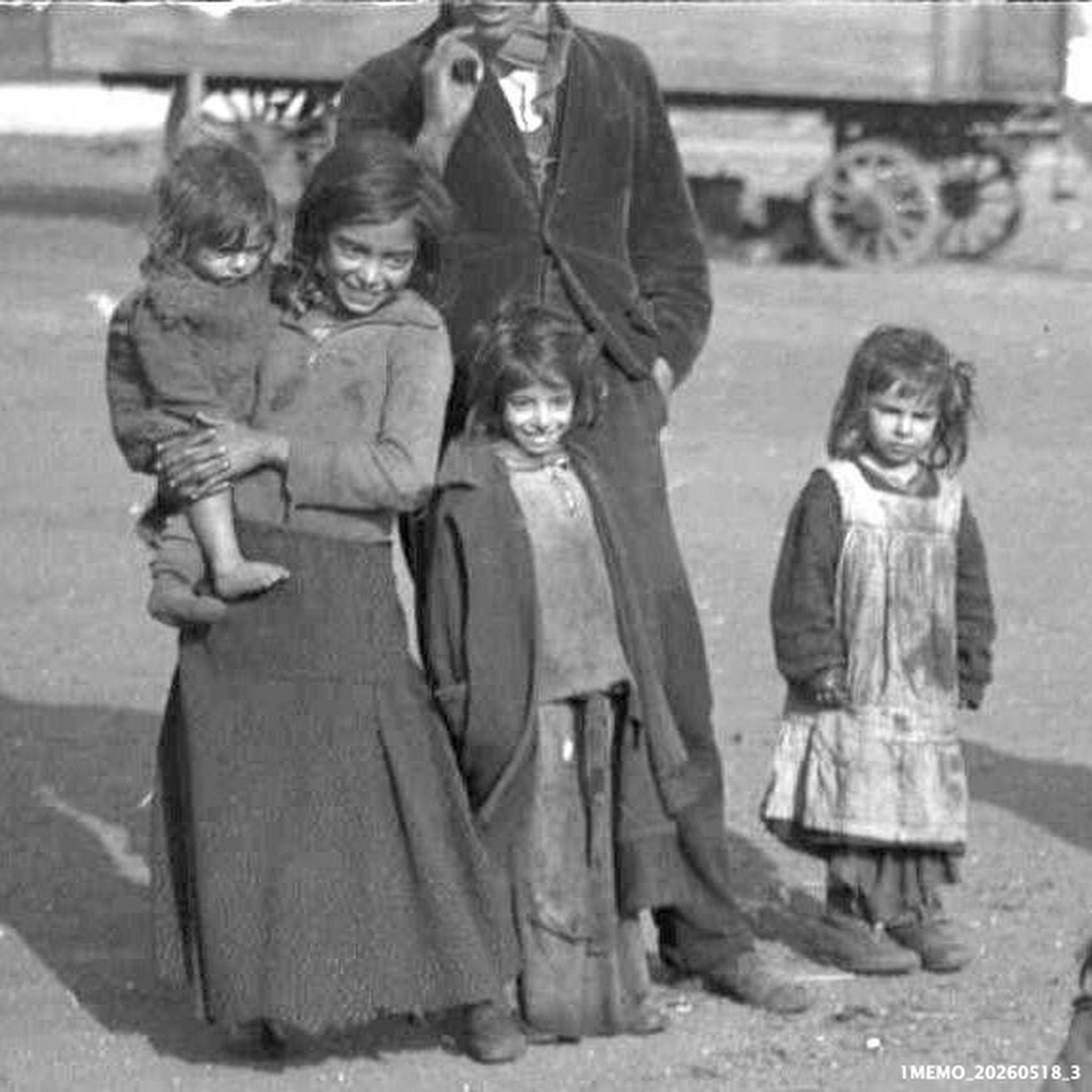
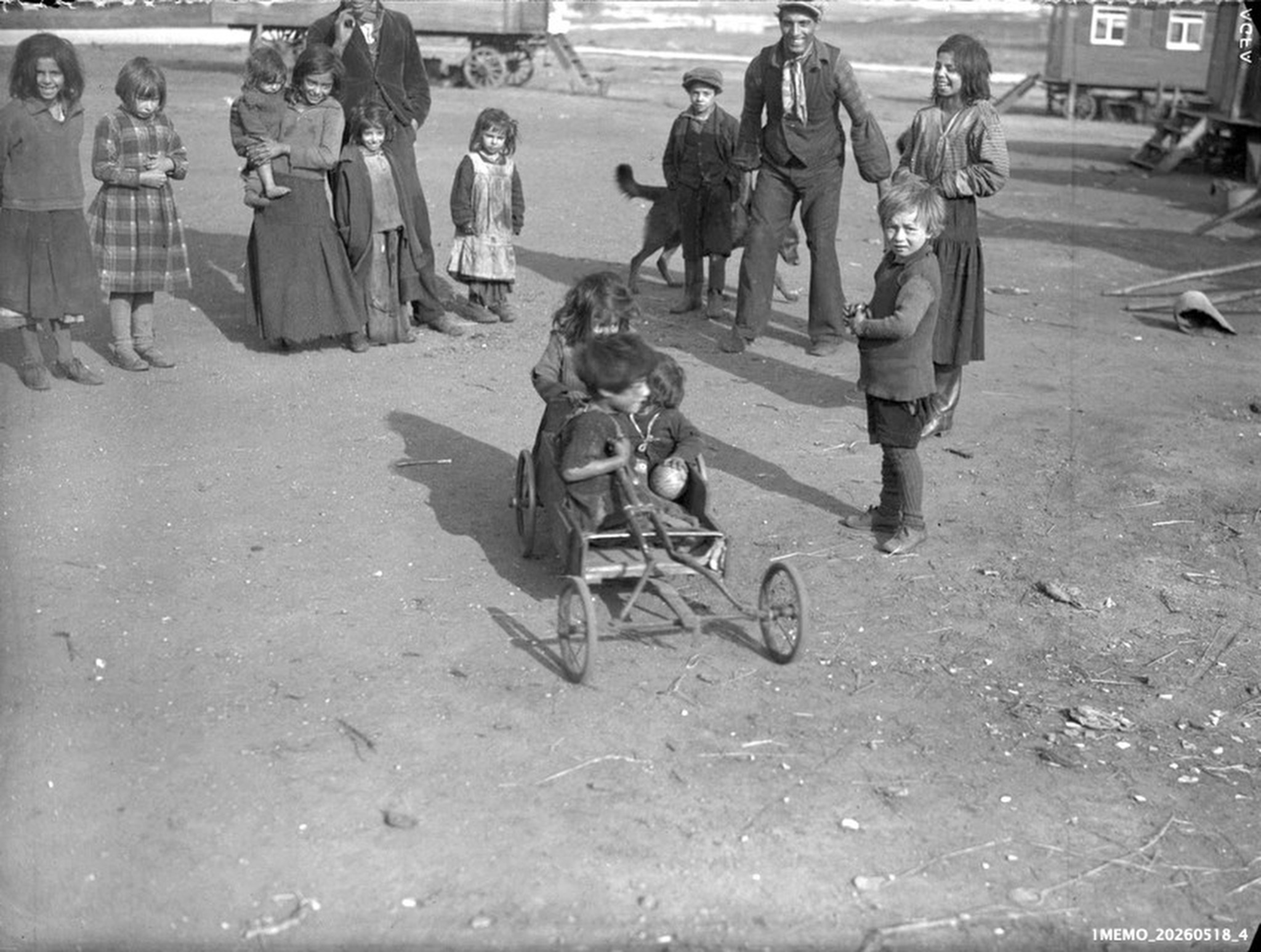
The boy with the violin is Willy Steinbach, an older brother of Settela Steinbach. The other 3 prints from the glass negatives that Jan de Jong made at the Heksenberg site in 1935 also show the Steinbach family, among others, with toddler Settela in the arms of her older sister Elisabeth Steinbach.
The toddler Settela in the arms of her older sister Elisabeth Steinbach (circled in blue) at the Heksenberg Sinti caravan site in 1935 • Photo Jan de Jong • 1MEMO_20260518_2
The toddler Settela in the arms of her older sister Elisabeth Steinbach at the Heksenberg Sinti caravan site in 1935 • Photo Jan de Jong • 1MEMO_20260518_3
The toddler Settela in the arms of her older sister Elisabeth Steinbach at the Heksenberg Sinti caravan site in 1935 • Photo Jan de Jong • 1MEMO_20260518_4
Settela Steinbach became known as the girl with the headscarf, featured a few seconds in the Westerbork film by Werner Rudolf Breslauer showing the deportation of the Steinbachs’ and other nomad families — all together ca 245 Sinti and Roma, and ca 450 Jews — on May 19th 1944 from the dutch transit camp Westerbork to Auschwitz (1,2).
Westerbork Girls – From left to right: Catharina Frank, Hannelore Cahn, Beatrice Lissauer, Ulla Gross, Lotte Heider-Lehmann and Ruth Pagener. (Source : Westerbork Memorial)
The documentary ‘Westerbork Girl’ (2007), directed by Steffie van den Oord, tells the story of Hannelore Cahn (later Eisinger-Cahn), a Jewish woman imprisoned in Camp Westerbork for more than two years during World War II. She performed as a dancer in the camp revue, attracting the attention of many, including camp commander Gemmeker and Jewish camp policeman Hans Eisinger, member of the Jewish Order Service—also known as “the Jewish SS”.
Westerbork Girl (VPRO 2007)
Hannelore had earlier met actor and resistance fighter Rob de Vries, with whom she was close. Rob smuggled her out of Westerbork by disguising himself as a train stoker and taking her to Amsterdam, where she briefly went into hiding. Hans Eisinger manages to track her down and one week after her escape Hannelore voluntarily accompanies him back to the camp…possibly due to loneliness, Rob’s existing relationship, or pressure from the Order Service to prevent others being deported to Auschwitz. Shortly thereafter, Hannelore and Hans get married in Westerbork.
Hannelore survived the war and avoided punishment after her return. The film reconstructs her story through interviews, archival footage, and music, presenting it as one of survival, love, and the difficult choices faced under Nazi persecution.
Hannelore sings and is still intensely sung about by Louis de Wijze, who witnessed her escape and remembered the revue songs from Westerbork: Ich hab es bei Nacht den Sternen erzählt, Ich liebe Dich.
Powerful documentary—this story, with close-ups of this Westerbork Girl, that resonate with me. Beautiful surprise while researching the use of the Westerborkfilm. Review by Michel van der Burg , editor Settela.Com
Citation info : Westerbork Girl • 20250916 | Michel van der Burg | Settela•Com | ISSN 2949-9313 | URL https://settela.com/2025/09/16
Images from the Westerborkfilm have been used countless times in documentaries and films about the Second World War. Here images screening in the virtual opera PUSH – based on the story of Simon Gronowski – an 11 year old Jewish boy who was pushed from the train – Transport XX – by his mother on the way to Auschwitz — Video clip https://youtube.com/clip/UgkxsM6Rj_HB0xEh4TksbjhIm4EzY81dc4H0
A virtual performance, during the April 2020 Corona virus lockdown, of the epilogue of the community opera PUSH , entitled : Ma Vie N’est Que Miracles | My life is only miracles – hosted by composer Howard Moody. It premiered on the night of the 19th April 2020, exactly 77 years after three Brussels resistance heroes stopped the Nazi train Transport XX, transporting 1600 Jewish deportees to Auschwitz, and more than 200 prisoners escaped from the train before the German border. Info : michelvanderburg.com/2020/04/19 .
Images from the Westerborkfilm have been used countless times in documentaries and films about the Second World War.
Here Westerborkfilm images – clips – screening semi-permanent ten years ago (Feb. 2013) in a museum introduction film (on holocaust, genocides, discrimination, diversity, rights) on one of the huge columns in the entrance hall of the Kazerne Dossin museum in Mechelen, Belgium (a few months after opening of the new Kazerne Dossin building). Note, shortly after this outbound deportation transport to Bergen-Belsen and Auschwitz, had left the Westerbork transit camp on May 19, 1944, the train paused at the nearby railway station of the dutch town Assen, where train cars were added from Belgian Transport XXV (25) with 508 deportees, Jews and the Roma deportee Stevo Caroli, from transit camp Kazerne Dossin (Dossin barracks) in Mechelen, and this combined transport with Jews, Sinti and Roma, including Settela Steinbach, continues to the east…to the Bergen-Belsen and Auschwitz concentration camps. Stevo Caroli survives Auschwitz-Birkenau. After returning to Belgium, Stevo Caroli’s request for a certificate, necessary for the compensation for political deportees or work refusers, is refused by the Belgian Aliens Police for racial reasons ( kazernedossin.memorial/biografie/stevo-karoli/ ).
Westerbork Film Football Edit | Edition 2021 | 20210517
SILENT FILM
The UNESCO – Memory of the World – ‘ Westerbork films’ dossier (REF 1) consists of both the actual film footage, as well as a dossier with the 1944 film plan, film script, title cards (intertitles), and a file with correspondence between the camp and the outside world on obtaining camera’s , film and film processing. That film footage was researched and presented before on Settela•Com.
In a recent post (Westerbork Film Intertitles | 20210515; REF 2) the drawings for the title cards were shown in a short film I made, that also showed a few seconds of Breslauer’s archive film footage demonstrating that not all of his Westerbork Film is a compilation of rushes only -he also had done some experiments filming and animating title cards. Aside from that, the film was not edited, and title cards were not yet inserted.
Today, working on presenting that 1944 film plan and script, I noticed in that editing script (all written in the German language) the instruction “Untertitel: ( in einen rollenden Fussball einkopiert ) Appelplatz am Sonntag Nachmittag.” , in English : ‘Subtitle: copied into a rolling football – roll call area on Sunday afternoon’. That is the text on one of these title cards I worked with, and I had seen Breslauer’s filming and slow-motion experiments with a rolling football, on that same F1014 reel that was used for his animation tests (REF 3). This has been described also in the 1997 dutch Westerbork film dossier analysis by Broersma & Rossing (REF 4) – a book I studied 2 years ago – and details I re-discovered later today. Tomorrow these authors will present a new edition (dutch), available later this month.
Breslauer never got the chance to try copying that title card on the rolling ball – I did today : a little digital experiment of copying that title card Appellplatz am Sonntag Nachmittag on the rolling ball. Just 4 seconds, repeated 4 times in this little film : Westerbork Film Football Edit.
2- Westerbork Film Intertitles | 20210515 | Michel van der Burg | Settela•Com | ISSN 2949-9313 (accessed 2021 May 17) URL: https://wp.me/p91enH-3e
3 – Unknown Westerbork Film Reel…F1014 | 20190616 | Michel van der Burg | Settela•Com | ISSN 2949-9313 (accessed 2021 May 15) URL: https://wp.me/p91enH-2b
4 – ‘Kamp Westerbork gefilmd’ by Koert Broersma and Gerard Rossing (editors Dirk Mulder and Ben Prinsen; ISBN 9023232658). Note, a new edition will be available May 2021 (editor Gorcum B.V., Koninklijke van; ISBN 9789023257622 ) – not yet published.
Notes : Both Appelplatz and Appellplatz are used in German and in script and title card
Credit
Thanks to ‘Kamp Westerbork gefilmd’ by Koert Broersma and Gerard Rossing (editors Dirk Mulder and Ben Prinsen; ISBN 9023232658). Note, a new edition will be available May 2021 (editor Gorcum B.V., Koninklijke van; ISBN 9789023257622 )
Film footage source : Filmed by Rudolf Breslauer, retrieved from : Unknown Westerbork Film Reel…F1014 | 20190616 | Michel van der Burg | Settela•Com | ISSN 2949-9313 (accessed 2021 May 17) URL: https://wp.me/p91enH-2b
Westerbork Film Football Edit | Edition 2021 | 20210517 | Michel van der Burg | Settela•Com | ISSN 2949-9313
Updates
20220604 – Format changes credit line , references
20230518 – Credits and references updated with ISSN
Westerbork Film Intertitles | 20210515 | Michel van der Burg | Settela•com
SILENT FILM
Westerbork Films Dossier
The UNESCO – Memory of the World – ‘ Westerbork films’ dossier (REF 1) consists of both the actual film footage, as well as a dossier with the 1944 film plan, film script, title cards (intertitles), and a file with correspondence between the camp and the outside world on obtaining camera’s , film and film processing. That film footage was researched and presented before on Settela•com.
These Westerbork film documents – the film script etc – complement the Westerbork film footage presented earlier – a first full version (RVD) of the Westerbork Film posted in 2019 (20190605) and the complete UNESCO album of all known footage shot by inmate Werner Rudolf Breslauer in the Westerbork camp in 1944, posted early 2020 (REF 2).
The final part of the UNESCO registry (Le film de Westerbork – édité le 8 mai 2017 – ID code 2016-118 ) lists all the documents on the Westerbork Film at the NIOD Institute for War, Holocaust and Genocide Studies.
That NIOD archive file — called (translated) : Directing, texts and correspondence of the film “Westerbork” consists of a file containing the original screenplay or script for the film, title cards, notes, correspondence and administration . That entire file has been scanned (total of 60 black and white scans) and is available online.
More information on the history and origin of the film translated from the french UNESCO registration is posted later.
Title Cards
Here, in this short film, the title cards are presented. Title cards referenced in the UNESCO registry, and prepared in the camp in 1944 for the Westerbork film. The name of the artist drawing these cards is not known, I guess. Digital scans of 11 different letter cards were retrieved from the public online archive of the NIOD Institute for War, Holocaust and Genocide Studies at the dutch National Archive (Nationaal Archief) – full info in CREDITS.
Film Sections
In this film these title cards are used in different ways, shown in 5 sections. The arrangement of the cards was chosen by me.
1 : ‘ORIGINALS’ – TRANSLATION IN SUBTITLES – The first section shows english subtitles with the restored scan images of the orignal drawings made in Camp Westerbork. The restoration includes exposure adjustment, crop, and if necessary rotation and flip horizontal or vertical of the supplied scans.
2: NEGATIVES – The second section shows the same images, now as negatives (white on black), the way title cards are usually shown in movies, and Breslauer did too while working on the Westerbork Film – see below on section 4.
3) The 3rd sequence of the title cards shows the negatives again, now animated with cross-overs (fade in- and out) between the negatives.
Trickaufnahmen – trick shots – was mentioned in the film plan (discussed further in a later post). Trick shots like slow-motion and similar animation work by Breslauer is actually found on the Westerbork film reel F1014 with so-called ‘Residual material’. This was previously reported in the 1997 edition of the book ‘Kamp Westerbork gefilmd’ by Broersma & Rossing (REF 3). That reel’s footage, to me feels like this was Breslauer’s working material for tests – so a test reel, rather than rest reel.
4 : BRESLAUER’S 1944 ANIMATION TEST – This 4th segment shows the above discussed footage of Breslauer’s test work with a title card’s negative on film, as well as his animation of cards with numbers of ‘input’ and outgoing deportations. That animation uses drawings , images , not found in the NIOD archive – showing statistics for deportations to Bergen-Belsen 3029 , and Lager Vught 897 . This Westerbork film footage was retrieved from : Unknown Westerbork Film Reel…F1014 (20190616) Michel van der Burg | Settela•Com | ISSN 2949-9313 (REF 4).
5 : ANIMATION COLLAGE – Here I combined the animation made in section 3 of this film, with the 1944 animation footage of Breslauer – all edited here again to conform.
3 – ‘Kamp Westerbork gefilmd’ by Koert Broersma and Gerard Rossing (editors Dirk Mulder and Ben Prinsen; ISBN 9023232658
4 – Unknown Westerbork Film Reel…F1014 | 20190616 | Michel van der Burg | Settela•Com | ISSN 2949-9313 (accessed 2021 May 15) URL: https://wp.me/p91enH-2b