Review RESCUE RUN • 20240927

RESCUE RUN : Capt. Jake Rogers’ Daring Return to Occupied Europe • John Winn Miller

After escaping the treacherous waters of WWII, Captain Jake Rogers leads his crew on a daring mission across Nazi-occupied Europe to rescue the father of his beloved, entangled in a web of espionage, betrayal, and relentless pursuit.

Review of John Winn Miller’s novel ‘Rescue Run’

John Winn Miller, a veteran of investigative journalism for decades, masterfully weaves historical detail into his World War II novel Rescue Run. The story follows American ship’s captain Jake Rogers, who, after his U.S. Liberty ship carrying war supplies is wrecked in the North Atlantic, first lands in Ireland. He then sets out with a few of his loyal men on a perilous mission to rescue the father of Miriam Maduro, the love of his life, from the Westerbork transit camp in Nazi-occupied Holland.

A gruelling journey follows from Amsterdam across Nazi-occupied Europe to Spain – on foot, by train, and by boat – via a long series of hiding places, historical locations and events, aided by well-known and lesser-known resistance organisations and historical figures, besieged by con men, double agents, gangsters and pursued by a ruthless Dutch bounty hunter.

As a non-native English speaker, I initially struggled a bit with the first few chapters, particularly the maritime terms and rich language used in the sea adventure with the Liberty ship, besides the introduction of the many characters. However, once past those pages, the novel became a true page-turner. The gripping, almost cinematic narrative had me finishing the book in just two or three days, despite also spending some time online searching for even more historical context, for example when Rogers is helped by the Dutch resistance group ‘Groep 2000’ led by Jacoba van Tongeren, and when characters like Etty Hillesum and Audrey Hepburn appear in the story.

Blending Fiction and Nonfiction

I rarely read fiction these days — almost exclusively occupied with non-fiction — but John Miller’s work intrigued me. I was curious to see how he managed to incorporate the reality of Nazi-occupied Europe, and in particular the Westerbork transit camp, into fiction. The result is exceptional. The blend of fiction and nonfiction strengthens the narrative, bringing the past vividly to life. Miller also provides an extensive set of notes at the end of the book, offering in-depth background information on the events and historical figures featured in the story, detailing also what happened to them after the events of the novel.

I especially appreciate how John Winn Miller brings the wartime past to life in Rescue Run, with accuracy and rich detail, from multiple perspectives. His cinematic storytelling draws readers into a narrative that inspires further exploration of this history.

Michel van der Burg, filmmaker, editor of Settela•Com


Notes

Additional Information:

  • Title: Rescue Run: Capt. Jake Rogers’ Daring Return to Occupied Europe
  • Author: John Winn Miller
  • Publisher: Bancroft Press
  • ISBN: 9781610886437 (HC), 9781610886451 (Ebook), 9781610886475 (Audiobook)
  • Release Date: Expected March 4, 2025
  • URL: Bancroft Press – Rescue Run

John Winn Miller is an award-winning investigative reporter, foreign correspondent, editor, publisher, screenwriter, indie movie producer and novelist. | Photo Bancroft Press. | More info at Miller’s website URL https://www.johnwinnmiller.com


John Winn Miller

Though Rescue Run is a sequel to Miller’s first novel, The Hunt for the Peggy C, no prior knowledge of the first book is required. A summary of the prequel is included for new readers or those needing a refresher.

Westerbork Film Frame

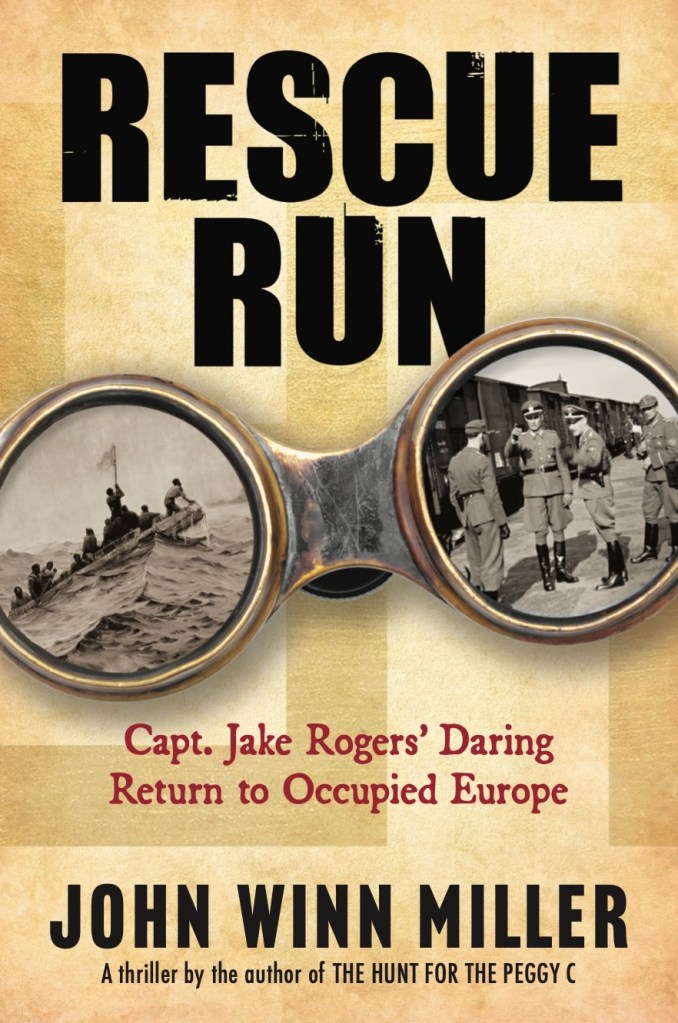
This review was prompted by my contribution of a still (image below) from the Westerbork film for Rescue Run’s book jacket , in collaboration with designer Christine Van Bree and author John Winn Miller.
John kindly provided me with a link for a free download of the Advance Reader Copy on the BookSirens’ platform. Since I’m documenting the Westerbork film through the online magazine Settela•Com, I happily accepted BookSiren’s invitation to join the review team.

Deportation | 20240225 | Settela•Com | Commander Albert Gemmeker oversees the deportation of Jews, Sinti, and Roma from the Westerbork transit camp May 19, 1944 | Frame 7426 from Deportation Westerbork Film | 20210719 | Settela•Com | ISSN 2949 9313

News

A gripping, almost cinematic narrative that blends fiction and non-fiction . By Michel van der Burg, filmmaker, editor of Settela•Com • RESCUE RUN Reviews. By John Winn Miller (Retrieved 20250606) URL https://www.johnwinnmiller.com/copy-of-readers-favorite

Shop : Via johnwinnmiller.com URL https://www.johnwinnmiller.com/copy-of-peggy-c-1


Citation info : Review RESCUE RUN • 20240927 • Michel van der Burg • Settela•Com • ISSN 2949-9313

Visit Transport Z | 20240528

Simon Gronowski and Maria Baumeister at “Transport Z” canvases | Open Memory, May 8, 2010, Cologne

Open Memory in Cologne (Köln) , Germany, May 8, 2010. Photo at the opening of the Open Memory installation with Simon Gronowski (survivor Transport XX to Auschwitz) together with Maria Baumeister (Cologne Initiative ‘Die Bahn erinnern’) and, seen from behind, Gitta R. (Lovara group of Roma) in front of one of the canvases with photographs and silhouettes of 351 Sinti and Roma from Northern France and Belgium, deported with “Transport Z” in January 1944 from Kazerne Dossin in Mechelen, Belgium to the Auschwitz-Birkenau extermination camp.

Notes

Documentary ‘Open Memory’ in :
Open Memory | 20240523 | Settela•Com | ISSN 2949-9313 | URL https://settela.com/2024/05/23/open-memory-20240523/

Edited image (anonymous photographer) selected from web gallery photos by Bahn erinnern , and S. Grollmuss at the Open Memory site open-memory.info – retrieved on Apr 13 , 2017.

Citation info : Visit Transport Z | 20240528 | Settela•Com | ISSN 2949-9313 | TakeNode 85faa3e6-5168-4909-9c02-fd233fa4a1bd

Open Memory | 20240523

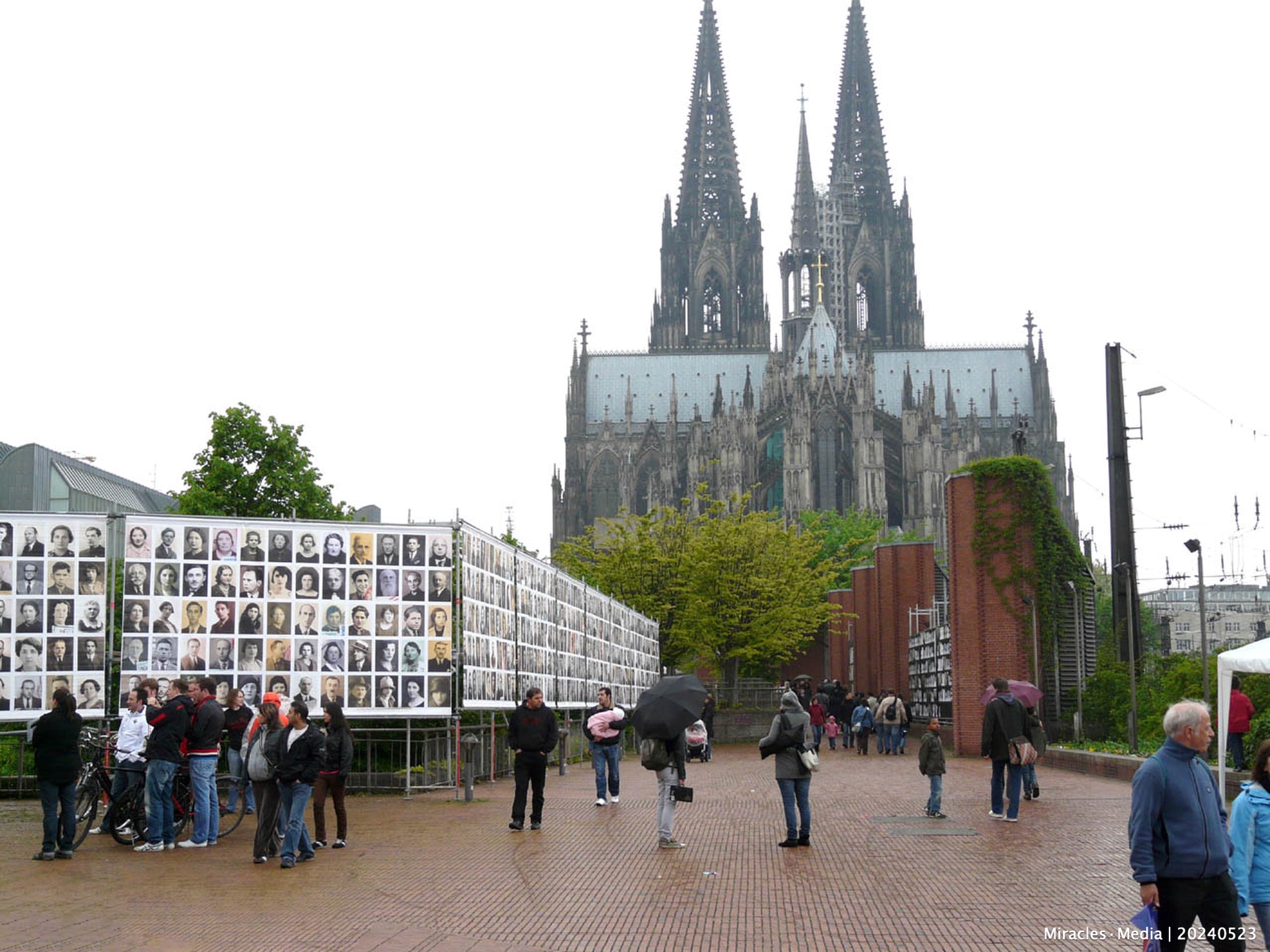
Open Memory , Cologne, May 2010. Transport XX (left) and Transport Z (right) in front of the with Cologne Cathedral. Still : Open Memory | Miracles Docs #3 | Miracles•Media | 20240523

From May 8th to May 24th, 2010, the memorial installation “Open Memory” was on display in a prominent location in Köln (Cologne, Germany) — in front of the Hohenzollern Bridge, at the left bank of the Rhine river, parallel to the railway tracks of the Cologne Central Station (Köln Hauptbahnhof), with the Cologne Cathedral (Kölner Dom) in the background.

It consisted of 26 large canvases on which portraits of more than 1,500 people were depicted. This open-air exhibition was intended to commemorate three events that occurred during this period: the end of the Second World War in Europe on May 8th and 9th, 1945, the 70th anniversary of the attack by the German Wehrmacht on the Benelux countries and France, and the 70th anniversary of the deportation of the Sinti and Roma from Cologne and the Rhineland (Western Germany).

The Museum La Coupole had created six canvases with photographs or silhouettes of 351 Sinti and Roma from Northern France and Belgium, deported with “Transport Z” in January 1944 from Kazerne Dossin in Mechelen, Belgium to the Auschwitz-Birkenau extermination camp.

On 20 other canvases were the portraits of 1,200 Jewish people deported with “Transport XX” in April 1943 from Kazerne Dossin in Mechelen to Auschwitz. This exhibition was created by the Jewish Deportation and Resistance Museum (Kazerne Dossin) in Mechelen. “Transport XX” is the only deportation train in Europe that was stopped by a resistance group.

The exhibition lined the route Roma and Sinti from Köln had to take from May 1940 en route across the Rhine via the Hohenzollern Bridge to the Cologne Fair (Köln Messe) transit camp for deportation to the extermination camps. The route was marked May 6, 1990, by the artist Gunter Demnig (later known for his Stolperstein project) by printing the writing “May 1940 – 1000 Sinti and Roma” on the streets in Cologne, using a wheel for painting with white paint.

The Open Memory installation was presented by : the Jewish Deportation and Resistance Museum (Kazerne Dossin) in Mechelen, Belgium • La Coupole – History Centre in Wizernes, France • NS Documentation Center Cologne • AK Memorial Centers NRW • Yavne Memorial and Educational Center • EL-DE-Haus Cologne.

Film by : Michel van der Burg, thanks to an amateur (2010) slide presentation by A. Lototsky

Citation info : Open Memory | 20240523 | Settela•Com | ISSN 2949-9313 | TakeNode 4e398109-d461-4a41-84d7-8d74756c82d8

First Stolperstein | 20240520

First Stolperstein. Installed on 16 Dec 1992 in front of the City Hall in Cologne , Germany.

Over the past 30 years the team of German artist Gunter Demnig installed over 100,000 Stumbling Stones – ‘Stolpersteine’ – across 26 countries in Europe – the world’s largest memorial.

Demnig’s Stolpersteine are small, cobblestone-sized brass memorials for the victims of National Socialism. Set into the pavement of sidewalks in front of the buildings where Nazi victims once lived or worked, they call attention both to the individual victim and the scope of the Nazi war crimes.

The very first Stolperstein, was installed on 16 December 1992 in front of Cologne City Hall , with Heinrich Himmler’s order for the initiation of deportations of all Roma (Gypsies) :

„Auf Befehl des Reichsführers SS vom 16.12.42 – Tgb. Nr. I 2652/42 Ad./RF/V. – sind Zigeunermischlinge, Rom-Zigeuner und nicht deutschblütige Angehörige zigeunerischer Sippen balkanischer Herkunft nach bestimmten Richtlinien auszuwählen und in einer Aktion von wenigen Wochen in ein Konzentrationslager einzuweisen. Dieser Personenkreis wird im nachstehenden kurz als ‚zigeunerische Personen‘ bezeichnet. Die Einweisung erfolgt ohne Rücksicht auf den Mischlingsgrad familienweise in das Konzentrationslager (Zigeunerlager) Auschwitz.“

Notes

Photo : First Stolperstein at the Cologne City Hall, Germany. Photo Jan. 1, 2008, by Willy Horsch, CC-BY .

Citation info : First Stolperstein | 20240520 | Settela•Com | ISSN 2949-9313 | URL https://settela.com/2024/05/20

Stefan & Ursula Breslauer in Westerborkfilm | 20240305

Stefan & Ursula Breslauer in Westerborkfilm | 20240305 – Clip from : Westerbork Film 🎦 2021 | 20220302 | Settela•Com | URL https://youtube.com/clip/UgkxdcMjzZQcH8jOtp1j2xFwrPxyAoHMcdFr

Filmmaker Rudolf Breslauer also filmed two of his children in the Westerborkfilm…

Stefan (left) & Ursula Breslauer, children of Rudolf Breslauer, the filmmaker of the Westerbork film at the farm of Camp Westerbork in 1944 – identified by the dutch photographer Sake Elzinga, who received Breslauer’s family photo albums last year when the family of Ursula – the only survivor – visited an expo on Breslauer in the Westerbork museum in the Netherlands.

Camp commander (SS-Obersturmführer) Albert Gemmeker ordered the Westerbork film , made by the German Jewish prisoner, photographer, Rudolf Breslauer in the spring of 1944.

Today 80 years ago – March 5, 1944 – the camp is an ‘Arbeitslager’ – a work camp – when Rudolf Breslauer starts filming the daily life of the Westerbork prisoners — inside : in the barracks, for example a religious service, cabaret, workshops, factories, aircraft and battery recycling, medical care, and outside the barracks : construction of a greenhouse, a football match, women working out, chopping wood, incoming transports, and eventually also the departure of a deportation train. After Breslauer films the deportation of Jews, Roma and Sinti to Bergen-Belsen and Auschwitz on May 19, 1944 the filming stops.
The haunting image of the 9-year-old dutch Sinti-girl Settela, standing in the closing doors of the goods train, and the unique footage of that deportation train that leaves the Westerbork camp, became iconic after the war.

Deportation Breslauer family

Werner Rudolf Breslauer , his wife Bella Weihsmann, sons Stefan and Max Michael (Mischa), and daughter Ursula were deported autumn 1944 from Westerbork to Theresienstadt and Auschwitz. Only Ursula survived.

Stefan & Ursula Breslauer in Westerborkfilm | 20240305 | Settela•Com | Frame 127475 from Westerbork Film 🎦 2021 | 20220302 | Settela•Com | ISSN 2949-9313 | Footage filmed by Rudolf Breslauer in 1944, courtesy of NIOD | Sound and Vision

Notes

Clip from : Westerbork Film 🎦 2021 | Complete Remastered Edition | YouTube https://youtu.be/ZiLNDziwEtc

Westerbork Film 🎦 2021 | 20220302 | Settela•Com | URL https://settela.com/2022/03/02/westerbork-film-🎦-2021-complete-remastered-edition-20220302/

Kinderen van filmmaker Breslauer herkend in historische Westerborkfilm. Dutch national news broadcaster NOS Nieuws, in cooperation with RTV Drenthe, 13:18 Monday 4 March 2024 | URL https://nos.nl/artikel/2511414-kinderen-van-filmmaker-breslauer-herkend-in-historische-westerborkfilm

Scene with Stefan & Ursula Breslauer, starting at 56:13 in the 1986 RVD edition of the Westerborkfilm:
Stefan & Ursula Breslauer in Westerbork Film RVD | 20240305 | Settela•Com | URL https://youtube.com/clip/UgkxfNzA72JeGgVoOFp_VTI4EQQr3yTwXu6_

Settela Film | 20220630 | Michel van der Burg | Settela•Com

Deportation Westerbork Film | 20210719 | Michel van der Burg | Settela•Com

English introduction to Westerborkfilm :
Westerborkfilm Introduction | 20220507 | Michel van der Burg | Settela•Com | URL https://settela.com/2022/05/07/westerborkfilm-introduction-20220507/

Citation info : Stefan & Ursula Breslauer in Westerborkfilm | 20240305 | Settela•Com | ISSN 2949-9313 | URL https://settela.com/2024/03/05

News

March 5, 2024 : Updated 21:21

Deportation | 20240226

Camp commander (SS-Obersturmführer) Albert Gemmeker oversees the deportation of Jews, Sinti, and Roma from the Westerbork transit camp May 19, 1944 .

Gemmeker is the producer of the Westerborkfilm — he ordered the film. Cameraman is the German Jewish prisoner Rudolf Breslauer.

Source : Frame 2608 from Westerborkfilm Introduction | 20220507 | Settela•Com | ISSN 2949-9313 | URL https://settela.com/2022/05/07/westerborkfilm-introduction-20220507/

Citation info : Deportation | 20240226 | Settela•Com | ISSN 2949-9313 | URL https://settela.com/2024/02/26 | TakeNode 3b14bb27-07aa-4b34-9fab-0b5da0bb8580

‘Entartete Art’ 1935 – Coleman Hawkins & Leo de la Fuente in Holland | 20231123


‘Entartete Art’ 1935 – Coleman Hawkins & Leo de la Fuente in Holland

American saxophonist Coleman Hawkins announces and plays – accompanied by Leo de la Fuente on piano – on his tenor saxophone ‘I wished that I were twins’.

In 1934, Coleman Hawkins left the Fletcher Henderson Orchestra and Amerika, moved to Europe, and joined the Jack Hylton Orchestra in England. Hylton and his band made regular ‘continental’ tours, and started another European tour January 1935 accompanied by Coleman Hawkins in Holland. At the end of January 1935 Hawkins joins the dutch band The Rambers … for 8 days … because Hawkins was denied entry to Germany because of his race, while Hylton and his band continued their tour without him and play for eight days at the Berlin Philharmonic Hall.

To end this special week with Hawkins well, the bandleader of The Ramblers – Theo Uden Masman – arranged with Decca for recordings 4 february 1935 in Pulchri Studio in The Hague, Holland, including this : I wish I were twins…that was also recorded on film by Polygoon (Polygoontoon) for the dutch cinema news for next week .

Coleman Hawkins is accomponied here on film by the dutch jazz pioneer Leo de la Fuente on piano , playing ‘I wished that I were twins’ . After the recordings, Hawkins moves further into Europe.

Leo – Leonard Henriques – de la Fuente, who was born Jewish in Amsterdam 28 March 1902, was deported by the nazi’s to Auschwitz on 2 November 1942, and died 30 April 1944 ‘somewhere in Mid Europe’.

References

About Leonard Henriques de la Fuente, his wife Hendrika de Vries and his daughters Benvenida and Mietje. Joods Monument. URL https://www.joodsmonument.nl/en/page/680262/about-leonard-henriques-de-la-fuente-his-wife-hendrika-de-vries-and

Biografie Leo de la Fuente. Muziekencyclopedie.nl | Beeld & Geluid. URL https://www.muziekencyclopedie.nl/action/entry/Leo+de+la+Fuente

The Hawk in Holland. Jacky de Vries. Theater Sentiment – De verhalen over de artiesten van weleer – Jaargang 3 Nummer 4. URL https://theatersentiment.nl/the-hawk-in-holland/

Jack Hylton 1892-1965. Abaigh McKee. Politics & Propaganda | Music and the Holocaust | URL https://holocaustmusic.ort.org/politics-and-propaganda/jack-hylton/

Film edited from source (video footage) : Polygoon Hollands Nieuws (Polygoontoon, producer) dutch cinema news reel week 7 , 1935 | Sound & Vision (Open Images)

Citation : ‘Entartete Art’ 1935 – Coleman Hawkins & Leo de la Fuente in Holland | 20231123 | Settela•Com | ISSN 2949-9313 | TakeNode 4f388407-5ccc-4816-aef6-6064fcee35b2

TAGS #Coleman #Hawkins #Leo #Fuente #music #jazz #Entartete #art #Europe #tour #tournee #Berlin #Germany #tenor #sax #saxophon #saxofoon #interbellum #Hawk #Holland #The #Hague #Pulchri #Studio #Netherlands #Decca #art #black #Jew #racism #diversity #nazi #politics #propaganda #holocaust #Polygoon #Polygoontoon #film #cinema #news #theater #band #pioneer #bandleader #Entartete #Kunst #degenerate #art #Jack #Hylton #orchestra #twins #Sound #Vision #broadcast #performance #history #England #1Memo #michelvanderburg #MiraclesMedia #SettelaCom