Simon Gronowski and Maria Baumeister at “Transport Z” canvases | Open Memory, May 8, 2010, Cologne
Open Memory in Cologne (Köln) , Germany, May 8, 2010. Photo at the opening of the Open Memory installation with Simon Gronowski (survivor Transport XX to Auschwitz) together with Maria Baumeister (Cologne Initiative ‘Die Bahn erinnern’) and, seen from behind, Gitta R. (Lovara group of Roma) in front of one of the canvases with photographs and silhouettes of 351 Sinti and Roma from Northern France and Belgium, deported with “Transport Z” in January 1944 from Kazerne Dossin in Mechelen, Belgium to the Auschwitz-Birkenau extermination camp.
Edited image (anonymous photographer) selected from web gallery photos by Bahn erinnern , and S. Grollmuss at the Open Memory site open-memory.info – retrieved on Apr 13 , 2017.
Citation info : Visit Transport Z | 20240528 | Settela•Com | ISSN 2949-9313 | TakeNode 85faa3e6-5168-4909-9c02-fd233fa4a1bd
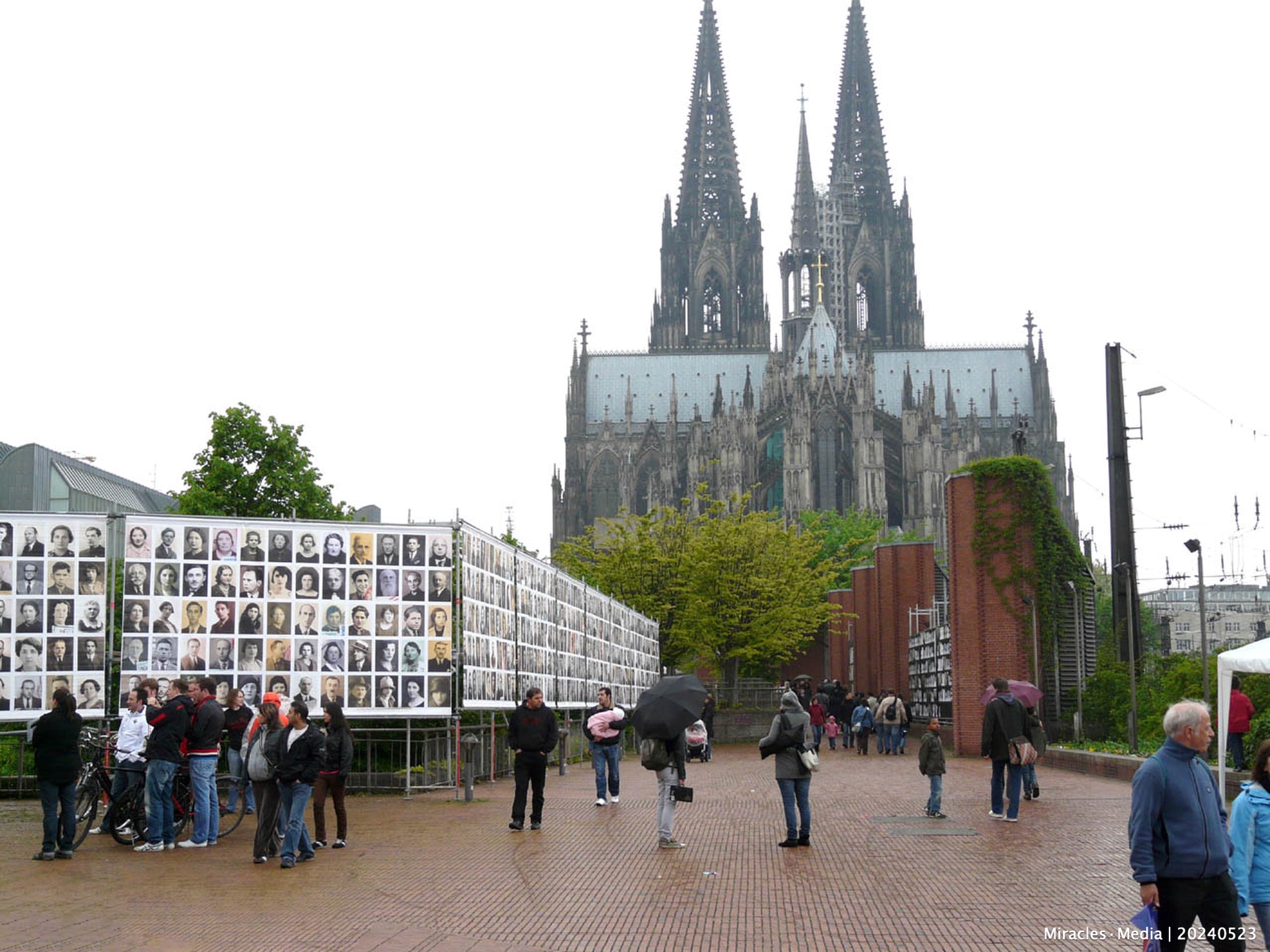
Open Memory , Cologne, May 2010. Transport XX (left) and Transport Z (right) in front of the with Cologne Cathedral. Still : Open Memory | Miracles Docs #3 | Miracles•Media | 20240523
From May 8th to May 24th, 2010, the memorial installation “Open Memory” was on display in a prominent location in Köln (Cologne, Germany) — in front of the Hohenzollern Bridge, at the left bank of the Rhine river, parallel to the railway tracks of the Cologne Central Station (Köln Hauptbahnhof), with the Cologne Cathedral (Kölner Dom) in the background.
It consisted of 26 large canvases on which portraits of more than 1,500 people were depicted. This open-air exhibition was intended to commemorate three events that occurred during this period: the end of the Second World War in Europe on May 8th and 9th, 1945, the 70th anniversary of the attack by the German Wehrmacht on the Benelux countries and France, and the 70th anniversary of the deportation of the Sinti and Roma from Cologne and the Rhineland (Western Germany).
The Museum La Coupole had created six canvases with photographs or silhouettes of 351 Sinti and Roma from Northern France and Belgium, deported with “Transport Z” in January 1944 from Kazerne Dossin in Mechelen, Belgium to the Auschwitz-Birkenau extermination camp.
On 20 other canvases were the portraits of 1,200 Jewish people deported with “Transport XX” in April 1943 from Kazerne Dossin in Mechelen to Auschwitz. This exhibition was created by the Jewish Deportation and Resistance Museum (Kazerne Dossin) in Mechelen. “Transport XX” is the only deportation train in Europe that was stopped by a resistance group.
The exhibition lined the route Roma and Sinti from Köln had to take from May 1940 en route across the Rhine via the Hohenzollern Bridge to the Cologne Fair (Köln Messe) transit camp for deportation to the extermination camps. The route was marked May 6, 1990, by the artist Gunter Demnig (later known for his Stolperstein project) by printing the writing “May 1940 – 1000 Sinti and Roma” on the streets in Cologne, using a wheel for painting with white paint.
The Open Memory installation was presented by : the Jewish Deportation and Resistance Museum (Kazerne Dossin) in Mechelen, Belgium • La Coupole – History Centre in Wizernes, France • NS Documentation Center Cologne • AK Memorial Centers NRW • Yavne Memorial and Educational Center • EL-DE-Haus Cologne.
Film by : Michel van der Burg, thanks to an amateur (2010) slide presentation by A. Lototsky
Citation info : Open Memory | 20240523 | Settela•Com | ISSN 2949-9313 | TakeNode 4e398109-d461-4a41-84d7-8d74756c82d8
First Stolperstein. Installed on 16 Dec 1992 in front of the City Hall in Cologne , Germany.
Over the past 30 years the team of German artist Gunter Demnig installed over 100,000 Stumbling Stones – ‘Stolpersteine’ – across 26 countries in Europe – the world’s largest memorial.
Demnig’s Stolpersteine are small, cobblestone-sized brass memorials for the victims of National Socialism. Set into the pavement of sidewalks in front of the buildings where Nazi victims once lived or worked, they call attention both to the individual victim and the scope of the Nazi war crimes.
The very first Stolperstein, was installed on 16 December 1992 in front of Cologne City Hall , with Heinrich Himmler’s order for the initiation of deportations of all Roma (Gypsies) :
„Auf Befehl des Reichsführers SS vom 16.12.42 – Tgb. Nr. I 2652/42 Ad./RF/V. – sind Zigeunermischlinge, Rom-Zigeuner und nicht deutschblütige Angehörige zigeunerischer Sippen balkanischer Herkunft nach bestimmten Richtlinien auszuwählen und in einer Aktion von wenigen Wochen in ein Konzentrationslager einzuweisen. Dieser Personenkreis wird im nachstehenden kurz als ‚zigeunerische Personen‘ bezeichnet. Die Einweisung erfolgt ohne Rücksicht auf den Mischlingsgrad familienweise in das Konzentrationslager (Zigeunerlager) Auschwitz.“
Notes
Photo : First Stolperstein at the Cologne City Hall, Germany. Photo Jan. 1, 2008, by Willy Horsch, CC-BY .
The Genocide of the Sinti and Roma. Research, Recognition and Remembrance | Karola Fings and Bas Kortholt | The Memory of Kamp Westerbork exhibition project
Online Lecture Feb 8, 2023 — The moving image of a young girl with a white headscarf, minutes before being deported to an unknown destination. The short clip became iconographic for the persecution of Dutch Jews. Only in the 1990s, it was discovered that the girl’s name was Settela Steinbach. She was one of 247 Sinti and Roma deported to Auschwitz from Westerbork in May 1944.
The late clarification of the identity of the victim symbolises how little the public and research were interested in the genocide of the Sinti and Roma after 1945. Yet hundreds of thousands were persecuted and expelled in Europe, locked up in camps, deported, shot, forcibly sterilised or murdered in gas chambers. In the lecture, Dr Karola Fings also looks at the pre- and post-history of the genocide. The subsequent dialogue with Bas Kortholt focusses on coming to terms with and remembering this genocide in the Netherlands.
From November 2022 to September 2023, the Herinneringscentrum Kamp Westerbork presents a monthly online lecture as part of The Memory of Kamp Westerbork exhibition project. The online lecture series provides academic background on various parts of the exhibition and the topics concerned.
Dr. Karola Fings is a historian and Deputy Director of the NS-Documentation Center of the City of Cologne. Bas Kortholt is a researcher of the Camp Westerbork Memorial Centre