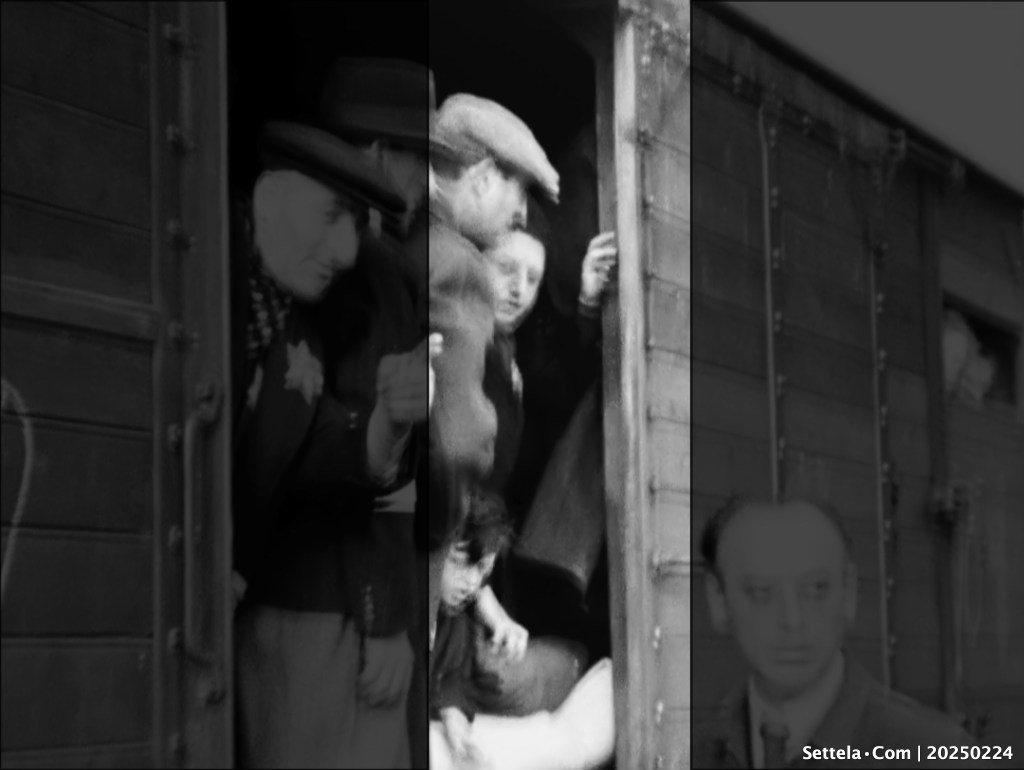
Almost certainly, three Jewish people have been recognized in the unique Westerbork film from 1944 (1). This time it concerns the 9-year-old boy Israël Wijnschenk, his father Max Wijnschenk, and his grandmother Betje Kokernoot-van Furth, who all lived in Utrecht (Holland).
Last week, the Dutch public broadcaster NOS (2) reported the news from the Utrecht (Dutch) news site Nieuws030 (3) that it is very likely that three people were recognized again in this film made by the Jewish prisoner and filmmaker Rudolf Breslauer showing the deportation of Jews, Roma and Sinti by train in Camp Westerbork on May 19, 1944.
Image researcher Koen Hulsbos — who previously identified an Amsterdam couple in this deportation train (4) — thought he recognized the young Israël Wijnschenk, a pupil at the time of the Joodse (Jewish) School Utrecht, and presented this to Victor Frederik, researcher of the Joodse School (5,6). The boy, the man, and the woman seem to belong together, and were recognized from family photos, also by family members.
It is certain that Max and his wife Chel (not in the images) returned to Utrecht after the war, their children Israël and his sister Kitty were murdered. Grandma Betje was also gassed in Auschwitz.
A portrait of Israël Wijnschenk is shown at the site of Joods Monument (7).
According to the transport list, there were two other children in that wagon, Joseph Beugeltas (11 years old) and Manfred Studzinsky (7 years old). Joseph Beugeltas appeared to have blond hair, and could not have been it (6). To be completely sure, the researchers are still looking for a photo of Manfred Studzinsky, for comparison…
The Dutch national broadcaster NOS (1) and the local RTV Drenthe (2) reported this morning (23 Dec 2024) that 2 more people have been recognized in the Westerbork film.
It is the Amsterdam couple Marcus Pels and Hendrika Brandon. They were identified by the image researcher Koen Hulsbos – volunteer worker at the Behind the Star project of the NIOD Institute for War, Holocaust and Genocide Studies .
The Jewish photographer and filmmaker Rudolf Breslauer, while a prisoner in the Westerbork transit camp in the Netherlands, was commissioned by camp commander Albert Gemmeker to make film recordings for the Westerbork film in the spring of 1944, featuring images of a deportation train.
The NOS broadcast referred to images in the first published Westerbork film (3) :
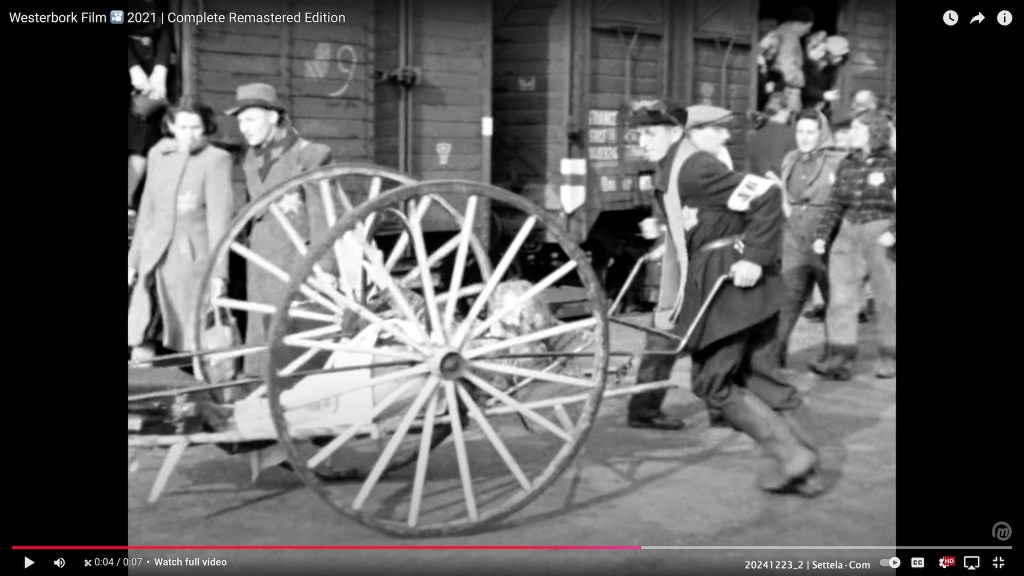
The film can be viewed in its entirety on YouTube. After just under 5 minutes 🔗 a man with a hat can be seen looking into the camera with a smile, and next to him a woman with black, slightly wavy hair can be seen from behind. The same couple appears again at 6 minutes 🔗. It turned out to be the Amsterdam couple Marcus Pels and Hendrika Brandon.
Pels & Brandon Clip 1 & 2
Also available on YouTube is the more recent second Westerborkfilm (4). This 2021 edition has the recently found original camera rolls of the deportation transport (Reel E198), with higher quality images of the couple.
Hulsbos had already had photos of Marcus Pels and Hendrika Brandon in his collection of images of prisoners who were transported on that day – May 19, 1944 – when Breslauer films the deportation of Jews, Roma and Sinti to Bergen-Belsen and Auschwitz.
“I’ve seen the film many times, but at one point I thought, ‘Hey, this couple is on screen twice.’ I had never really noticed that before,” says Hulsbos.
Hulsbos then compared the film footage with his photos. “And then I thought: that’s it,” says the amateur film historian.
Marcus Pels was murdered immediately after arriving in Auschwitz. Hendrika Brandon survived the war, as did their daughter and son, who were in hiding with a foster family. Katy (Keetje, 86 years old) and Philip (83) are still alive and live in Canada. They were shown the film footage and confirmed that they were their parents.
“They don’t remember their father. So to actually see images of him, to see him just walking around alive, there are no words to describe it,” granddaughter Lisa Kaufman said as a family spokesperson. “It was very special to see my grandmother, who I grew up with.”
Anonym | Girl with the headscarf …
In the Westerbork film, Hendrika looks at the woman on the stretcher, who was recognized in the 1990s through her suitcase as Frouwke Kroon, and thus was the key to identifying this transport and thus also to the name of the anonymous girl with the headscarf between the wagon doors – Settela (5,6).
Deportation Breslauer family
Earlier this year it was reported that filmmaker Rudolf Breslauer had also filmed two of his children , Stefan , and Ursula Breslauer in the Westerborkfilm at the farm (7).
Werner Rudolf Breslauer , his wife Bella Weihsmann, sons Stefan and Max Michael (Mischa), and daughter Ursula were deported later in 1944 from Westerbork to Theresienstadt and Auschwitz. Only Ursula survived.
Filmmaker Rudolf Breslauer also filmed two of his children in the Westerborkfilm…
Stefan (left) & Ursula Breslauer, children of Rudolf Breslauer, the filmmaker of the Westerbork film at the farm of Camp Westerbork in 1944 – identified by the dutch photographer Sake Elzinga, who received Breslauer’s family photo albums last year when the family of Ursula – the only survivor – visited an expo on Breslauer in the Westerbork museum in the Netherlands.
Camp commander (SS-Obersturmführer) Albert Gemmeker ordered the Westerbork film , made by the German Jewish prisoner, photographer, Rudolf Breslauer in the spring of 1944.
Today 80 years ago – March 5, 1944 – the camp is an ‘Arbeitslager’ – a work camp – when Rudolf Breslauer starts filming the daily life of the Westerbork prisoners — inside : in the barracks, for example a religious service, cabaret, workshops, factories, aircraft and battery recycling, medical care, and outside the barracks : construction of a greenhouse, a football match, women working out, chopping wood, incoming transports, and eventually also the departure of a deportation train. After Breslauer films the deportation of Jews, Roma and Sinti to Bergen-Belsen and Auschwitz on May 19, 1944 the filming stops. The haunting image of the 9-year-old dutch Sinti-girl Settela, standing in the closing doors of the goods train, and the unique footage of that deportation train that leaves the Westerbork camp, became iconic after the war.
Deportation Breslauer family
Werner Rudolf Breslauer , his wife Bella Weihsmann, sons Stefan and Max Michael (Mischa), and daughter Ursula were deported autumn 1944 from Westerbork to Theresienstadt and Auschwitz. Only Ursula survived.
Stefan & Ursula Breslauer in Westerborkfilm | 20240305 | Settela•Com | Frame 127475 from Westerbork Film 🎦 2021 | 20220302 | Settela•Com | ISSN 2949-9313 | Footage filmed by Rudolf Breslauer in 1944, courtesy of NIOD | Sound and Vision
Scene with Stefan & Ursula Breslauer, starting at 56:13 in the 1986 RVD edition of the Westerborkfilm: Stefan & Ursula Breslauer in Westerbork Film RVD | 20240305 | Settela•Com | URL https://youtube.com/clip/UgkxfNzA72JeGgVoOFp_VTI4EQQr3yTwXu6_
Settela Film | 20220630 | Michel van der Burg | Settela•Com
Deportation Westerbork Film | 20210719 | Michel van der Burg | Settela•Com
From 20 January 2023, the Jewish Museum of Belgium, in partnership with the Auschwitz Foundation, presents the exhibition entitled ‘ 236, Land(es)capes from the 20th Convoy ‘. It is set up in the museum’s project space and offers an artistic look at an exceptional and forgotten event in the Second World War.
The 20th convoy
At 10 p.m. on April 19, 1943, the 20th convoy departed from the Kazerne Dossin transit camp in Mechelen with 1,631 Jewish deportees in cattle cars, heading for Auschwitz. Thanks to resistance actions, both inside the wagons and from outside, 236 of these deportees managed to jump from that train, that was leading them to extermination. An unique event in Europe under the Nazi administration.
Jo Struyven, photographer
The work of the Belgian photographer Jo Struyven (°Sint-Truiden, 1961) takes us back to these acts of resistance – commemorating the 80th anniversary in 2023 – and gives us a glimpse of the landscapes in which this striking story took place. Taking the perspective of those who jumped off that train, an act for which many of them paid with their lives, Struyven creates a contemporary ‘memorial’ with 19 large ‘nocturnal’ black and white images, and one colour print.
Jo Struyven :
The 20th convoy, heading for the unspeakable “Auschwitz”, crossed the area where I grew up, barely 50 meters from my childhood bedroom — I found out 2 years ago after meeting Simon Gronowski. Ever since, I imagine the distress of the deportees. The destination was unknown to them. Some, sensing the worst, tried to escape it. I wanted to give an account of this border between life and death, between resignation and the impossibility of choosing, and the freedom regained with resistance to the oppressor’s plans.
Works presented by Jo Struyven
Land(es)capes from the 20th Convoy, 2020-2022, 19 black and white prints, 1 color print, 90×60 cm (Private collection – Belgium)
Jo Struyven, Land(es)capes from the 20th convoy 2020-2022, black and white print, 90x 60 cm, Wijchmaal (Private Collection, Belgium)Jo Struyven, Land(es)capes from the 20th Convoy 2020-2022, black and white print, 90x 60 cm, Bierbeek (Private Collection, Belgium)Jo Struyven, Land(es)capes from the 20th Convoy, 2020-2022, black and white print, 90x 60 cm, Borgloon (Private Collection, Belgium)Jo Struyven, Land(es)capes from the 20th Convoy, 2020-2022, black and white print, 90x 60 cm, Piringen (Private Collection, Belgium)Jo Struyven, Land(es)capes from the 20th Convoy, 2020-2022, black and white print, 90x 60 cm, Botzelaer (Private Collection, Belgium)
Luc Tuymans, visual artist
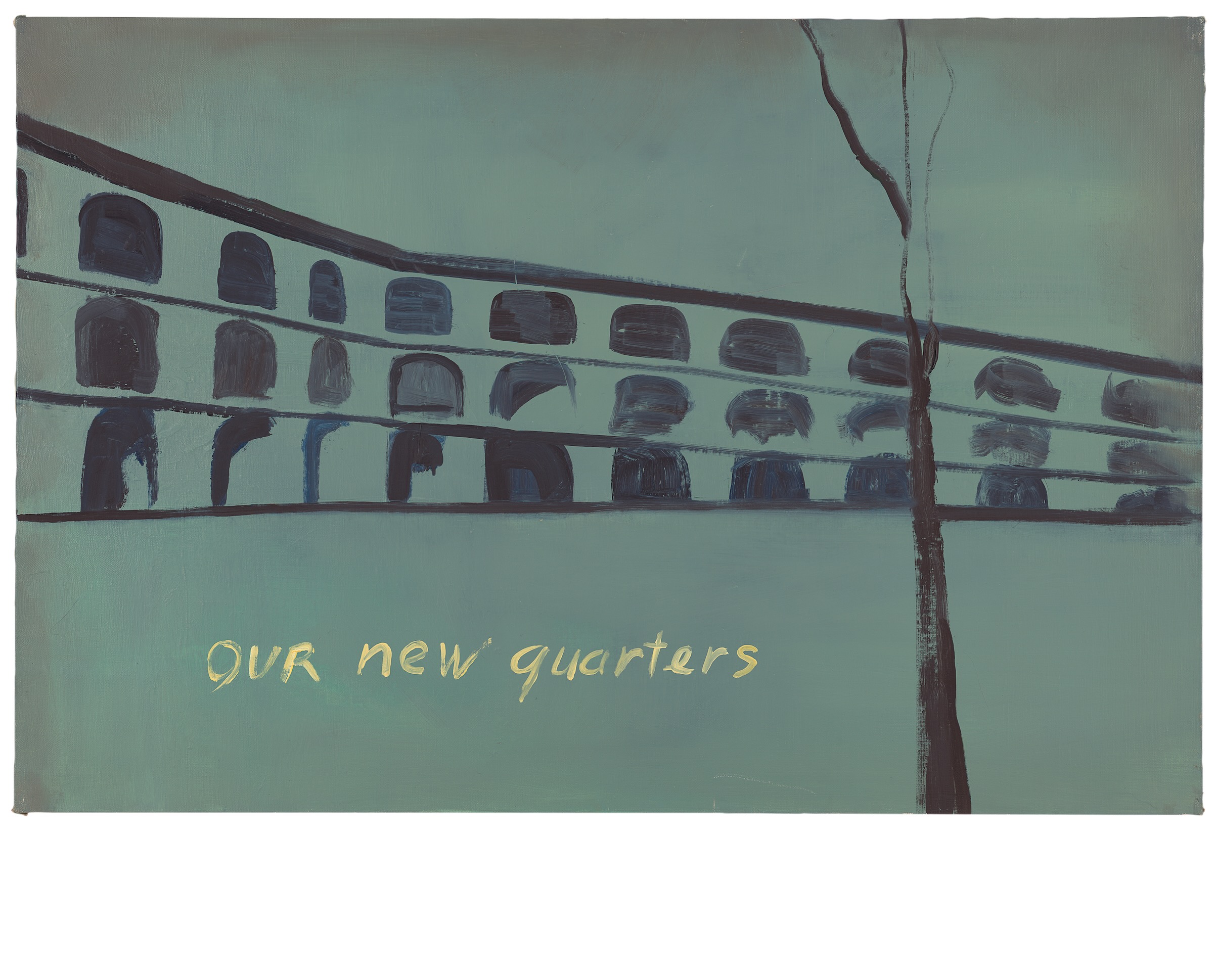
In dialogue with Jo Struyven’s photographs, two works by Belgian visual artist Luc Tuymans (°Mortsel, 1958) evoke the destruction of the Jews and Roma of Europe. Die Wiedergutmachung (The Reparation) depicts body parts – left the eyes of gypsy children who had been experimented on by the Nazis. … images that in its incompleteness, reflect the inability to represent facts and memory .
Works presented by Luc Tuymans
Luc Tuymans, Our New Quarters, 1986, Oil on canvas, 80,5 x 120 cm (MMK – Germany) (Photo Ben Blackwell, courtesy David Zwirner, New York, London)Luc Tuymans, Die Wiedergutmachung, 1989, Oil on cardboard, mounted on plywood, Oil on canvas; diptych, 36,6 x 43 cm, 39,4 x 51,8 cm, courtesy: Private collection (Photo Studio Luc Tuymans)
Art after the Shoah
“Writing a poem after Auschwitz is barbaric”, wrote German philosopher Theodor W. Adorno in 1949. Through two contemporary perspectives from the visual arts, this exhibition seeks to address this question of the (im)possibility of art after the Shoah in a new way.
Testimonies & Catalogue
This exhibition will be accompanied by a catalogue book edited by Daniel Weyssow and Jo Struyven and published by the Auschwitz Foundation entitled Land(es)capes from the 20th Convoy (press release on April 19, 2023), as well as an educational space presenting the testimonies from interviews and archives of convoy escapees.
Info+ ( & Français | Nederlands)
236 Land(es)capes from the 20th Convoy Jo Struyven / Luc Tuymans Exhibition at the Jewish Museum of Belgium, in Brussels, Belgium 20 January – 14 August 2023 Brussels Website https://www.mjb-jmb.org
Video report : Vernissage ‘236’ Land(es)capes 20th convoy
Thursday January 19th, 2023, the vernissage of the photo exhibition 236 — Land(es)capes from the 20th Convoy was opened with speeches by Philippe Blondin, President of the Jewish Museum, and by Pierre-Yves Jeholet , Minister-President of the Government of the Federation Wallonia-Brussels. Next, the Belgian photographer Jo Struyven presented his work — escape landscape photographs glowing in the dark — like being lit by moonlight — as well as paintings contributed by Luc Tuymans in the project space. The exhibition runs from January 20 – August 14, 2023 in the Jewish Museum of Belgium, Brussels, Belgium. Video report (20230120) Michel van der Burg | Miracles•Media .
Jan 20, 2023 – VRT | Kristien Bonneure (Belgian Flemish Broadcast) 20 jan 2023
Westerbork Film Football Edit | Edition 2021 | 20210517
SILENT FILM
The UNESCO – Memory of the World – ‘ Westerbork films’ dossier (REF 1) consists of both the actual film footage, as well as a dossier with the 1944 film plan, film script, title cards (intertitles), and a file with correspondence between the camp and the outside world on obtaining camera’s , film and film processing. That film footage was researched and presented before on Settela•Com.
In a recent post (Westerbork Film Intertitles | 20210515; REF 2) the drawings for the title cards were shown in a short film I made, that also showed a few seconds of Breslauer’s archive film footage demonstrating that not all of his Westerbork Film is a compilation of rushes only -he also had done some experiments filming and animating title cards. Aside from that, the film was not edited, and title cards were not yet inserted.
Today, working on presenting that 1944 film plan and script, I noticed in that editing script (all written in the German language) the instruction “Untertitel: ( in einen rollenden Fussball einkopiert ) Appelplatz am Sonntag Nachmittag.” , in English : ‘Subtitle: copied into a rolling football – roll call area on Sunday afternoon’. That is the text on one of these title cards I worked with, and I had seen Breslauer’s filming and slow-motion experiments with a rolling football, on that same F1014 reel that was used for his animation tests (REF 3). This has been described also in the 1997 dutch Westerbork film dossier analysis by Broersma & Rossing (REF 4) – a book I studied 2 years ago – and details I re-discovered later today. Tomorrow these authors will present a new edition (dutch), available later this month.
Breslauer never got the chance to try copying that title card on the rolling ball – I did today : a little digital experiment of copying that title card Appellplatz am Sonntag Nachmittag on the rolling ball. Just 4 seconds, repeated 4 times in this little film : Westerbork Film Football Edit.
2- Westerbork Film Intertitles | 20210515 | Michel van der Burg | Settela•Com | ISSN 2949-9313 (accessed 2021 May 17) URL: https://wp.me/p91enH-3e
3 – Unknown Westerbork Film Reel…F1014 | 20190616 | Michel van der Burg | Settela•Com | ISSN 2949-9313 (accessed 2021 May 15) URL: https://wp.me/p91enH-2b
4 – ‘Kamp Westerbork gefilmd’ by Koert Broersma and Gerard Rossing (editors Dirk Mulder and Ben Prinsen; ISBN 9023232658). Note, a new edition will be available May 2021 (editor Gorcum B.V., Koninklijke van; ISBN 9789023257622 ) – not yet published.
Notes : Both Appelplatz and Appellplatz are used in German and in script and title card
Credit
Thanks to ‘Kamp Westerbork gefilmd’ by Koert Broersma and Gerard Rossing (editors Dirk Mulder and Ben Prinsen; ISBN 9023232658). Note, a new edition will be available May 2021 (editor Gorcum B.V., Koninklijke van; ISBN 9789023257622 )
Film footage source : Filmed by Rudolf Breslauer, retrieved from : Unknown Westerbork Film Reel…F1014 | 20190616 | Michel van der Burg | Settela•Com | ISSN 2949-9313 (accessed 2021 May 17) URL: https://wp.me/p91enH-2b
Westerbork Film Football Edit | Edition 2021 | 20210517 | Michel van der Burg | Settela•Com | ISSN 2949-9313
Updates
20220604 – Format changes credit line , references
20230518 – Credits and references updated with ISSN
Westerbork Film Intertitles | 20210515 | Michel van der Burg | Settela•com
SILENT FILM
Westerbork Films Dossier
The UNESCO – Memory of the World – ‘ Westerbork films’ dossier (REF 1) consists of both the actual film footage, as well as a dossier with the 1944 film plan, film script, title cards (intertitles), and a file with correspondence between the camp and the outside world on obtaining camera’s , film and film processing. That film footage was researched and presented before on Settela•com.
These Westerbork film documents – the film script etc – complement the Westerbork film footage presented earlier – a first full version (RVD) of the Westerbork Film posted in 2019 (20190605) and the complete UNESCO album of all known footage shot by inmate Werner Rudolf Breslauer in the Westerbork camp in 1944, posted early 2020 (REF 2).
The final part of the UNESCO registry (Le film de Westerbork – édité le 8 mai 2017 – ID code 2016-118 ) lists all the documents on the Westerbork Film at the NIOD Institute for War, Holocaust and Genocide Studies.
That NIOD archive file — called (translated) : Directing, texts and correspondence of the film “Westerbork” consists of a file containing the original screenplay or script for the film, title cards, notes, correspondence and administration . That entire file has been scanned (total of 60 black and white scans) and is available online.
More information on the history and origin of the film translated from the french UNESCO registration is posted later.
Title Cards
Here, in this short film, the title cards are presented. Title cards referenced in the UNESCO registry, and prepared in the camp in 1944 for the Westerbork film. The name of the artist drawing these cards is not known, I guess. Digital scans of 11 different letter cards were retrieved from the public online archive of the NIOD Institute for War, Holocaust and Genocide Studies at the dutch National Archive (Nationaal Archief) – full info in CREDITS.
Film Sections
In this film these title cards are used in different ways, shown in 5 sections. The arrangement of the cards was chosen by me.
1 : ‘ORIGINALS’ – TRANSLATION IN SUBTITLES – The first section shows english subtitles with the restored scan images of the orignal drawings made in Camp Westerbork. The restoration includes exposure adjustment, crop, and if necessary rotation and flip horizontal or vertical of the supplied scans.
2: NEGATIVES – The second section shows the same images, now as negatives (white on black), the way title cards are usually shown in movies, and Breslauer did too while working on the Westerbork Film – see below on section 4.
3) The 3rd sequence of the title cards shows the negatives again, now animated with cross-overs (fade in- and out) between the negatives.
Trickaufnahmen – trick shots – was mentioned in the film plan (discussed further in a later post). Trick shots like slow-motion and similar animation work by Breslauer is actually found on the Westerbork film reel F1014 with so-called ‘Residual material’. This was previously reported in the 1997 edition of the book ‘Kamp Westerbork gefilmd’ by Broersma & Rossing (REF 3). That reel’s footage, to me feels like this was Breslauer’s working material for tests – so a test reel, rather than rest reel.
4 : BRESLAUER’S 1944 ANIMATION TEST – This 4th segment shows the above discussed footage of Breslauer’s test work with a title card’s negative on film, as well as his animation of cards with numbers of ‘input’ and outgoing deportations. That animation uses drawings , images , not found in the NIOD archive – showing statistics for deportations to Bergen-Belsen 3029 , and Lager Vught 897 . This Westerbork film footage was retrieved from : Unknown Westerbork Film Reel…F1014 (20190616) Michel van der Burg | Settela•Com | ISSN 2949-9313 (REF 4).
5 : ANIMATION COLLAGE – Here I combined the animation made in section 3 of this film, with the 1944 animation footage of Breslauer – all edited here again to conform.
3 – ‘Kamp Westerbork gefilmd’ by Koert Broersma and Gerard Rossing (editors Dirk Mulder and Ben Prinsen; ISBN 9023232658
4 – Unknown Westerbork Film Reel…F1014 | 20190616 | Michel van der Burg | Settela•Com | ISSN 2949-9313 (accessed 2021 May 15) URL: https://wp.me/p91enH-2b
Eating Tulip Bulbs ~ Hunger Winter Holland 1944-1945 .
(silent film)
My mother did not tell me much and no details on her experiences in World War 2, except for the Hongerwinter (“Hunger winter”) – the Dutch famine of 1944–45 – that she had to eat tulip bulbs.
As children in the 1950s our mother always told us to finish and clean our plates (and pretty large portions, served by our parents) , before being allowed to leave the table. The one thing we were regularly reminded of was the famine my mother and others had experienced…and that she even had to eat tulip bulbs – then a 16-year old teenager living (with her parents) in the city of The Hague during the Dutch famine of 1944–45.
The famine was caused by a German blockade plus the harsh winter blocking alternative water routes, that cut off food and fuel shipments to the western Netherlands were food stocks rapidly ran out in the large cities of The Hague, Rotterdam, and Amsterdam . Tulip bulbs and sugar beets were commonly consumed. Trees in The Hague city woods (like Scheveningse Bosjes shown in the film) were cut , and in the end furniture and houses were dismantled to provide fuel for heating.
When the famine was worst and deaths were reaching a peak , the Bezuidenhout neighbourhood of The Hague – were my mothers family lived – was bombed by British bomber crews with the wrong coordinates flying in fog and clouds, causing widespread death and destruction. More on that ‘Bombing of the Bezuidenhout’ later this month.
Menno Huizinga (1907–1947) took photographs illegally during the occupation , mainly in his hometown The Hague in Holland. He was a member of the group of Dutch photographers ‘De Ondergedoken Camera’ (1943-1945) – The Underground Camera – doing resistance work during the Second World War.
‘Eating Tulip Bulbs ~ Hunger Winter Holland 1944-1945’ is a silent film by Michel van der Burg , using photographs captured during this ‘Hunger winter’ 1944-1945 by Menno Huizinga in Holland (mainly in The Hague) from the public domain collection of the NIOD Institute for War, Holocaust and Genocide Studies , curated by Dutch Network War Collections (NOB) for WO2 Open Data Depot via Wikimedia Commons.
Credits
Photographs by Menno Huizinga, Holland 1944-1945 | NIOD | WO2 Open Data Depot | Wikimedia Commons.
Film : Eating Tulip Bulbs | 20200325 | Michel van der Burg | Settela•Com | ISSN 2949-9313 | CC BY 4.0