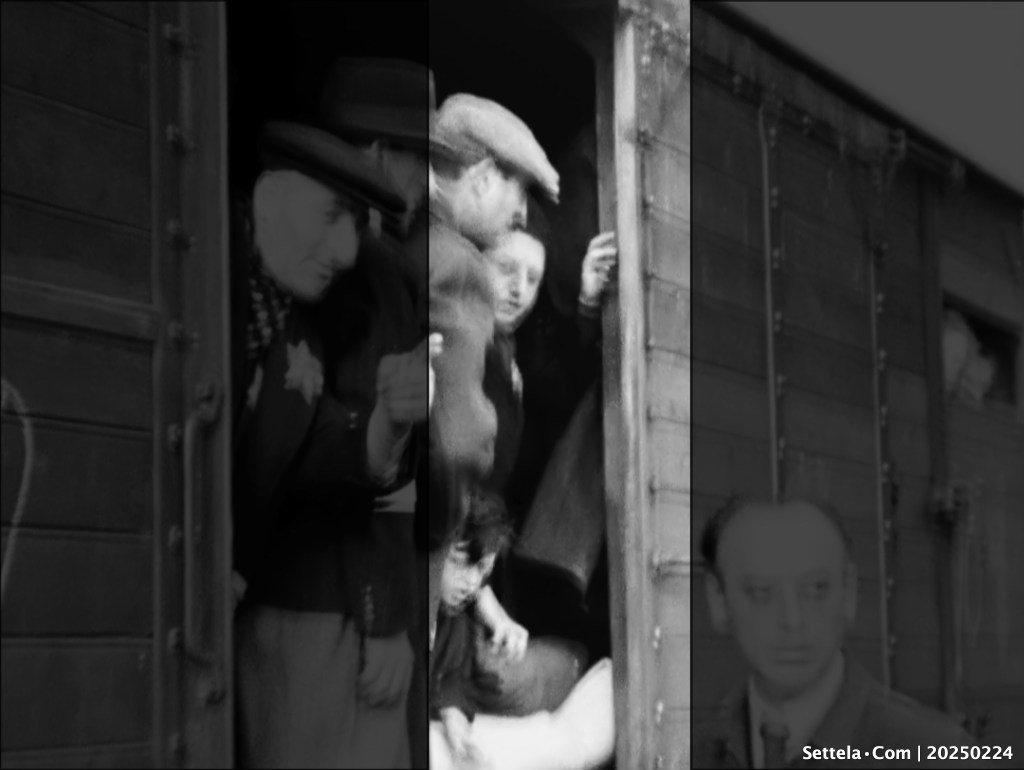
Almost certainly, three Jewish people have been recognized in the unique Westerbork film from 1944 (1). This time it concerns the 9-year-old boy Israël Wijnschenk, his father Max Wijnschenk, and his grandmother Betje Kokernoot-van Furth, who all lived in Utrecht (Holland).
Last week, the Dutch public broadcaster NOS (2) reported the news from the Utrecht (Dutch) news site Nieuws030 (3) that it is very likely that three people were recognized again in this film made by the Jewish prisoner and filmmaker Rudolf Breslauer showing the deportation of Jews, Roma and Sinti by train in Camp Westerbork on May 19, 1944.
Image researcher Koen Hulsbos — who previously identified an Amsterdam couple in this deportation train (4) — thought he recognized the young Israël Wijnschenk, a pupil at the time of the Joodse (Jewish) School Utrecht, and presented this to Victor Frederik, researcher of the Joodse School (5,6). The boy, the man, and the woman seem to belong together, and were recognized from family photos, also by family members.
It is certain that Max and his wife Chel (not in the images) returned to Utrecht after the war, their children Israël and his sister Kitty were murdered. Grandma Betje was also gassed in Auschwitz.
A portrait of Israël Wijnschenk is shown at the site of Joods Monument (7).
According to the transport list, there were two other children in that wagon, Joseph Beugeltas (11 years old) and Manfred Studzinsky (7 years old). Joseph Beugeltas appeared to have blond hair, and could not have been it (6). To be completely sure, the researchers are still looking for a photo of Manfred Studzinsky, for comparison…
The Dutch national broadcaster NOS (1) and the local RTV Drenthe (2) reported this morning (23 Dec 2024) that 2 more people have been recognized in the Westerbork film.
It is the Amsterdam couple Marcus Pels and Hendrika Brandon. They were identified by the image researcher Koen Hulsbos – volunteer worker at the Behind the Star project of the NIOD Institute for War, Holocaust and Genocide Studies .
The Jewish photographer and filmmaker Rudolf Breslauer, while a prisoner in the Westerbork transit camp in the Netherlands, was commissioned by camp commander Albert Gemmeker to make film recordings for the Westerbork film in the spring of 1944, featuring images of a deportation train.
The NOS broadcast referred to images in the first published Westerbork film (3) :
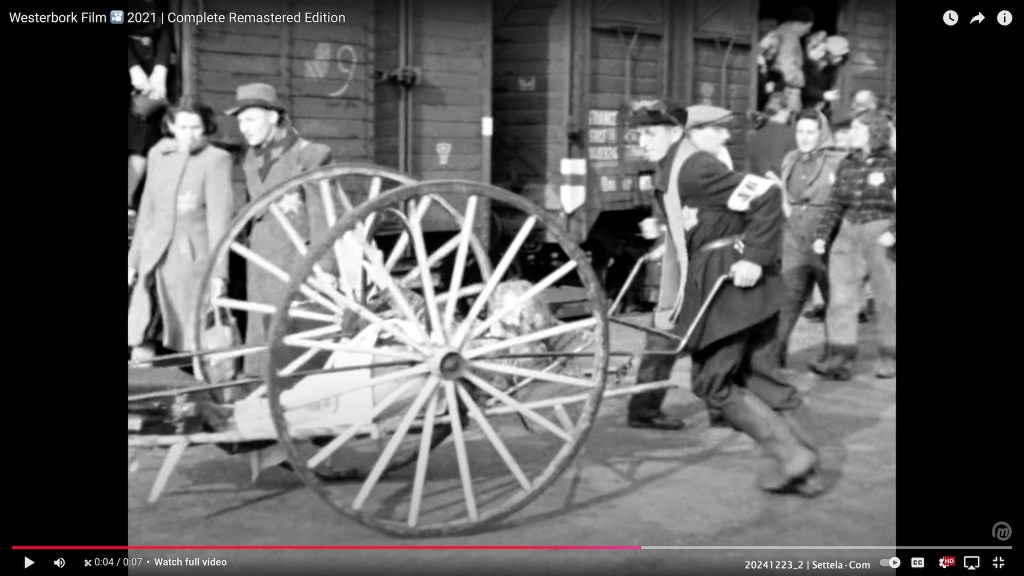
The film can be viewed in its entirety on YouTube. After just under 5 minutes 🔗 a man with a hat can be seen looking into the camera with a smile, and next to him a woman with black, slightly wavy hair can be seen from behind. The same couple appears again at 6 minutes 🔗. It turned out to be the Amsterdam couple Marcus Pels and Hendrika Brandon.
Pels & Brandon Clip 1 & 2
Also available on YouTube is the more recent second Westerborkfilm (4). This 2021 edition has the recently found original camera rolls of the deportation transport (Reel E198), with higher quality images of the couple.
Hulsbos had already had photos of Marcus Pels and Hendrika Brandon in his collection of images of prisoners who were transported on that day – May 19, 1944 – when Breslauer films the deportation of Jews, Roma and Sinti to Bergen-Belsen and Auschwitz.
“I’ve seen the film many times, but at one point I thought, ‘Hey, this couple is on screen twice.’ I had never really noticed that before,” says Hulsbos.
Hulsbos then compared the film footage with his photos. “And then I thought: that’s it,” says the amateur film historian.
Marcus Pels was murdered immediately after arriving in Auschwitz. Hendrika Brandon survived the war, as did their daughter and son, who were in hiding with a foster family. Katy (Keetje, 86 years old) and Philip (83) are still alive and live in Canada. They were shown the film footage and confirmed that they were their parents.
“They don’t remember their father. So to actually see images of him, to see him just walking around alive, there are no words to describe it,” granddaughter Lisa Kaufman said as a family spokesperson. “It was very special to see my grandmother, who I grew up with.”
Anonym | Girl with the headscarf …
In the Westerbork film, Hendrika looks at the woman on the stretcher, who was recognized in the 1990s through her suitcase as Frouwke Kroon, and thus was the key to identifying this transport and thus also to the name of the anonymous girl with the headscarf between the wagon doors – Settela (5,6).
Deportation Breslauer family
Earlier this year it was reported that filmmaker Rudolf Breslauer had also filmed two of his children , Stefan , and Ursula Breslauer in the Westerborkfilm at the farm (7).
Werner Rudolf Breslauer , his wife Bella Weihsmann, sons Stefan and Max Michael (Mischa), and daughter Ursula were deported later in 1944 from Westerbork to Theresienstadt and Auschwitz. Only Ursula survived.
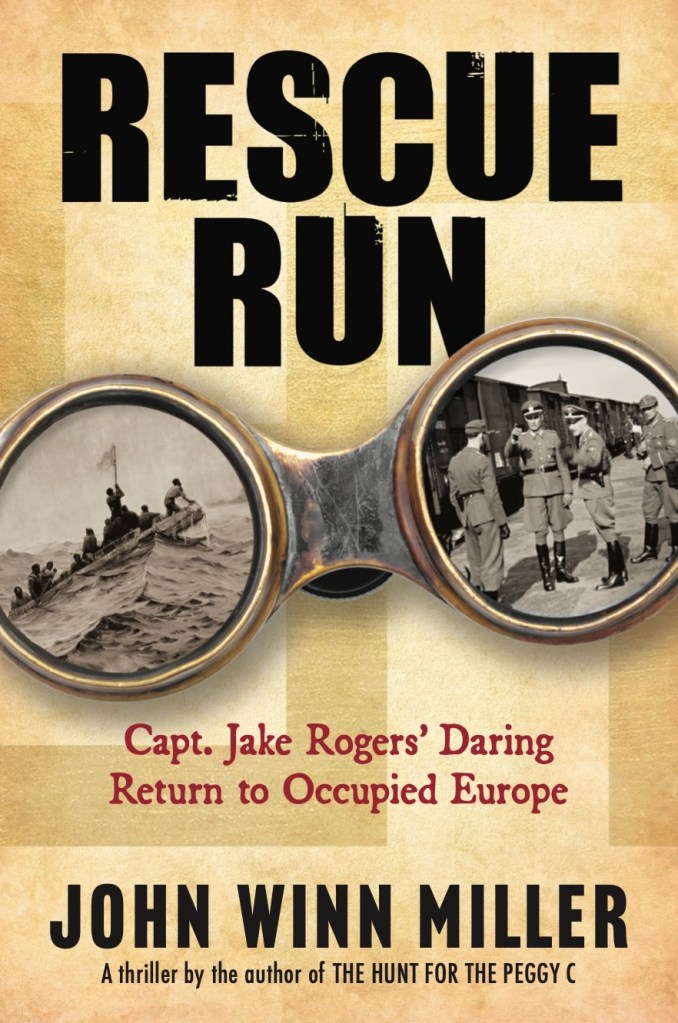
RESCUE RUN : Capt. Jake Rogers’ Daring Return to Occupied Europe • John Winn Miller
After escaping the treacherous waters of WWII, Captain Jake Rogers leads his crew on a daring mission across Nazi-occupied Europe to rescue the father of his beloved, entangled in a web of espionage, betrayal, and relentless pursuit.
Review of John Winn Miller’s novel ‘Rescue Run’
John Winn Miller, a veteran of investigative journalism for decades, masterfully weaves historical detail into his World War II novel Rescue Run. The story follows American ship’s captain Jake Rogers, who, after his U.S. Liberty ship carrying war supplies is wrecked in the North Atlantic, first lands in Ireland. He then sets out with a few of his loyal men on a perilous mission to rescue the father of Miriam Maduro, the love of his life, from the Westerbork transit camp in Nazi-occupied Holland.
A gruelling journey follows from Amsterdam across Nazi-occupied Europe to Spain – on foot, by train, and by boat – via a long series of hiding places, historical locations and events, aided by well-known and lesser-known resistance organisations and historical figures, besieged by con men, double agents, gangsters and pursued by a ruthless Dutch bounty hunter.
As a non-native English speaker, I initially struggled a bit with the first few chapters, particularly the maritime terms and rich language used in the sea adventure with the Liberty ship, besides the introduction of the many characters. However, once past those pages, the novel became a true page-turner. The gripping, almost cinematic narrative had me finishing the book in just two or three days, despite also spending some time online searching for even more historical context, for example when Rogers is helped by the Dutch resistance group ‘Groep 2000’ led by Jacoba van Tongeren, and when characters like Etty Hillesum and Audrey Hepburn appear in the story.
Blending Fiction and Nonfiction
I rarely read fiction these days — almost exclusively occupied with non-fiction — but John Miller’s work intrigued me. I was curious to see how he managed to incorporate the reality of Nazi-occupied Europe, and in particular the Westerbork transit camp, into fiction. The result is exceptional. The blend of fiction and nonfiction strengthens the narrative, bringing the past vividly to life. Miller also provides an extensive set of notes at the end of the book, offering in-depth background information on the events and historical figures featured in the story, detailing also what happened to them after the events of the novel.
I especially appreciate how John Winn Miller brings the wartime past to life in Rescue Run, with accuracy and rich detail, from multiple perspectives. His cinematic storytelling draws readers into a narrative that inspires further exploration of this history.
Michel van der Burg, filmmaker, editor of Settela•Com
Notes
Additional Information:
Title:Rescue Run: Capt. Jake Rogers’ Daring Return to Occupied Europe
John Winn Miller is an award-winning investigative reporter, foreign correspondent, editor, publisher, screenwriter, indie movie producer and novelist. | Photo Bancroft Press. | More info at Miller’s website URL https://www.johnwinnmiller.com
John Winn Miller
Though Rescue Run is a sequel to Miller’s first novel, The Hunt for the Peggy C, no prior knowledge of the first book is required. A summary of the prequel is included for new readers or those needing a refresher.
Westerbork Film Frame
This review was prompted by my contribution of a still (image below) from the Westerbork film for Rescue Run’s book jacket , in collaboration with designer Christine Van Bree and author John Winn Miller. John kindly provided me with a link for a free download of the Advance Reader Copy on the BookSirens’ platform. Since I’m documenting the Westerbork film through the online magazine Settela•Com, I happily accepted BookSiren’s invitation to join the review team.
Deportation | 20240225 | Settela•Com | Commander Albert Gemmeker oversees the deportation of Jews, Sinti, and Roma from the Westerbork transit camp May 19, 1944 | Frame 7426 from Deportation Westerbork Film | 20210719 | Settela•Com | ISSN 2949 9313
News
A gripping, almost cinematic narrative that blends fiction and non-fiction . By Michel van der Burg, filmmaker, editor of Settela•Com • RESCUE RUN Reviews. By John Winn Miller (Retrieved 20250606) URL https://www.johnwinnmiller.com/copy-of-readers-favorite
The Genocide of the Sinti and Roma. Research, Recognition and Remembrance | Karola Fings and Bas Kortholt | The Memory of Kamp Westerbork exhibition project
Online Lecture Feb 8, 2023 — The moving image of a young girl with a white headscarf, minutes before being deported to an unknown destination. The short clip became iconographic for the persecution of Dutch Jews. Only in the 1990s, it was discovered that the girl’s name was Settela Steinbach. She was one of 247 Sinti and Roma deported to Auschwitz from Westerbork in May 1944.
The late clarification of the identity of the victim symbolises how little the public and research were interested in the genocide of the Sinti and Roma after 1945. Yet hundreds of thousands were persecuted and expelled in Europe, locked up in camps, deported, shot, forcibly sterilised or murdered in gas chambers. In the lecture, Dr Karola Fings also looks at the pre- and post-history of the genocide. The subsequent dialogue with Bas Kortholt focusses on coming to terms with and remembering this genocide in the Netherlands.
From November 2022 to September 2023, the Herinneringscentrum Kamp Westerbork presents a monthly online lecture as part of The Memory of Kamp Westerbork exhibition project. The online lecture series provides academic background on various parts of the exhibition and the topics concerned.
Dr. Karola Fings is a historian and Deputy Director of the NS-Documentation Center of the City of Cologne. Bas Kortholt is a researcher of the Camp Westerbork Memorial Centre
ANONIEM | Meisje met hoofddoekje … (film zonder geluid)
Wie is zij ?
Dit bange meisje met donkere ogen en haar witte hoofddoekje – anoniem icoon van de holocaust … een paar seconden in de unieke Westerbork Film. Ruwe beelden gemaakt door kampgevangene Rudolf Breslauer tijdens de Tweede Wereldoorlog in Westerbork, Nederland.
Begin jaren negentig – 50 jaar later – is er weinig bekend over deze film uit Westerbork. In 1992 start de Nederlandse journalist Aad Wagenaar zijn speurtocht naar de naam van het meisje. Project ‘Esther’ – zijn werktitel.
Sleutelbevinding – samen met de onderzoekers Gerard Rossing en Koert Broersma van Herinneringscentrum Kamp Westerbork die de filmbeelden analyseren – is de inscriptie op de koffer van die vrouw die op een brancard naar dat transport is gebracht.
Nauwkeurige inspectie van die koffer – het filmbeeld omdraaien – de film frame voor frame bekijken – heen en weer – onthulde haar naam en geboortedatum:
F.KROON
26.9.82
In deze video heb ik ook nog het zwart-wit omgekeerd.
Verder is nu een duidelijker beeld mogelijk in de hier gepresenteerde ‘still’ – op zelfde wijze bewerkt – genomen uit de kwalitatief betere, recentelijk teruggevonden ‘camera-originele’ film , gevonden op andere spoelen in het archief door Gerard Nijssen voor het Nederlands Instituut voor Beeld en Geluid | NIOD – en 20 januari 2020 gepubliceerd.
Die ene speciale treinwagon met Settela, wagon # 16, met verticale planken waarop 74 Pers. staat genoteerd , was ook onderdeel van die trein gefilmd door kampgevangene Rudolf Breslauer, die Westerbork verliet – toen met de ‘4’ doorgestreept en een 5 toegevoegd – dus er was voor vertrek één persoon toegevoegd.
Op die brancard lag Frouwke Kroon – geboren 26 september 1882 – gedeporteerd 19 mei 1944 – en bij aankomst in Auschwitz vermoord.
Die trein verliet Kamp Westerbork op 19 mei 1944 met ongeveer 700 mensen – zowel Joden als 245 Sinti en Roma – het ‘Zigeunertransport’.
Het meisje met het witte hoofddoekje kreeg haar naam terug op maandag 7 februari 1994, toen Aad Wagenaar overlevende ‘zigeunermama’ Theresia Crasa Wagner ontmoette.
Ze vertelde hem, dat ze op de grond achter het meisje zat, dat bij de deur stond. Toen ze hoorden dat de deuren werden gesloten, schreeuwde haar moeder:
‘Settela!
Ga weg bij die deur, straks komt je kop er nog tussen !! ’
Dát was haar naam: Settela!
Het Nederlandse Sinti-meisje Settela (Anna Maria) Steinbach werd – op traditionele wijze, onder de woonwagen van haar ouders – geboren op 23 december 1934 in Buchten in de Nederlandse provincie Limburg.
Settela’s familie was drie dagen voordat ze werden gedeporteerd, gearresteerd bij een razzia. In Kamp Westerbork werd Settela’s haar afgeschoren – vandaar de ‘hoofddoek’ gemaakt door haar moeder.
Moeder Toetela (Emilia) Steinbach werd met tien kinderen en een kleinkind naar Auschwitz-Birkenau gedeporteerd. De 9-jarige Settela werd begin augustus 1944 vergast en verbrand.
Settela’s vader Moeselman (Heinrich) Steinbach stierf van verdriet in 1946 in Nederland.
Credits
Gefilmd door Rudolf Breslauer 19 mei 1944 in kamp Westerbork, Nederland.
Video van Westerbork film montage spoel 1 (RVD cat.nr. 02-1167-01) met dank aan het NIOD Instituut voor Oorlogs-, Holocaust- en Genocidestudies (KNAW) en het Nederlands Instituut voor Beeld en Geluid.
Still (bewerking Michel van der Burg) uit camera-originele film gepubliceerd op 20 januari 2020 met dank aan Gerard Nijssen | Nederlands Instituut voor Beeld en Geluid | NIOD | NOS.
Verhaal gebaseerd op:
* Settela, het meisje heeft haar naam terug (1995-2007) door Aad Wagenaar ISBN 9789089751898 / Engelse vertaling door Janna Eliot ‘Settela’ (2005-2016) ISBN 978-0-9933898-2-5 .
* Documentaire film ‘Settela, gezicht van het verleden’ door Cherry Duyns (VPRO, 1994).
* ‘Kamp Westerbork gefilmd’ door Koert Broersma en Gerard Rossing (redactie Dirk Mulder en Ben Prinsen; ISBN 9023232658 .
* Westerbork Film | Full version RVD 1986 | 20190605 | Michel van der Burg | Settela•Com | ISSN 2949-9313 (geraadpleegd 2021 Apr 16) URL: https://wp.me/p91enH-1x
* Nieuwe beelden van iconische Westerborkfilm gevonden (door Ronja Hijmans | NIEUWSUUR | NOS (geraadpleegd 2020 Jan 20) URL https://nos.nl/nieuwsuur/artikel/2319497-nieuwe-beelden-van-iconische-westerborkfilm-gevonden.html
* Settela en Willy en Het geheim van de Heksenberg (2e druk) door Rob Hendrikx m.m.v. Marouska Steinbach (Heerlen : Historisch Goud – Rijckheyt, centrum voor regionale geschiedenis en Stichting Historische Kring “Het Land van Herle”, April 2017) ISBN 9789082241686. URL https://www.landvanherle.nl/product/settela-en-willy-en-het-geheim-van-de-heksenberg-2e-druk/
* ‘Sinti en Roma in Den Haag, voor, tijdens en na de Tweede Wereldoorlog (1900-1970)’ door Peter Jorna (Haags Gemeentearchief, 2021) PDF online (geraadpleegd 2021 Apr 15) URL https://www.owrs.nl/nieuws/nieuw-boek-sinti-en-roma-in-den-haag
* De Vergeten Genocide – Het lot van de Sinti en Roma. Online tentoonstellling door Tweedewereldoorlog.nl . Met een clip van het gesprek van journalist Aad Wagenaar met Crasa Wagner ; uit de documentaire ‘Settela, gezicht van het verleden’ van Cherry Duyns (VPRO 1994) (geraadpleegd 2021 Apr 15) URL https://romasinti.eu/nl/
This frightened, dark-eyed girl with a white headscarf – anonymous icon of the holocaust … a few seconds in the unique Westerbork Film. Raw footage shot by Camp Westerbork inmate Rudolf Breslauer during World War II in Holland.
Early 1990s – 50 years later – little is known about this Westerbork film. Dutch journalist Aad Wagenaar starts searching for the girl’s name. Project ‘Esther’ – his working title.
Key finding together with the Camp Westerbork Memorial Centre researchers Gerard Rossing en Koert Broersma analyzing the film footage, is the inscription on the suitcase of that woman brought on a stretcher to that transport. Close inspection of that suitcase – flipping the image – viewing the film frame by frame – to and fro – revealed her name and birthdate : F.KROON
26.9.82
In this video I also inverted the black–white.
Further , a clearer image is possible now in the still presented here – likewise edited – taken from the higher quality , recently recovered ‘camera-original’ film found on other archived reels by Gerard Nijssen for the Netherlands Institute for Sound and Vision | NIOD – and published Jan 20, 2020.
That special train car with Settela, car #16, with the 74 pers. mark on the vertical shelves, was also part of that train filmed by camp inmate Rudolf Breslauer leaving Westerbork – with the ‘4’ crossed out and a 5 added – so one person had been added before departure.
On that stretcher was Frouwke Kroon – born 26 September 1882 – deported May 19, 1944 – and murdered on arrival in Auschwitz.
That train left Camp Westerbork on May 19, 1944 with ca 700 people – both Jews and 245 Sinti and Roma – the so-called ‘Gypsy transport’ – dutch: ‘Zigeunertransport’.
The girl with the headscarf got her name back Monday 7th February 1994, when Aad Wagenaar met survivor ‘Gypsy mama’ Theresia Crasa Wagner . She told him, she sat on the floor behind the girl , standing near the door. When they heard the doors being closed , her mother yelled :
‘Settela !
Get away from the door, or your head will get stuck !!’
The Dutch Sinti girl Settela (Anna Maria) Steinbach was born – the traditional way , under the family wagon – on 23 December 1934 in Buchten in the Dutch province of Limburg.
Settela’s family had been arrested 3 days before they were deported. Settela’s hair was shaved off in Camp Westerbork – hence the ‘headscarf’ made by her mother.
Mother Toetela (Emilia) Steinbach with ten children and a grandchild were deported to Auschwitz-Birkenau. The 9-year old Settela was gassed and burned early August 1944.
Settela’s father Moeselman (Heinrich) Steinbach died of grief in 1946 in Holland.
Credits
Filmed by Rudolf Breslauer 19 May 1944 in Camp Westerbork, Netherlands.
Video from Westerbork film montage reel 1 (RVD cat.nr. 02-1167-01) courtesy of NIOD Institute for War, Holocaust and Genocide Studies (KNAW), and the Netherlands Institute for Sound and Vision.
Still (edit by Michel van der Burg) from camera-original film published Jan 20, 2020 courtesy of Gerard Nijssen | Netherlands Institute for Sound and Vision | NIOD | NOS.
Story based on :
* Settela, het meisje heeft haar naam terug (1995-2007) by Aad Wagenaar ISBN 9789089751898 / English translation by Janna Eliot ‘Settela’ (2005-2016) ISBN 978-0-9933898-2-5 .
* Documentary film Settela, gezicht van het verleden by Cherry Duyns (VPRO, 1994).
* Kamp Westerbork gefilmd by Koert Broersma and Gerard Rossing (editors Dirk Mulder and Ben Prinsen; ISBN 9023232658 .
* Westerbork Film | Full version RVD 1986 | 20190605 | Michel van der Burg | Settela•Com | ISSN 2949-9313 (accessed 2021 Apr 16) URL: https://wp.me/p91enH-1x
* Nieuwe beelden van iconische Westerborkfilm gevonden (by Ronja Hijmans | NIEUWSUUR | NOS (accessed 2020 Jan 20) URL https://nos.nl/nieuwsuur/artikel/2319497-nieuwe-beelden-van-iconische-westerborkfilm-gevonden.html
* Settela en Willy en Het geheim van de Heksenberg (2e druk) by Rob Hendrikx and Marouska Steinbach (Heerlen : Historisch Goud – Rijckheyt, centrum voor regionale geschiedenis en Stichting Historische Kring “Het Land van Herle”, April 2017) ISBN 9789082241686. URL https://www.landvanherle.nl/product/settela-en-willy-en-het-geheim-van-de-heksenberg-2e-druk/
* ‘Sinti en Roma in Den Haag, voor, tijdens en na de Tweede Wereldoorlog (1900-1970)’ by Peter Jorna (Haags Gemeentearchief, 2021) PDF online (accessed 2021 Apr 15) URL https://www.owrs.nl/nieuws/nieuw-boek-sinti-en-roma-in-den-haag
* The Forgotten Genocide – The fate of the Sinti and Roma. Online exhibition by Tweedewereldoorlog.nl . Including a clip of the interview by journalist Aad Wagenaar with Crasa Wagner ; from documentary Settela, gezicht van het verleden, directed by Cherry Duyns (VPRO 1994) (accessed 2021 Apr 15) URL https://romasinti.eu
Flammable Films Bunker
Former german bunker (Atlantic Wall) in the dunes along the North Sea near Scheveningen , The Hague, with special safes to store the flammable nitrate films of dutch history from the national dutch archive – historic films for safety reasons not allowed within built-up areas.
Here the Westerbork film footage also was examined in the 1990s for clues about the deportation trains and the name of the girl with the ‘working’ name Esther (by researcher Aad Wagenaar) – later to be identified as Settela.
Here a 1980 Polygoon newsreel on the restauration of this RVD archive bunker with new safes.
Credit
Source : Polygoon-Profilti (producer) / Netherlands Institute for Sound and Vision (curator).
Film edit : Flammable Films Bunker | 20191216 | Michel van der Burg | Settela•Com | ISSN 2949-9313 | CC BY 4.0