Westerbork Girl • 20250916

Westerbork Girls – From left to right: Catharina Frank, Hannelore Cahn, Beatrice Lissauer, Ulla Gross, Lotte Heider-Lehmann and Ruth Pagener. (Source : Westerbork Memorial)

The documentary ‘Westerbork Girl’ (2007), directed by Steffie van den Oord, tells the story of Hannelore Cahn (later Eisinger-Cahn), a Jewish woman imprisoned in Camp Westerbork for more than two years during World War II. She performed as a dancer in the camp revue, attracting the attention of many, including camp commander Gemmeker and Jewish camp policeman Hans Eisinger, member of the Jewish Order Service—also known as “the Jewish SS”.

Westerbork Girl (VPRO 2007)

Hannelore had earlier met actor and resistance fighter Rob de Vries, with whom she was close. Rob smuggled her out of Westerbork by disguising himself as a train stoker and taking her to Amsterdam, where she briefly went into hiding. Hans Eisinger manages to track her down and one week after her escape Hannelore voluntarily accompanies him back to the camp…possibly due to loneliness, Rob’s existing relationship, or pressure from the Order Service to prevent others being deported to Auschwitz. Shortly thereafter, Hannelore and Hans get married in Westerbork.

Hannelore survived the war and avoided punishment after her return. The film reconstructs her story through interviews, archival footage, and music, presenting it as one of survival, love, and the difficult choices faced under Nazi persecution.

Hannelore sings and is still intensely sung about by Louis de Wijze, who witnessed her escape and remembered the revue songs from Westerbork: Ich hab es bei Nacht den Sternen erzählt, Ich liebe Dich.

Powerful documentary—this story, with close-ups of this Westerbork Girl, that resonate with me. Beautiful surprise while researching the use of the Westerborkfilm. Review by Michel van der Burg , editor Settela.Com

Citation info : Westerbork Girl • 20250916 | Michel van der Burg | Settela•Com | ISSN 2949-9313 | URL https://settela.com/2025/09/16

500 Jewish Children • Arrival in Holland • 20250811


Summary — September 1947 Dutch cinema news on circa 500 Jewish children , displaced children from East Europe, who many of them lost parents in the Nazi camps, arriving from Prague by train in the Netherlands, where they will stay for up to 3 years, and trained for their future task in Palestine.

Dutch cinema news reports the arrival of a steam train carrying approximately 500 Jewish children in Holland, Monday, September 22, 1947 — filmed here during a stopover at Nijmegen station.
Displaced children from Eastern Europe, many of whom lost their parents in the Nazi camps. Through collaboration with the International Refugee Organization (IRO) and the Joint American Distribution Committee, they were selected in Romania from members of the eight Zionist youth organizations in Romania: Aguda, B’nei Akiba, Gordonja, Dror Igoed, Dror Haboniem, Hanoar Hatzioni, Hashomer Hatzair, and Betar. For orphans who lost both parents, the political preference of the deceased parents was estimated.
The children were first concentrated in Prague.


On Saturday evening, September 20, 1947, they began their train journey from Prague (Prague-Bubny), bound for the children’s village “Ilaniah” specially established for them in the “Het Apeldoornse Bos” building complex near Apeldoorn, the Netherlands. They arrived there on Monday evening, September 22, 1947.

Notes


1) Sign on train :
Repatriation train • Prague Bubny Station (Repatriačni vlak • (Dílny Praha Bubny)

2) Transcript (translated from dutch)

This train arriving in Nijmegen [Netherlands], brings 450 Jewish children from Eastern Europe to our country, most of whose parents died in the gas chambers of the German concentration camps.

They also lived in camps after the war, together with thousands of others, and most of them show that.

Our government has allowed these children, all between the ages of 6 and 14, to stay in the Netherlands for 3 years, in Apeldoorn, where they will be trained for their future task in Palestine.

Jewish organizations ensure that the children get something to eat and drink after the tiring journey.

And that turns out to be well received.

3) NL – Transcript (dutch , original)

Deze trein die in Nijmegen arriveert, brengt naar ons land 450 Joodse kinderen uit Oost-Europa wier ouders voor het merendeel de dood vonden in de gaskamers der Duitse concentratiekampen.

Ze hebben ook na de oorlog tesamen met nog duizenden anderen in kampen geleefd, en de meesten van hen is dat wel aan te zien.

Onze regering heeft toegestaan dat deze kinderen, allen tussen 6 en 14 jaar, gedurende 3 jaar in Nederland verblijven, in Apeldoorn, waar ze opgeleid zullen worden voor hun toekomstige taak in Palestina.

Joodse organisaties zorgen ervoor, dat de kinderen na de vermoeiende reis wat te eten en te drinken krijgen.

En dat blijkt goed in de smaak te vallen.

Tags #children #train #Jewish #displaced #DP #orphan #Palestine #Aliyah #Holland #Ilaniah #Romania #Apeldoorn #Nijmegen #school #zionism #training #education #emigration #holocaust #news #history #ww2

Updates

20250818 Minor text edit , with addition : For orphans who lost both parents, the political preference of the deceased parents was estimated.

20250820 correction description text source date (45>47)

Credits

Source: Dutch cinema news Polygoon-Profilti (Producer | 22 September 1947) courtesy of Netherlands Institute for Sound and Vision (Open Images).

Citation info : 500 Jewish Children • Arrival in Holland • 20250811 | Michel van der Burg | Miracles•Media | Settela•Com | ISSN 2949-9313 | TakeNode 5c6e966b-5b45-47ef-ba01-17650007ae20 | URL https://settela.com/2025/08/11/

Discoveries Deportation Westerbork Film • 20250224

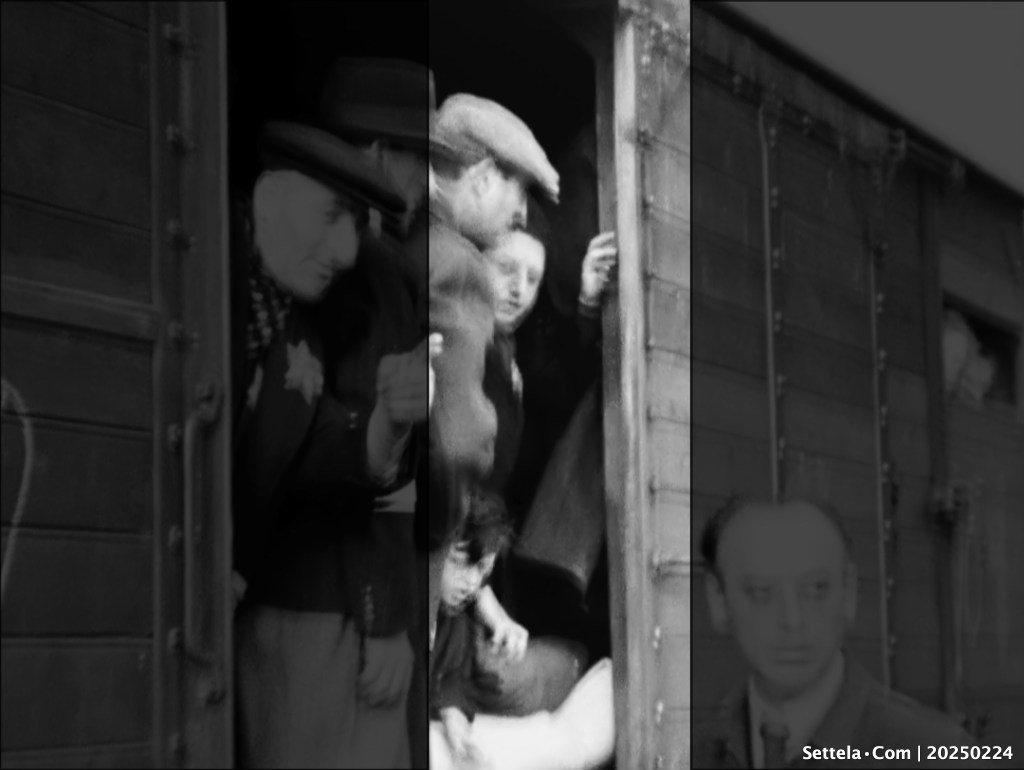
Discoveries Deportation Westerbork Film • 20250224 • The boy, the man, and the woman selected in this edited still of the linked video clip (15 s) URL https://youtube.com/clip/UgkxBw3eso6Bi3vIaR25h_bDWRHSx5EfMylN

Utrecht family identification , almost complete…

Almost certainly, three Jewish people have been recognized in the unique Westerbork film from 1944 (1). This time it concerns the 9-year-old boy Israël Wijnschenk, his father Max Wijnschenk, and his grandmother Betje Kokernoot-van Furth, who all lived in Utrecht (Holland).

Last week, the Dutch public broadcaster NOS (2) reported the news from the Utrecht (Dutch) news site Nieuws030 (3) that it is very likely that three people were recognized again in this film made by the Jewish prisoner and filmmaker Rudolf Breslauer showing the deportation of Jews, Roma and Sinti by train in Camp Westerbork on May 19, 1944.

Image researcher Koen Hulsbos — who previously identified an Amsterdam couple in this deportation train (4) — thought he recognized the young Israël Wijnschenk, a pupil at the time of the Joodse (Jewish) School Utrecht, and presented this to Victor Frederik, researcher of the Joodse School (5,6). The boy, the man, and the woman seem to belong together, and were recognized from family photos, also by family members.

It is certain that Max and his wife Chel (not in the images) returned to Utrecht after the war, their children Israël and his sister Kitty were murdered. Grandma Betje was also gassed in Auschwitz.

A portrait of Israël Wijnschenk is shown at the site of Joods Monument (7).

According to the transport list, there were two other children in that wagon, Joseph Beugeltas (11 years old) and Manfred Studzinsky (7 years old). Joseph Beugeltas appeared to have blond hair, and could not have been it (6). To be completely sure, the researchers are still looking for a photo of Manfred Studzinsky, for comparison…

Notes

1) Deportation Westerbork Film • Edition 2021 | 20210719 | Settela•Com | ISSN 2949-9313 | Footage filmed by Rudolf Breslauer in 1944, courtesy of NIOD | Sound and Vision . URL https://settela.com/2021/07/19/deportation-westerbork-film-20210719/

2) Utrechters ‘vrijwel zeker’ herkend op Westerborkfilm uit 1944. NOS Nieuws Feb 22, 2025. URL https://nos.nl/l/2556858

3) Nieuwe herkenningen in Westerborkfilm ‘bijna zeker’. Jim Terlingen | Nieuws030 . URL https://www.nieuws030.nl/hist030rie/drie-nieuwe-herkenningen-in-westerborkfilm-zo-goed-als-zeker/

4) Amsterdam couple found in Westerbork film • 20241223 | Settela•Com | ISSN 2949-9313 | URL https://settela.com/2024/12/23

5) Joodse school Utrecht. Website. URL https://joodseschoolutrecht.nl

6) Israël op Westerborkfilm? Victor Frederik- Web site Joodse school Utrecht. (Accessed 20250224). URL https://joodseschoolutrecht.nl/nl/Verhalen-over-leerlingen/Kitty-en-Israel-Wijnschenk/Israel-op-Westerborkfilm/

7) Portrait of Israël Wijnschenk. Site Joods Monument. URL https://www.joodsmonument.nl/nl/page/122045/israël-wijnschenk

Citation info : Discoveries Deportation Westerbork Film • 20250224 | Settela•Com | ISSN 2949-9313 | URL https://settela.com/2025/02/24/

Amsterdam couple found in Westerbork film • 20241223

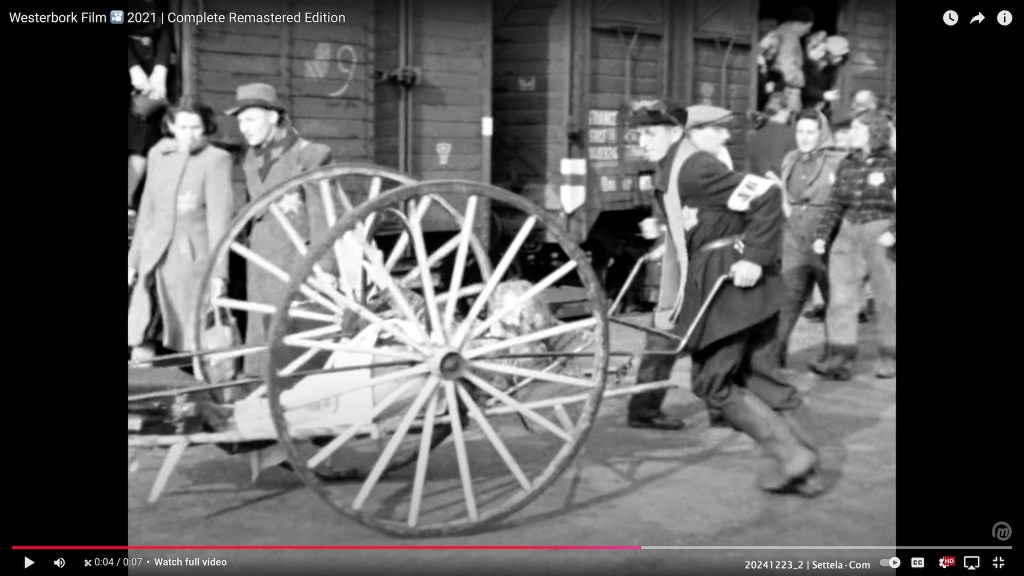
The Dutch national broadcaster NOS (1) and the local RTV Drenthe (2) reported this morning (23 Dec 2024) that 2 more people have been recognized in the Westerbork film.

It is the Amsterdam couple Marcus Pels and Hendrika Brandon. They were identified by the image researcher Koen Hulsbos – volunteer worker at the Behind the Star project of the NIOD Institute for War, Holocaust and Genocide Studies .

The Jewish photographer and filmmaker Rudolf Breslauer, while a prisoner in the Westerbork transit camp in the Netherlands, was commissioned by camp commander Albert Gemmeker to make film recordings for the Westerbork film in the spring of 1944, featuring images of a deportation train.

The NOS broadcast referred to images in the first published Westerbork film (3) :

The film can be viewed in its entirety on YouTube. After just under 5 minutes 🔗 a man with a hat can be seen looking into the camera with a smile, and next to him a woman with black, slightly wavy hair can be seen from behind. The same couple appears again at 6 minutes 🔗. It turned out to be the Amsterdam couple Marcus Pels and Hendrika Brandon.

Pels & Brandon Clip 1 & 2

Also available on YouTube is the more recent second Westerborkfilm (4). This 2021 edition has the recently found original camera rolls of the deportation transport (Reel E198), with higher quality images of the couple.

20241223_1 | Settela•Com | Pels & Brandon Clip 1 after 20 min 🔗


20241223_2 | Settela•Com | Pels & Brandon Clip 2 after 21 min 🔗

That’s it

Hulsbos had already had photos of Marcus Pels and Hendrika Brandon in his collection of images of prisoners who were transported on that day – May 19, 1944 – when Breslauer films the deportation of Jews, Roma and Sinti to Bergen-Belsen and Auschwitz.

“I’ve seen the film many times, but at one point I thought, ‘Hey, this couple is on screen twice.’ I had never really noticed that before,” says Hulsbos.

Hulsbos then compared the film footage with his photos. “And then I thought: that’s it,” says the amateur film historian.

Marcus Pels was murdered immediately after arriving in Auschwitz. Hendrika Brandon survived the war, as did their daughter and son, who were in hiding with a foster family. Katy (Keetje, 86 years old) and Philip (83) are still alive and live in Canada. They were shown the film footage and confirmed that they were their parents.

“They don’t remember their father. So to actually see images of him, to see him just walking around alive, there are no words to describe it,” granddaughter Lisa Kaufman said as a family spokesperson. “It was very special to see my grandmother, who I grew up with.”

Anonym | Girl with the headscarf …

In the Westerbork film, Hendrika looks at the woman on the stretcher, who was recognized in the 1990s through her suitcase as Frouwke Kroon, and thus was the key to identifying this transport and thus also to the name of the anonymous girl with the headscarf between the wagon doors – Settela (5,6).

Deportation Breslauer family

Earlier this year it was reported that filmmaker Rudolf Breslauer had also filmed two of his children , Stefan , and Ursula Breslauer in the Westerborkfilm at the farm (7).

Werner Rudolf Breslauer , his wife Bella Weihsmann, sons Stefan and Max Michael (Mischa), and daughter Ursula were deported later in 1944 from Westerbork to Theresienstadt and Auschwitz. Only Ursula survived.

Notes

1) Twee mensen herkend in Westerborkfilm: ‘Kan niet missen’ | NOS Nieuws • Dec 23, 2024 09:45 | URL https://nos.nl/artikel/2549390-twee-mensen-herkend-in-westerborkfilm-kan-niet-missen

2) Nieuwe ontdekking in Westerbork-film: Amsterdams echtpaar krijgt gezicht | RTV Drenthe • Dec 23, 2024 07:10 | URL https://www.rtvdrenthe.nl/nieuws/17091818/nieuwe-ontdekking-in-westerbork-film-amsterdams-echtpaar-krijgt-gezicht

3) Westerbork Film | Full version RVD 1986 | 20190605 | Michel van der Burg | Settela•Com | ISSN 2949-9313 | URL https://settela.com/2019/06/05/westerbork-film-full-version-rvd/

4) Westerbork Film 🎦 2021 | 20220302 | Michel van der Burg | Settela•Com | ISSN 2949-9313 | URL https://settela.com/2022/03/02/westerbork-film-🎦-2021-complete-remastered-edition-20220302/

5) ANONYM | Girl with the headscarf … | 20210416 | Michel van der Burg | Settela•Com | ISSN 2949-9313 | URL https://settela.com/2021/04/16/anonym-girl-with-the-headscarf-20210416/

6) ANONIEM | Meisje met hoofddoekje … | 20210417 | Michel van der Burg | Settela•Com | ISSN 2949-9313 | URL https://settela.com/2021/04/17/anoniem-meisje-met-hoofddoekje-20210417/

7) Stefan & Ursula Breslauer in Westerborkfilm | 20240305 | Settela•Com | ISSN 2949-9313 | URL https://settela.com/2024/03/05

Citation info : Amsterdam couple found in Westerbork film • 20241223 | Settela•Com | ISSN 2949-9313 | URL https://settela.com/2024/12/23

Stefan & Ursula Breslauer in Westerborkfilm | 20240305

Stefan & Ursula Breslauer in Westerborkfilm | 20240305 – Clip from : Westerbork Film 🎦 2021 | 20220302 | Settela•Com | URL https://youtube.com/clip/UgkxdcMjzZQcH8jOtp1j2xFwrPxyAoHMcdFr

Filmmaker Rudolf Breslauer also filmed two of his children in the Westerborkfilm…

Stefan (left) & Ursula Breslauer, children of Rudolf Breslauer, the filmmaker of the Westerbork film at the farm of Camp Westerbork in 1944 – identified by the dutch photographer Sake Elzinga, who received Breslauer’s family photo albums last year when the family of Ursula – the only survivor – visited an expo on Breslauer in the Westerbork museum in the Netherlands.

Camp commander (SS-Obersturmführer) Albert Gemmeker ordered the Westerbork film , made by the German Jewish prisoner, photographer, Rudolf Breslauer in the spring of 1944.

Today 80 years ago – March 5, 1944 – the camp is an ‘Arbeitslager’ – a work camp – when Rudolf Breslauer starts filming the daily life of the Westerbork prisoners — inside : in the barracks, for example a religious service, cabaret, workshops, factories, aircraft and battery recycling, medical care, and outside the barracks : construction of a greenhouse, a football match, women working out, chopping wood, incoming transports, and eventually also the departure of a deportation train. After Breslauer films the deportation of Jews, Roma and Sinti to Bergen-Belsen and Auschwitz on May 19, 1944 the filming stops.
The haunting image of the 9-year-old dutch Sinti-girl Settela, standing in the closing doors of the goods train, and the unique footage of that deportation train that leaves the Westerbork camp, became iconic after the war.

Deportation Breslauer family

Werner Rudolf Breslauer , his wife Bella Weihsmann, sons Stefan and Max Michael (Mischa), and daughter Ursula were deported autumn 1944 from Westerbork to Theresienstadt and Auschwitz. Only Ursula survived.

Stefan & Ursula Breslauer in Westerborkfilm | 20240305 | Settela•Com | Frame 127475 from Westerbork Film 🎦 2021 | 20220302 | Settela•Com | ISSN 2949-9313 | Footage filmed by Rudolf Breslauer in 1944, courtesy of NIOD | Sound and Vision

Notes

Clip from : Westerbork Film 🎦 2021 | Complete Remastered Edition | YouTube https://youtu.be/ZiLNDziwEtc

Westerbork Film 🎦 2021 | 20220302 | Settela•Com | URL https://settela.com/2022/03/02/westerbork-film-🎦-2021-complete-remastered-edition-20220302/

Kinderen van filmmaker Breslauer herkend in historische Westerborkfilm. Dutch national news broadcaster NOS Nieuws, in cooperation with RTV Drenthe, 13:18 Monday 4 March 2024 | URL https://nos.nl/artikel/2511414-kinderen-van-filmmaker-breslauer-herkend-in-historische-westerborkfilm

Scene with Stefan & Ursula Breslauer, starting at 56:13 in the 1986 RVD edition of the Westerborkfilm:
Stefan & Ursula Breslauer in Westerbork Film RVD | 20240305 | Settela•Com | URL https://youtube.com/clip/UgkxfNzA72JeGgVoOFp_VTI4EQQr3yTwXu6_

Settela Film | 20220630 | Michel van der Burg | Settela•Com

Deportation Westerbork Film | 20210719 | Michel van der Burg | Settela•Com

English introduction to Westerborkfilm :
Westerborkfilm Introduction | 20220507 | Michel van der Burg | Settela•Com | URL https://settela.com/2022/05/07/westerborkfilm-introduction-20220507/

Citation info : Stefan & Ursula Breslauer in Westerborkfilm | 20240305 | Settela•Com | ISSN 2949-9313 | URL https://settela.com/2024/03/05

News

March 5, 2024 : Updated 21:21

Deportation | 20240226

Camp commander (SS-Obersturmführer) Albert Gemmeker oversees the deportation of Jews, Sinti, and Roma from the Westerbork transit camp May 19, 1944 .

Gemmeker is the producer of the Westerborkfilm — he ordered the film. Cameraman is the German Jewish prisoner Rudolf Breslauer.

Source : Frame 2608 from Westerborkfilm Introduction | 20220507 | Settela•Com | ISSN 2949-9313 | URL https://settela.com/2022/05/07/westerborkfilm-introduction-20220507/

Citation info : Deportation | 20240226 | Settela•Com | ISSN 2949-9313 | URL https://settela.com/2024/02/26 | TakeNode 3b14bb27-07aa-4b34-9fab-0b5da0bb8580

French Refugees October 1918 in Holland | 20231031


Silent film — Towards the end of World War I – in the summer 1918 , after the Allies defeated the Germans in the Second Battle of the Marne – large groups of Belgians and French refugees flee in front of the retreating enemy force to the neutral Netherlands.

The Dutch army and Red Cross prepared to receive a possible 100,000 evacuees in the border towns in the south of the Netherlands.

After wandering weeks in the north of France , and next crossing Belgium on foot, the first group of French refugees arrived at the Dutch border October 20, completely exhausted.

At the gate in the electric wire fence at the border to the Netherlands – the so-called ‘Death Wire’ (dutch : Dodendraad ) Dutch soldiers took them over from German escorts.

Some refugees had travelled by tram part of the route crossing Belgium to the belgian border town Molenbeersel.

At the dutch border the refugees were welcomed and ladies from relief committees provide the refugees with food and drinks on the road to Stramproy in the Netherlands.

Within days , thousands of French refugees arrive in the village of Stramproy and are transferred to the city of Weert .

On arrival in the city center of Weert the dutch army registered people and handed out soup and bread.

The weak, the sick, and maternity women were cared for by the Red Cross and taken to an aid post for further care.

The refugees were sheltered the night in buildings like convents and schools in Weert, before being housed elsewhere in the country the following days.

References

Source (video footage) : Belgische vluchtelingen 1e Wereldoorlog. Open Images | Beeld & Geluid (Sound &Vision).

Weert en het einde van W.O.-I. | Jan Henkens | Stichting Historisch Onderzoek Weert | URL http://www.showeert.nl

Noord-Franse vluchtelingen in Weert 1918 in Den Grooten Oorlog | Grevenbroekmuseum vzw | URL https://www.grevenbroekmuseum.be

Citation : French Refugees October 1918 in Holland | 20231031 | Settela•Com | ISSN 2949-9313 | TakeNode bf10307b-fc98-4d67-ad22-82ef8cb3fddd

TAGS #french #refugee #train #tram #steam #horse #woman #WorldWarI #WW1 #Weert #Molenbeersel #Stramproy #Germany #France #Belgium #Netherlands #Holland #Europe #border #electric #wire #Dodendraad #death #war #peace #fence #shelter #flag #flight #evacuation #Red #Cross #army #help #welcome #food #drink #soup #jenever #walk #battle #Marne #1Memo #michelvanderburg #MiraclesMedia #SettelaCom