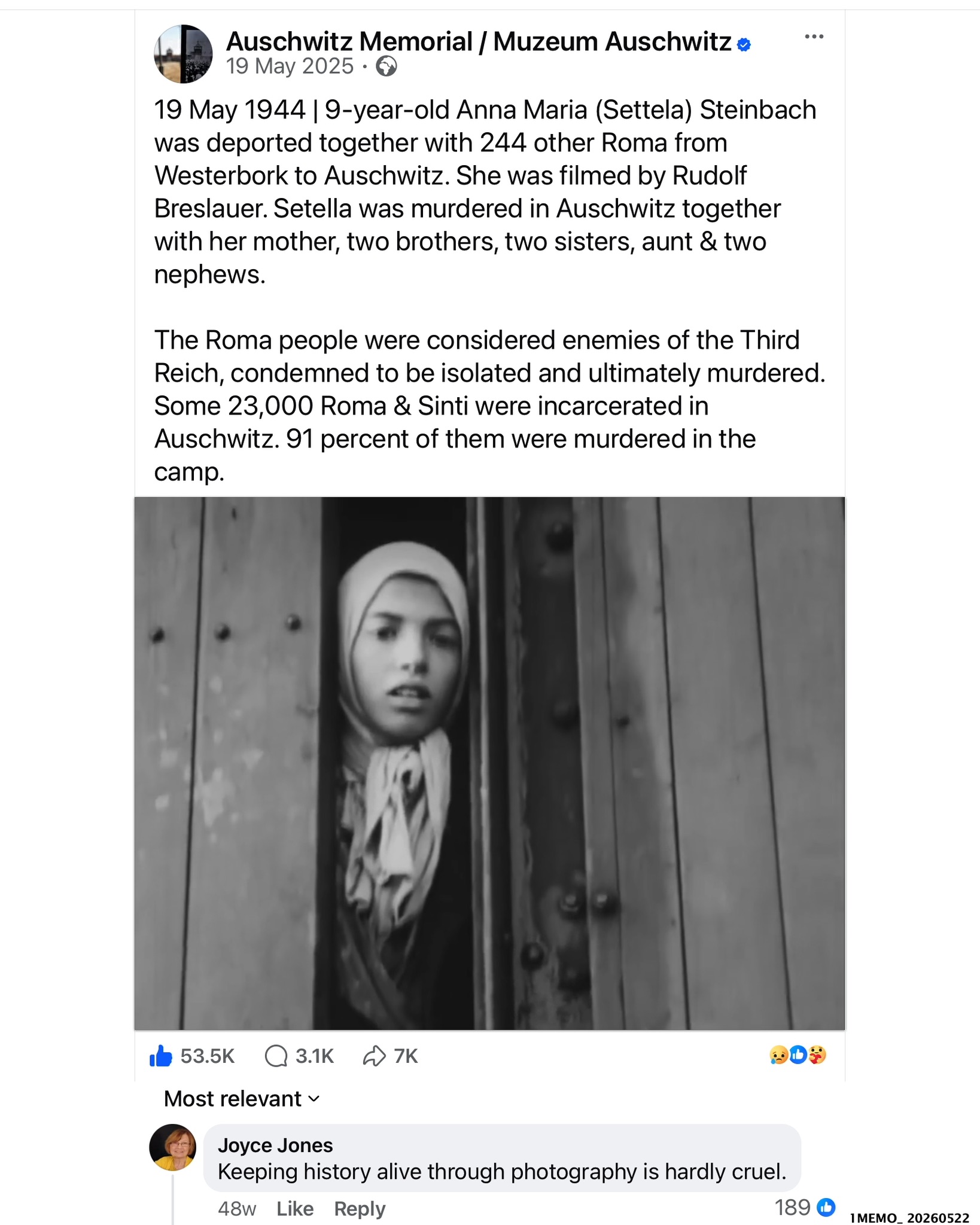
Deportation of Dutch Roma to Auschwitz – 19 May 1944 • 9-year-old Anna Maria (Settela) Steinbach was deported together with 244 other Roma from Westerbork to Auschwitz (1,2) • Source : Settela•Com • Collection Auschwitz Museum • URL https://fb.watch/Hgg5lusc-8/
The Auschwitz Museum acquired the short film ‘Settela’ from Settela•Com (1) in the Auschwitz Memorial Collection (3), and is succesfully screening the film each year since 2019 on the 19th May at the Auschwitz Memorial / Muzeum Auschwitz facebook page .
Last year’s post of the film ‘Settela’ , 19th May 2025 at the Auschwitz Memorial / Muzeum Auschwitz facebook page, accumulated by now one million views, and over 3000 comments (Image 1MEMO_20260522).
The film was created in an attempt to keep the scene on screen longer on the one hand, and to preserve the natural and historical original on the other. Thus a compilation was created, showing the same scene twice. The film ends with the original 3 seconds clip selected from the Westerbork film footage shot by Jewish prisoner Rudolf Breslauer (4), and the film starts with that same clip , digitally slowed down 10× in post-production.
This film was created and first online in 2017 (5) , and published (antedated) as the first post (1) shortly after the start May 19, 2019, of the online journal Settela•Communications — short Settela•Com (6).
More on the Roma in Auschwitz , online at the Auschwitz Museum (7).
Citation info : Settela Film Auschwitz Museum • 20260522 | Michel van der Burg | Settela•Com | ISSN 2949-9313 | CC BY 4.0 | URL https://settela.com/2026/05/22
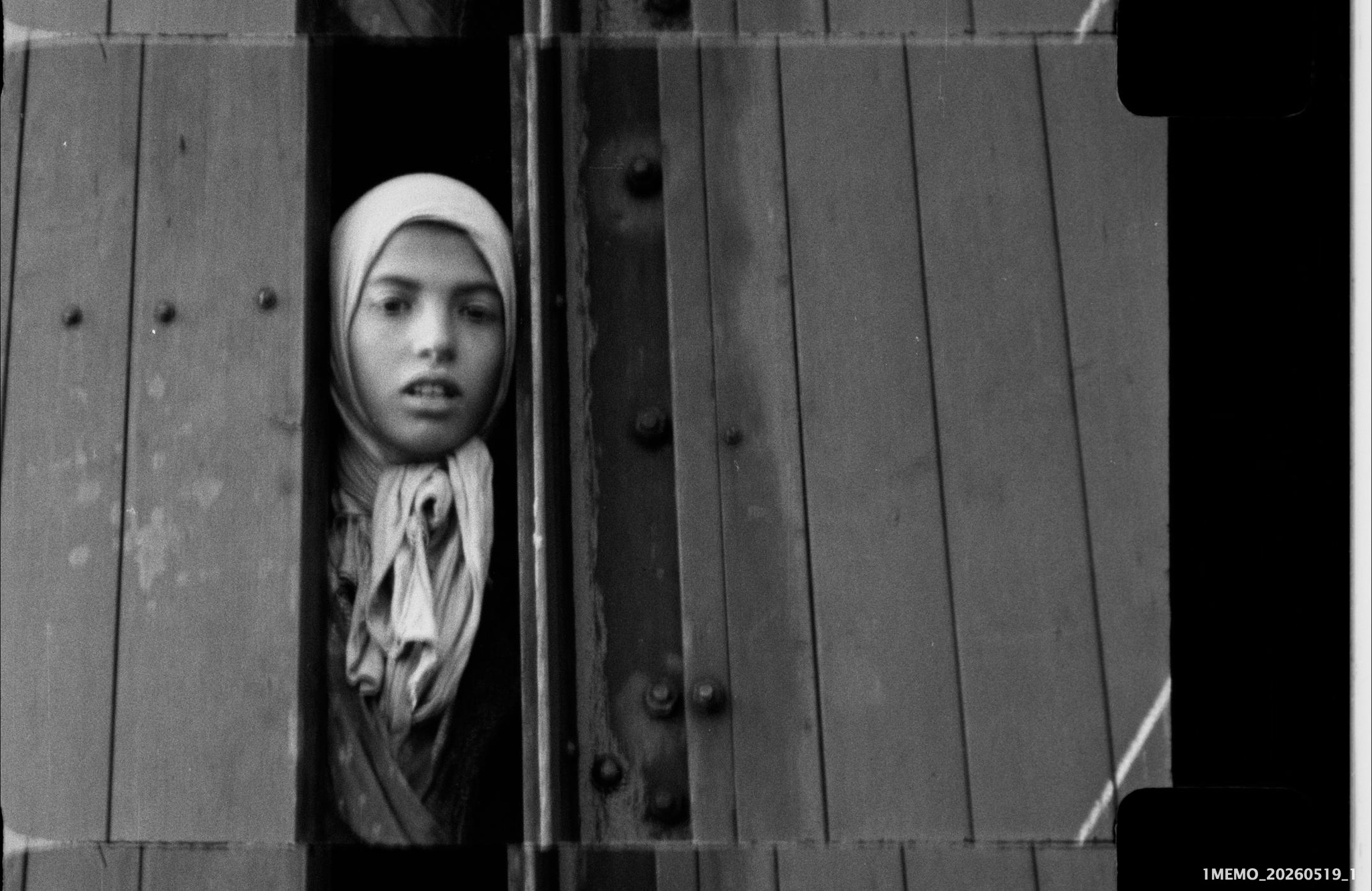
Settela Steinbach — The Girl with the Headscarf • 1MEMO_20260519_1 • Settela•Com • Frame from camera original film reel of the Westerborkfilm (1).
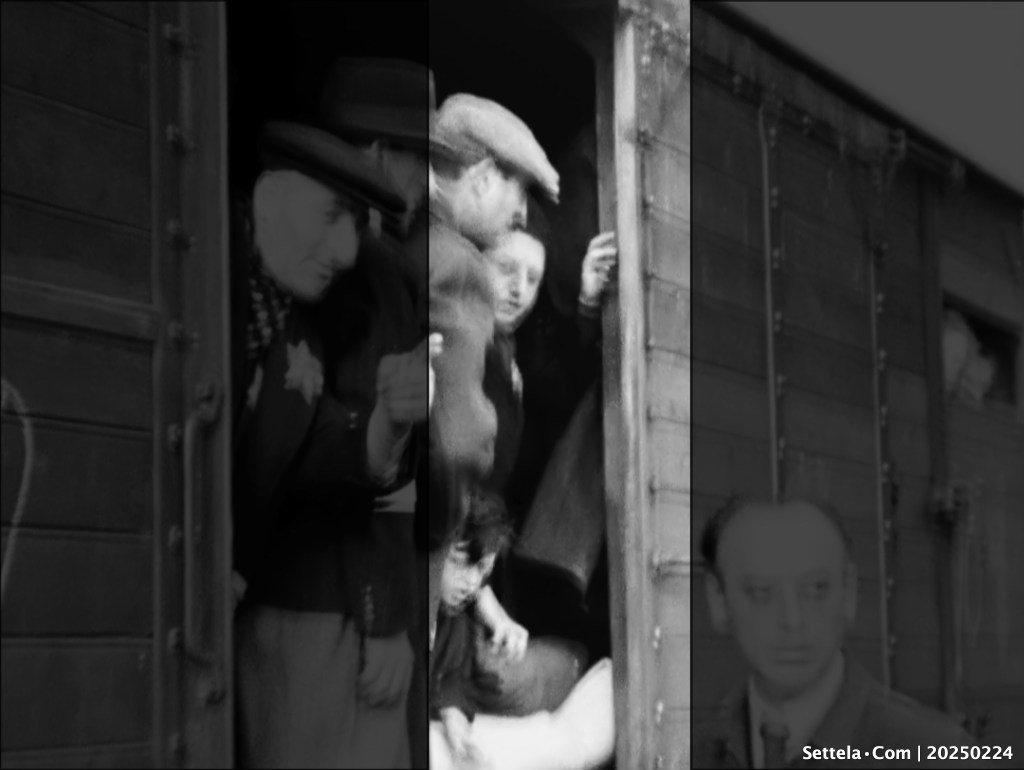
On May 19, 1944, at the Westerbork transit camp, a glimpse of Sinti girl Settela Steinbach wearing a headscarf appears between the sliding doors of a cattle car awaiting deportation to Auschwitz (1,2,3). In May 1945, her father, Moeselman Steinbach, wrote to “Repatriation” in the Netherlands: “…I very politely request you to inform me whether my wife and 10 children have arrived, or only children (Gypsy children) from the Auschwitz concentration camp in Poland.” (4).
The 9-year-old dutch Sinti-girl Anna Maria ‘Settela’ Steinbach peeks outside , at the last moment just before the sliding door is closed , standing inside a cattle car with 74 people on May 19 , 1944 in the Westerbork transit camp in Holland , when this deportation train leaves for Auschwitz-Birkenau – where Settela is murdered a few months later in one of the gas chambers (5).
While Settela peeks outside , her mother cries behind her in that cattle car : “Get out of there, or soon your head gets in between!”
She is wearing a headscarf made from a torn sheet because the Nazis shaved her head upon arrival at Westerbork transit camp on May 16, 1944, following the “Gypsy raid” carried out that same day at the Zwaaikom caravan site in Eindhoven, the Netherlands (6).
Settela Film • 20220630
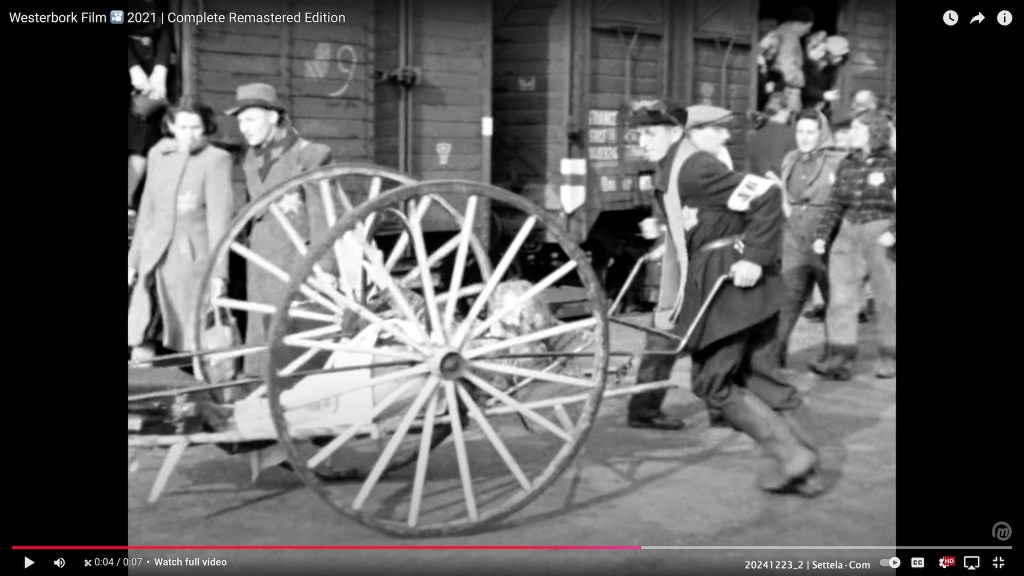
Settela was filmed only a few seconds by the Jewish prisoner filmmaker Rudolf Breslauer as part of a documentary film being made in 1944 on the Westerbork camp . Those seconds , also in slow-motion are shown in the 2022 Settela Film • 20220630 (7)
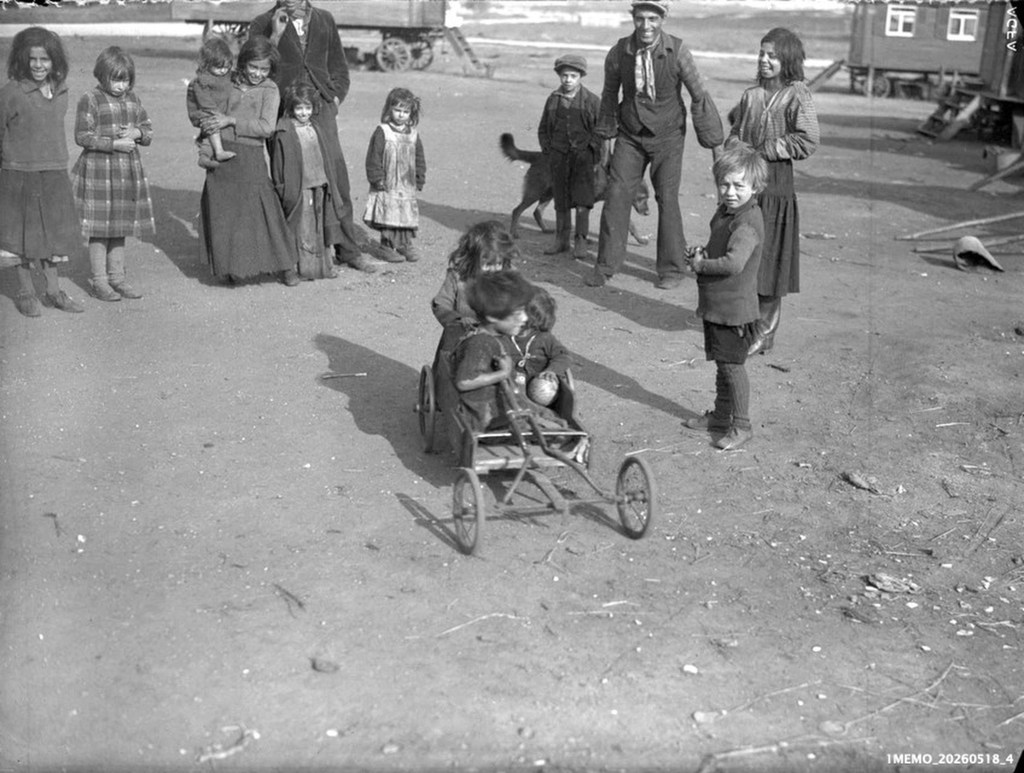
The toddler Settela in the arms of her older sister Elisabeth Steinbach at the Heksenberg Sinti caravan site in 1935 • Photo Jan de Jong • 1MEMO_20260518_4
Anna Maria (‘Settela’) Steinbach was born 23 December 1934 in Buchten, Netherlands, and photographed at age ~1 , in the arms of her older sister Elisabeth Steinbach, with others of the Steinbach family, and other families, at the nearby Sinti caravan site ‘Heksenberg’, October 1935, by photographer Jan de Jong (8) • 1MEMO_20260518_4
Settela was deported together with her brothers and sisters (Willy “Celestinus”, Willem, Elisabeth, Johanna, Philibert, Florentina, Willem, Anna), and mother Toetela (Emilia) Steinbach (born 23 March 1902 in Antwerp, Belgium), with other Steinbach and other nomad families – all together ca 245 Sinti and Roma and ca 450 Jews – on May 19th 1944 from the dutch Camp Westerbork to the Auschwitz and Bergen-Belsen camps (5,6).
Toetela’s eldest child Moekela (Magdalena; born 14 Sep 1922) had gone to Belgium and had been deported earlier – 15 Jan 1944 – with her 6 months old baby Jeanette – Toetela’s granddaughter – on the Z-Transport from transit camp Kazerne Dossin in Mechelen to Auschwitz, were they were murdered on arrival.
Settela’s father Heinrich (‘Moeselman’) Steinbach (born Nov 11, 1901 in Gründorf in Germany) died alone of grief June 6, 1946 in Maastricht in the Netherlands – his wife and 10 children had not survived the camps.
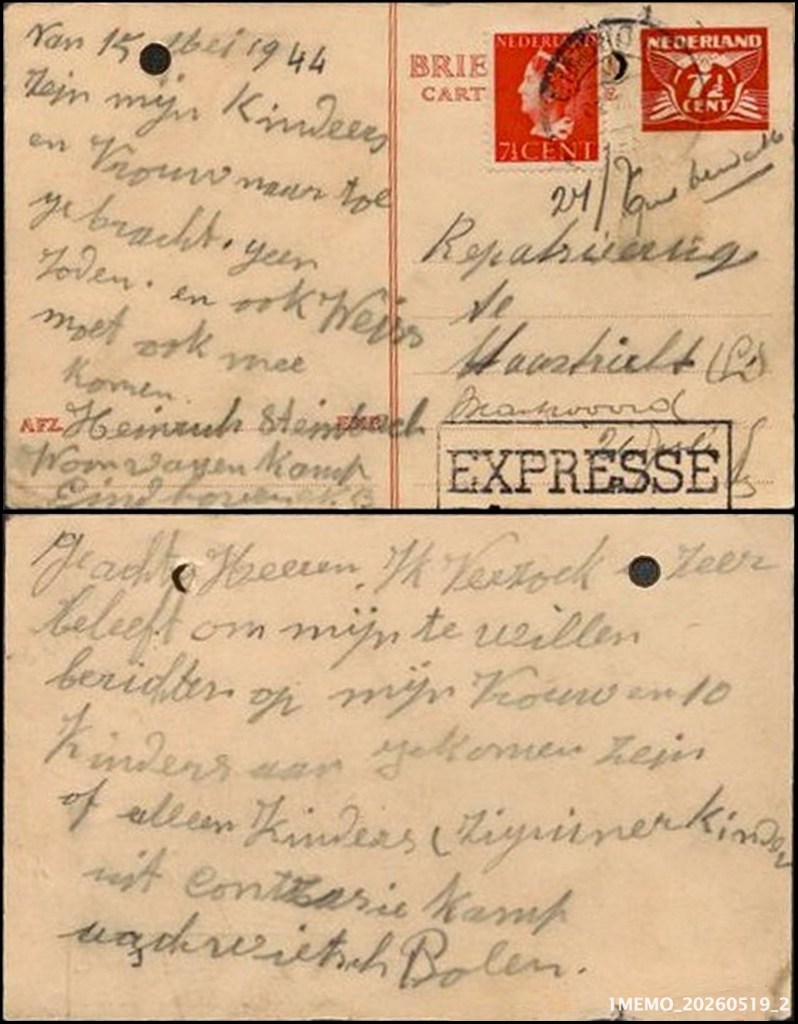
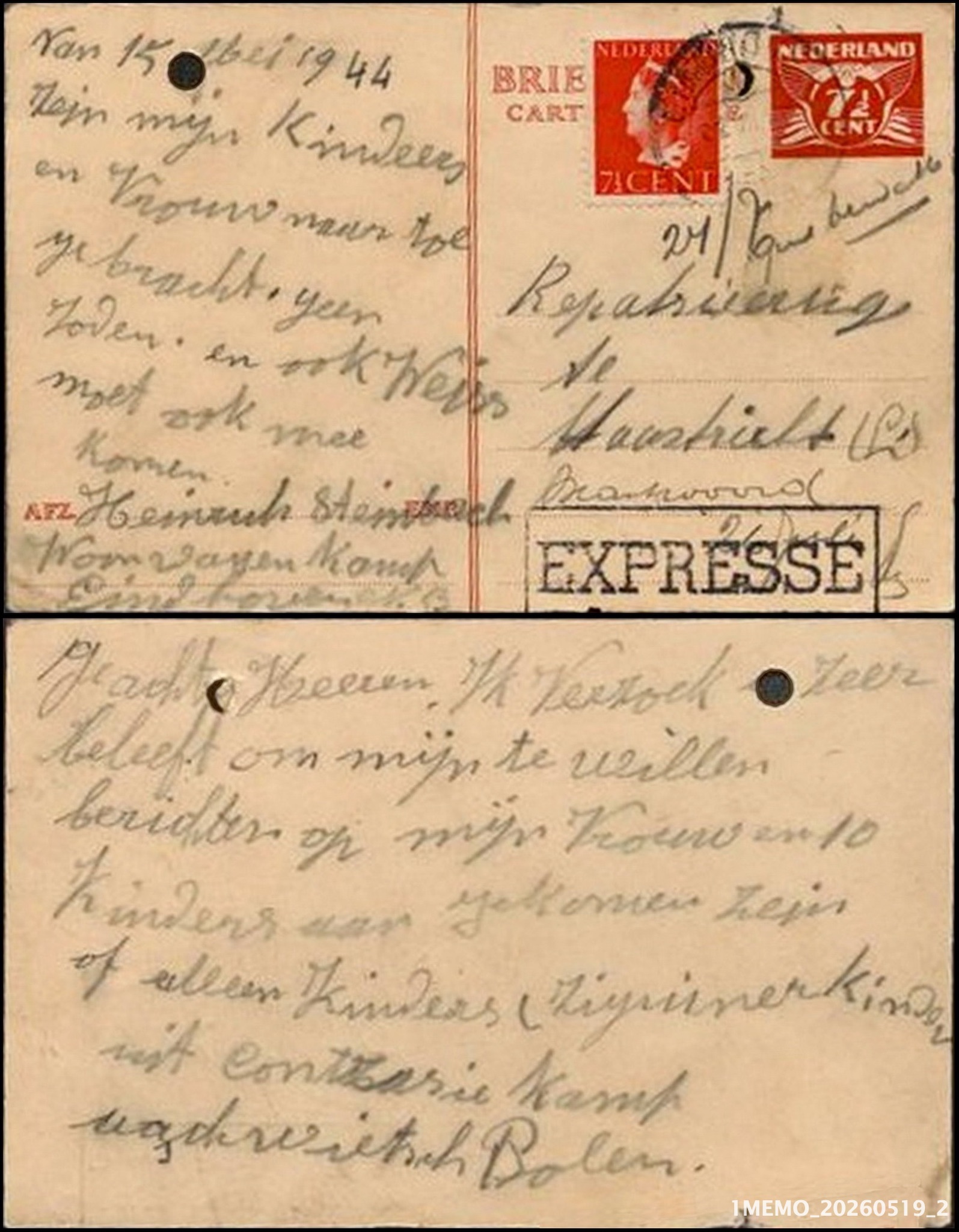
To : “Repatriation” in Maastricht (Netherlands) — “Dear Sirs, I very politely request you to inform me whether my wife and 10 children have arrived, or only children (Gypsy children) from the Auschwitz concentration camp in Poland. From May 15, 1944, my children and wife were taken there; no Jews. And Weiss had to come along too. — Heinrich Steinbach. Caravan site Eindhoven , North Brabant” • 1MEMO_20260519_2 • Settela•Com
One year earlier , May 22, 1945, two weeks after the liberation of Holland, Heinrich Steinbach — living at the caravan site in Eindhoven (North Brabant, Netherlands) — inquires about the fate of his wife and ten children on a postcard written to the “Repatriation” in Maastricht (Netherlands). The text on the postcard reads — translated from dutch (4) :
“Dear Sirs, I very politely request you to inform me whether my wife and 10 children have arrived, or only children (Gypsy children) from the Auschwitz concentration camp in Poland.
From May 15, 1944, my children and wife were taken there; no Jews. And Weiss had to come along too.
Heinrich Steinbach. Caravan site Eindhoven, North Brabant”
‘Moeselman’ Heinrich Steinbach — living at the caravan site in Eindhoven (North Brabant, Netherlands) — inquires about the fate of his wife and ten children on a postcard written to the “Repatriation” in Maastricht (Netherlands). The dutch text on the postcard reads :
“Geachte Heeren, Ik verzoek u zeer beleeft om mijn te willen berichten op mijn vrouw en 10 kinders aan gekomen zein of alleen kinders (zigeunerkinders) uit contrasie kamp uaschwietsch Polen.
Van 15 mei 1944 zein mijn kindeers en vrouw naar toe gebracht, geen joden. En ook Weiss moet ook mee komen. Heinrich Steinbach. Woonwagenkamp Eindhoven N.B.”
Westerbork Girls – From left to right: Catharina Frank, Hannelore Cahn, Beatrice Lissauer, Ulla Gross, Lotte Heider-Lehmann and Ruth Pagener. (Source : Westerbork Memorial)
The documentary ‘Westerbork Girl’ (2007), directed by Steffie van den Oord, tells the story of Hannelore Cahn (later Eisinger-Cahn), a Jewish woman imprisoned in Camp Westerbork for more than two years during World War II. She performed as a dancer in the camp revue, attracting the attention of many, including camp commander Gemmeker and Jewish camp policeman Hans Eisinger, member of the Jewish Order Service—also known as “the Jewish SS”.
Westerbork Girl (VPRO 2007)
Hannelore had earlier met actor and resistance fighter Rob de Vries, with whom she was close. Rob smuggled her out of Westerbork by disguising himself as a train stoker and taking her to Amsterdam, where she briefly went into hiding. Hans Eisinger manages to track her down and one week after her escape Hannelore voluntarily accompanies him back to the camp…possibly due to loneliness, Rob’s existing relationship, or pressure from the Order Service to prevent others being deported to Auschwitz. Shortly thereafter, Hannelore and Hans get married in Westerbork.
Hannelore survived the war and avoided punishment after her return. The film reconstructs her story through interviews, archival footage, and music, presenting it as one of survival, love, and the difficult choices faced under Nazi persecution.
Hannelore sings and is still intensely sung about by Louis de Wijze, who witnessed her escape and remembered the revue songs from Westerbork: Ich hab es bei Nacht den Sternen erzählt, Ich liebe Dich.
Powerful documentary—this story, with close-ups of this Westerbork Girl, that resonate with me. Beautiful surprise while researching the use of the Westerborkfilm. Review by Michel van der Burg , editor Settela.Com
Citation info : Westerbork Girl • 20250916 | Michel van der Burg | Settela•Com | ISSN 2949-9313 | URL https://settela.com/2025/09/16
Summary — September 1947 Dutch cinema news on circa 500 Jewish children , displaced children from East Europe, who many of them lost parents in the Nazi camps, arriving from Prague by train in the Netherlands, where they will stay for up to 3 years, and trained for their future task in Palestine.
Dutch cinema news reports the arrival of a steam train carrying approximately 500 Jewish children in Holland, Monday, September 22, 1947 — filmed here during a stopover at Nijmegen station. Displaced children from Eastern Europe, many of whom lost their parents in the Nazi camps. Through collaboration with the International Refugee Organization (IRO) and the Joint American Distribution Committee, they were selected in Romania from members of the eight Zionist youth organizations in Romania: Aguda, B’nei Akiba, Gordonja, Dror Igoed, Dror Haboniem, Hanoar Hatzioni, Hashomer Hatzair, and Betar. For orphans who lost both parents, the political preference of the deceased parents was estimated. The children were first concentrated in Prague.
On Saturday evening, September 20, 1947, they began their train journey from Prague (Prague-Bubny), bound for the children’s village “Ilaniah” specially established for them in the “Het Apeldoornse Bos” building complex near Apeldoorn, the Netherlands. They arrived there on Monday evening, September 22, 1947.
Notes
1) Sign on train : Repatriation train • Prague Bubny Station (Repatriačni vlak • (Dílny Praha Bubny)
2) Transcript (translated from dutch)
This train arriving in Nijmegen [Netherlands], brings 450 Jewish children from Eastern Europe to our country, most of whose parents died in the gas chambers of the German concentration camps.
They also lived in camps after the war, together with thousands of others, and most of them show that.
Our government has allowed these children, all between the ages of 6 and 14, to stay in the Netherlands for 3 years, in Apeldoorn, where they will be trained for their future task in Palestine.
Jewish organizations ensure that the children get something to eat and drink after the tiring journey.
And that turns out to be well received.
3) NL – Transcript (dutch , original)
Deze trein die in Nijmegen arriveert, brengt naar ons land 450 Joodse kinderen uit Oost-Europa wier ouders voor het merendeel de dood vonden in de gaskamers der Duitse concentratiekampen.
Ze hebben ook na de oorlog tesamen met nog duizenden anderen in kampen geleefd, en de meesten van hen is dat wel aan te zien.
Onze regering heeft toegestaan dat deze kinderen, allen tussen 6 en 14 jaar, gedurende 3 jaar in Nederland verblijven, in Apeldoorn, waar ze opgeleid zullen worden voor hun toekomstige taak in Palestina.
Joodse organisaties zorgen ervoor, dat de kinderen na de vermoeiende reis wat te eten en te drinken krijgen.
20250818 Minor text edit , with addition : For orphans who lost both parents, the political preference of the deceased parents was estimated.
20250820 correction description text source date (45>47)
Credits
Source: Dutch cinema news Polygoon-Profilti (Producer | 22 September 1947) courtesy of Netherlands Institute for Sound and Vision (Open Images).
Citation info : 500 Jewish Children • Arrival in Holland • 20250811 | Michel van der Burg | Miracles•Media | Settela•Com | ISSN 2949-9313 | TakeNode 5c6e966b-5b45-47ef-ba01-17650007ae20 | URL https://settela.com/2025/08/11/
Almost certainly, three Jewish people have been recognized in the unique Westerbork film from 1944 (1). This time it concerns the 9-year-old boy Israël Wijnschenk, his father Max Wijnschenk, and his grandmother Betje Kokernoot-van Furth, who all lived in Utrecht (Holland).
Last week, the Dutch public broadcaster NOS (2) reported the news from the Utrecht (Dutch) news site Nieuws030 (3) that it is very likely that three people were recognized again in this film made by the Jewish prisoner and filmmaker Rudolf Breslauer showing the deportation of Jews, Roma and Sinti by train in Camp Westerbork on May 19, 1944.
Image researcher Koen Hulsbos — who previously identified an Amsterdam couple in this deportation train (4) — thought he recognized the young Israël Wijnschenk, a pupil at the time of the Joodse (Jewish) School Utrecht, and presented this to Victor Frederik, researcher of the Joodse School (5,6). The boy, the man, and the woman seem to belong together, and were recognized from family photos, also by family members.
It is certain that Max and his wife Chel (not in the images) returned to Utrecht after the war, their children Israël and his sister Kitty were murdered. Grandma Betje was also gassed in Auschwitz.
A portrait of Israël Wijnschenk is shown at the site of Joods Monument (7).
According to the transport list, there were two other children in that wagon, Joseph Beugeltas (11 years old) and Manfred Studzinsky (7 years old). Joseph Beugeltas appeared to have blond hair, and could not have been it (6). To be completely sure, the researchers are still looking for a photo of Manfred Studzinsky, for comparison…
The Dutch national broadcaster NOS (1) and the local RTV Drenthe (2) reported this morning (23 Dec 2024) that 2 more people have been recognized in the Westerbork film.
It is the Amsterdam couple Marcus Pels and Hendrika Brandon. They were identified by the image researcher Koen Hulsbos – volunteer worker at the Behind the Star project of the NIOD Institute for War, Holocaust and Genocide Studies .
The Jewish photographer and filmmaker Rudolf Breslauer, while a prisoner in the Westerbork transit camp in the Netherlands, was commissioned by camp commander Albert Gemmeker to make film recordings for the Westerbork film in the spring of 1944, featuring images of a deportation train.
The NOS broadcast referred to images in the first published Westerbork film (3) :
The film can be viewed in its entirety on YouTube. After just under 5 minutes 🔗 a man with a hat can be seen looking into the camera with a smile, and next to him a woman with black, slightly wavy hair can be seen from behind. The same couple appears again at 6 minutes 🔗. It turned out to be the Amsterdam couple Marcus Pels and Hendrika Brandon.
Pels & Brandon Clip 1 & 2
Also available on YouTube is the more recent second Westerborkfilm (4). This 2021 edition has the recently found original camera rolls of the deportation transport (Reel E198), with higher quality images of the couple.
Hulsbos had already had photos of Marcus Pels and Hendrika Brandon in his collection of images of prisoners who were transported on that day – May 19, 1944 – when Breslauer films the deportation of Jews, Roma and Sinti to Bergen-Belsen and Auschwitz.
“I’ve seen the film many times, but at one point I thought, ‘Hey, this couple is on screen twice.’ I had never really noticed that before,” says Hulsbos.
Hulsbos then compared the film footage with his photos. “And then I thought: that’s it,” says the amateur film historian.
Marcus Pels was murdered immediately after arriving in Auschwitz. Hendrika Brandon survived the war, as did their daughter and son, who were in hiding with a foster family. Katy (Keetje, 86 years old) and Philip (83) are still alive and live in Canada. They were shown the film footage and confirmed that they were their parents.
“They don’t remember their father. So to actually see images of him, to see him just walking around alive, there are no words to describe it,” granddaughter Lisa Kaufman said as a family spokesperson. “It was very special to see my grandmother, who I grew up with.”
Anonym | Girl with the headscarf …
In the Westerbork film, Hendrika looks at the woman on the stretcher, who was recognized in the 1990s through her suitcase as Frouwke Kroon, and thus was the key to identifying this transport and thus also to the name of the anonymous girl with the headscarf between the wagon doors – Settela (5,6).
Deportation Breslauer family
Earlier this year it was reported that filmmaker Rudolf Breslauer had also filmed two of his children , Stefan , and Ursula Breslauer in the Westerborkfilm at the farm (7).
Werner Rudolf Breslauer , his wife Bella Weihsmann, sons Stefan and Max Michael (Mischa), and daughter Ursula were deported later in 1944 from Westerbork to Theresienstadt and Auschwitz. Only Ursula survived.
Filmmaker Rudolf Breslauer also filmed two of his children in the Westerborkfilm…
Stefan (left) & Ursula Breslauer, children of Rudolf Breslauer, the filmmaker of the Westerbork film at the farm of Camp Westerbork in 1944 – identified by the dutch photographer Sake Elzinga, who received Breslauer’s family photo albums last year when the family of Ursula – the only survivor – visited an expo on Breslauer in the Westerbork museum in the Netherlands.
Camp commander (SS-Obersturmführer) Albert Gemmeker ordered the Westerbork film , made by the German Jewish prisoner, photographer, Rudolf Breslauer in the spring of 1944.
Today 80 years ago – March 5, 1944 – the camp is an ‘Arbeitslager’ – a work camp – when Rudolf Breslauer starts filming the daily life of the Westerbork prisoners — inside : in the barracks, for example a religious service, cabaret, workshops, factories, aircraft and battery recycling, medical care, and outside the barracks : construction of a greenhouse, a football match, women working out, chopping wood, incoming transports, and eventually also the departure of a deportation train. After Breslauer films the deportation of Jews, Roma and Sinti to Bergen-Belsen and Auschwitz on May 19, 1944 the filming stops. The haunting image of the 9-year-old dutch Sinti-girl Settela, standing in the closing doors of the goods train, and the unique footage of that deportation train that leaves the Westerbork camp, became iconic after the war.
Deportation Breslauer family
Werner Rudolf Breslauer , his wife Bella Weihsmann, sons Stefan and Max Michael (Mischa), and daughter Ursula were deported autumn 1944 from Westerbork to Theresienstadt and Auschwitz. Only Ursula survived.
Stefan & Ursula Breslauer in Westerborkfilm | 20240305 | Settela•Com | Frame 127475 from Westerbork Film 🎦 2021 | 20220302 | Settela•Com | ISSN 2949-9313 | Footage filmed by Rudolf Breslauer in 1944, courtesy of NIOD | Sound and Vision
Scene with Stefan & Ursula Breslauer, starting at 56:13 in the 1986 RVD edition of the Westerborkfilm: Stefan & Ursula Breslauer in Westerbork Film RVD | 20240305 | Settela•Com | URL https://youtube.com/clip/UgkxfNzA72JeGgVoOFp_VTI4EQQr3yTwXu6_
Settela Film | 20220630 | Michel van der Burg | Settela•Com
Deportation Westerbork Film | 20210719 | Michel van der Burg | Settela•Com