The former Höhere SS- und Polizeiführer in the Netherlands, H.A. Rauter, must stand trial in The Hague for his crimes, which he committed in World War II. Hanns A. Rauter, an Austrian, was the highest SS official in Nazi-occupied Holland and was tasked with setting up the camps in Westerbork and other dutch cities, and the arrests , internment and deportation of Dutch Jews , Roma, Sinti, resistance workers, and other groups of Dutch people. Dutch cinema news March (week 14) 1948 (company : Polygoon Hollands Nieuws) . The sessions will take place on 1, 2, 3 and 22 April in the former palace on the Kneuterdijk in The Hague. The court is chaired by mr. P.G.M. van Meeuwen; attorney-at-law is mr. J. Zaayer; defender (added) is mr. K. van Rijckevorsel. SHOTS: – exterior Special Court building; – a long line of interested people stands in the rain in front of the public entrance and rushes in when the door opens; Rauter arrives, with guards, in a crook’s car in the courtyard; thick file under the arm; goes in; – interior of courtroom packed with audience: Rauter (in uniform without insignia) enters and sits down between two guards; judges enter; – session starts; Rauter makes a statement standing.
The trial news continues in the previously published film : Westerbork Film in ‘Proces Rauter’ 1948 | 20190520 | Settela•Com | ISSN 2949-9313
De vroegere Höhere SS- und Polizeiführer in Nederland, H.A. Rauter, moet in Den Haag terechtstaan voor zijn misdaden, die hij beging in de Tweede Wereldoorlog. Weekjournaal van Polygoon Hollands Nieuws van week 14 uit 1948. De zittingen hebben, op 1,2,3 en 22 april plaats in het voormalige paleis aan de Kneuterdijk. Het hof staat onder voorzitterschap van jhr. mr. P.G.M. van Meeuwen; als procureur-fiscaal treedt op mr. J. Zaayer; als (toegevoegd) verdediger mr. K. van Rijckevorsel. Beeld: – ext. gebouw Bijzonder Gerechtshof; – een lange rij belangstellenden staat in de regen voor de publieke ingang en haast zich naar binnen als de deur open gaat; – Rauter arriveert, met bewakers, in een boevenwagen op de binnenplaats; dik dossier onder de arm; gaat naar binnen; – int. van een met publiek volgepakte rechtszaal: Rauter (in uniform zonder distinctieven) komt binnen en gaat – tussen twee bewakers – zitten; rechters komen binnen; – zitting begint; Rauter legt – staande – een verklaring af.
Het proces nieuws wordt vervolgd in de eerder gepubliceerde film : Westerbork Film in ‘Proces Rauter’ 1948 | 20190520 | Settela•Com
Bron : Polygoon Hollands Nieuws / Sound & Vision (Open Beelden). License Info : SS Führer Rauter Trial Start 1948 | 20230127 | Settela•Com | ISSN 2949-9313 | TakeNode 3d48e3a5-2fc8-4d8d-ba8b-21c07d238570
From 20 January 2023, the Jewish Museum of Belgium, in partnership with the Auschwitz Foundation, presents the exhibition entitled ‘ 236, Land(es)capes from the 20th Convoy ‘. It is set up in the museum’s project space and offers an artistic look at an exceptional and forgotten event in the Second World War.
The 20th convoy
At 10 p.m. on April 19, 1943, the 20th convoy departed from the Kazerne Dossin transit camp in Mechelen with 1,631 Jewish deportees in cattle cars, heading for Auschwitz. Thanks to resistance actions, both inside the wagons and from outside, 236 of these deportees managed to jump from that train, that was leading them to extermination. An unique event in Europe under the Nazi administration.
Jo Struyven, photographer
The work of the Belgian photographer Jo Struyven (°Sint-Truiden, 1961) takes us back to these acts of resistance – commemorating the 80th anniversary in 2023 – and gives us a glimpse of the landscapes in which this striking story took place. Taking the perspective of those who jumped off that train, an act for which many of them paid with their lives, Struyven creates a contemporary ‘memorial’ with 19 large ‘nocturnal’ black and white images, and one colour print.
Jo Struyven :
The 20th convoy, heading for the unspeakable “Auschwitz”, crossed the area where I grew up, barely 50 meters from my childhood bedroom — I found out 2 years ago after meeting Simon Gronowski. Ever since, I imagine the distress of the deportees. The destination was unknown to them. Some, sensing the worst, tried to escape it. I wanted to give an account of this border between life and death, between resignation and the impossibility of choosing, and the freedom regained with resistance to the oppressor’s plans.
Works presented by Jo Struyven
Land(es)capes from the 20th Convoy, 2020-2022, 19 black and white prints, 1 color print, 90×60 cm (Private collection – Belgium)
Jo Struyven, Land(es)capes from the 20th convoy 2020-2022, black and white print, 90x 60 cm, Wijchmaal (Private Collection, Belgium)Jo Struyven, Land(es)capes from the 20th Convoy 2020-2022, black and white print, 90x 60 cm, Bierbeek (Private Collection, Belgium)Jo Struyven, Land(es)capes from the 20th Convoy, 2020-2022, black and white print, 90x 60 cm, Borgloon (Private Collection, Belgium)Jo Struyven, Land(es)capes from the 20th Convoy, 2020-2022, black and white print, 90x 60 cm, Piringen (Private Collection, Belgium)Jo Struyven, Land(es)capes from the 20th Convoy, 2020-2022, black and white print, 90x 60 cm, Botzelaer (Private Collection, Belgium)
Luc Tuymans, visual artist
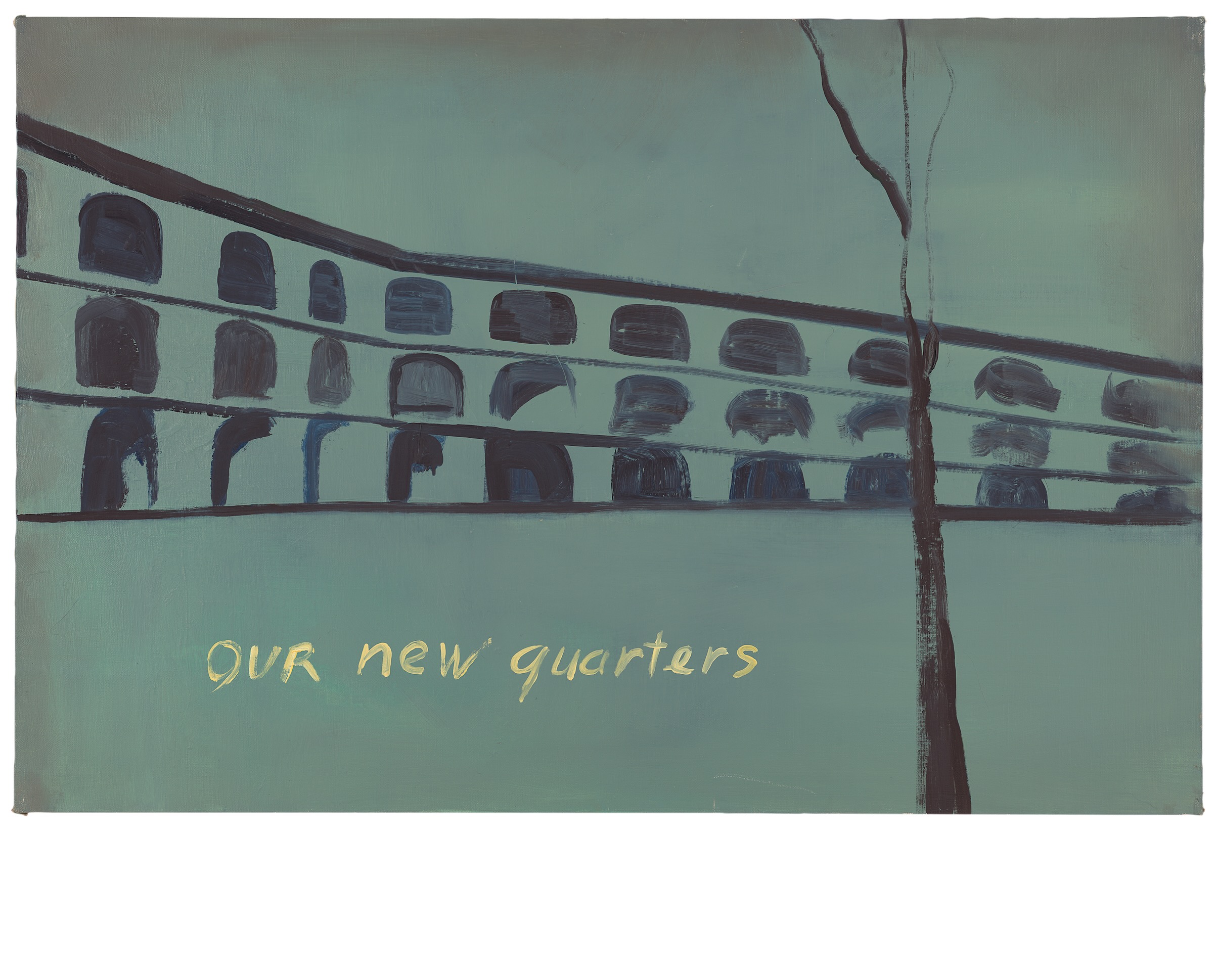
In dialogue with Jo Struyven’s photographs, two works by Belgian visual artist Luc Tuymans (°Mortsel, 1958) evoke the destruction of the Jews and Roma of Europe. Die Wiedergutmachung (The Reparation) depicts body parts – left the eyes of gypsy children who had been experimented on by the Nazis. … images that in its incompleteness, reflect the inability to represent facts and memory .
Works presented by Luc Tuymans
Luc Tuymans, Our New Quarters, 1986, Oil on canvas, 80,5 x 120 cm (MMK – Germany) (Photo Ben Blackwell, courtesy David Zwirner, New York, London)Luc Tuymans, Die Wiedergutmachung, 1989, Oil on cardboard, mounted on plywood, Oil on canvas; diptych, 36,6 x 43 cm, 39,4 x 51,8 cm, courtesy: Private collection (Photo Studio Luc Tuymans)
Art after the Shoah
“Writing a poem after Auschwitz is barbaric”, wrote German philosopher Theodor W. Adorno in 1949. Through two contemporary perspectives from the visual arts, this exhibition seeks to address this question of the (im)possibility of art after the Shoah in a new way.
Testimonies & Catalogue
This exhibition will be accompanied by a catalogue book edited by Daniel Weyssow and Jo Struyven and published by the Auschwitz Foundation entitled Land(es)capes from the 20th Convoy (press release on April 19, 2023), as well as an educational space presenting the testimonies from interviews and archives of convoy escapees.
Info+ ( & Français | Nederlands)
236 Land(es)capes from the 20th Convoy Jo Struyven / Luc Tuymans Exhibition at the Jewish Museum of Belgium, in Brussels, Belgium 20 January – 14 August 2023 Brussels Website https://www.mjb-jmb.org
Video report : Vernissage ‘236’ Land(es)capes 20th convoy
Thursday January 19th, 2023, the vernissage of the photo exhibition 236 — Land(es)capes from the 20th Convoy was opened with speeches by Philippe Blondin, President of the Jewish Museum, and by Pierre-Yves Jeholet , Minister-President of the Government of the Federation Wallonia-Brussels. Next, the Belgian photographer Jo Struyven presented his work — escape landscape photographs glowing in the dark — like being lit by moonlight — as well as paintings contributed by Luc Tuymans in the project space. The exhibition runs from January 20 – August 14, 2023 in the Jewish Museum of Belgium, Brussels, Belgium. Video report (20230120) Michel van der Burg | Miracles•Media .
Jan 20, 2023 – VRT | Kristien Bonneure (Belgian Flemish Broadcast) 20 jan 2023
(Silent Film) The Amsterdam Jewish Quarter — Joodsche Wijk (dutch) | Juden Viertel (german) — was cordoned off by the Nazis and declared a Jewish ghetto, February 1941, during World War II. Source : Producer unknown | Sound & Vision (Open Images)
License : Amsterdam Ghetto 1941 | 20221209 | Settela•Com | ISSN 2949-9313 | CC BY SA 3.0 | TakeNode 00e86cb5-adf6-4b73-8de6-64627aa27bca
Breslauer films Settela after Degen kids | Excerpt (20220510) from Westerbork Film 🎦 2021 | Michel van der Burg | Settela•Com | ISSN 2949-9313 – Click image for video clip (Link in REF 10).
The original deportation footage of the annotated 2021 Westerbork film (REF 1) provides insight into Breslauer’s way of filming.
Focussing on film roll 2 of the deportation reel it is evident that Breslauer — right after filming the toddlers Marc and Stella Degen (REF 11) in 3rd class carriage I at the front of the train ( 00:16:49 ) — for his next shot ( 00:16:52 ) went all the way to the rear of the train for a close-up of the 9-year-old Settela Steinbach in cattle car number 16 — with Romani and Sinti people bound for Auschwitz (REF 6,12).
Further note that the first shot that day also focusses on a child, here in cattle car #7 with Jewish people (REF 6) bound for Auschwitz (00:20:18 start of roll 4/4 of reel E198).
The 2021 Westerbork film as mentioned in the recently presented Westerborkfilm Introduction (REF 2) is the outcome of a thorough search that started Spring 2019 for all available film cans in the Dutch media archives of Sound & Vision and the EYE Filmmuseum. All restored unique shots using both the camera original film and film copies (duplicates – when no original is known) were used for the new restored Westerbork film compilation made available as ‘display edition’.
Sound & Vision curator Valentine Kuypers reported in her dutch blog 12 May 2021 (REF 3) that a total of 23 film cans were found, including 2 cans with camera-original negative film – a discovery , because before only reels with film duplicates (copies) were known with only a few minutes section of original footage (see below). For the new 2021 Westerbork film “a compilation of unique scenes in the highest quality was made. Eight films from the archives of Sound & Vision and Eye were used for the compilation, consisting of: 16 mm original negative, duplicate negative, duplicate positive and original reversal film. ” [my translation].
Digital restoration with a conservative approach was used to stabilize and reframe the images , deflicker , and remove dust, scratches, and visible splices (REF 4). The display copy for distribution was color graded and adjusted for the correct playback speed.
Examination of the Westerbork Film for annotation showed the film starts with the two newly discovered camera-original reels E325 and E198, resp.
The first reel (E325) has sections of footage shot at various work sites of the Westerbork camp — starting 00:00:29 and ending at 00:14:22 — that can be traced back in the 1986 RVD Westerbork Film duplicates Act 2 and Act 3 , listed with numbers 5 , 17 , 12 , 5, 18, 9, 10, 9, 10, 19, 20 resp. in the post (REF 5) Westerbork Film – full version (RVD). The last scene on this reel E325 – a newly discovered clip of a few seconds – is showing a soldier standing guard at the camp entrance.
Dutch researchers Koert Broersma and Gerard Rossing reported in their new book on the film (REF 6) that the footage on both reels – although original – has been cut — with reel E325 showing 7 splices. I wasn’t able to discover splices, probably because of the digital restoration. The next reel E198, however, with the deportation footage, clearly does show 2 of the 3 spices reported by Broersma and Rossing — these show up as white transitions in this digital display edition around 0:16:22 and 0:18:14 resp. The location of that 3rd splice that is no longer showing in this restored film could be traced with help of the image of that splice published in Broersma and Rossing ‘s book , page 110 (REF 6) – right after Gemmeker looking up , starting 00:20:18 .
Since the splices between the film rolls on this reel could be identified here , the film roll numbers 1 to 4 are specified in the annotations.
The display edition of this deportation footage shows the order of the rolls found on reel E198. For the correct chronological order clearly rolls 1 and 4 have to change places, as shown before in the reconstruction Deportation Westerbork Film | 20210719 (REF 7).
The reels E325 and E198 with original film are followed by reels with restored duplicate films – omitting scenes already shown as original footage :
i) first, the 4 reels (acts) of the restored RVD film (REF 5);
ii) next, the so-called Unknown Westerbork Film Reel…F1014 (REF 8) starting with the Transport data animation at 02:03:31 ;
iii) and finally, the so-called Forgotten Westerbork Film Reel…F1015 (REF 9) starting at 02:11:53 with the Gevaert logo. Footage of the Religuous service on this F1015 reel was reported by Broersma and Rossing (REF 6) to be original film also .
CREDITS
Special thanks to researchers, authors, Koert Broersma, Gerard Rossing, and Aad Wagenaar, to curator Valentine Kuypers and her Sound & Vision colleagues Gerard Nijssen and others. The new Westerbork film project is a joint effort of four dutch organizations : the Dutch media archive Sound & Vision, Camp Westerbork Memorial Centre , the NIOD Institute for War, Holocaust and Genocide Studies, and the Jewish Cultural Quarter in Amsterdam.
Westerbork Film Shots Order | 20220511 | Michel van der Burg | Settela•Com | ISSN 2949-9313 | CC BY 4.0
5 – Westerbork Film | Full version RVD 1986 | 20190605 | Michel van der Burg | Settela•Com | ISSN 2949-9313 (accessed 2022 May 10) URL: https://wp.me/p91enH-1x
12 – Settela, het meisje heeft haar naam terug (1995-2007) by Aad Wagenaar ISBN 9789089751898 / English translation by Janna Eliot ‘Settela’ (2005-2016) ISBN 978-0-9933898-2-5 .
Spring 1944 a film is being made in the Westerbork camp, ordered and produced by camp commander SS-Obersturmführer Albert Gemmeker. Cameraman is the German Jewish prisoner Rudolf Breslauer – the camp photographer. In addition film scripts were made, but the film was never really finished or edited.
Westerbork Film Dossier
In 2017 the film dossier – with the film footage and production documents – enters the UNESCO Memory of the World Register (REF 1) . The final part of the UNESCO registry (Le film de Westerbork – édité le 8 mai 2017 – ID code 2016-118 ) lists all the documents on the Westerbork Film at the NIOD Institute for War, Holocaust and Genocide Studies (REF 2).
That NIOD archive file — called (translated) : Directing, texts and correspondence of the film “Westerbork” has been scanned and made available online. The file contains film scripts, title cards, and the correspondence on the film.
Westerbork Film
May 7, 2022 the latest edition of the Westerbork Film – a compilation of digitally restored footage – was posted with annotations as optional closed captions – CC (REF 3). In addition a short film ‘Westerborkfilm Introduction’ was posted (REF 4) that addresses briefly the history, context, and contents of the film dossier, camp and film crew, postwar route of the film footage, including a glimpse of the film plan, title cards and correspondence.
Production documents
Before , the title cards (REF 5) and the film scripts (REF 6) were posted.
All other production documents – a file with correspondence between the camp and the outside world on obtaining camera’s , film and film processing – are detailed chronologically here in this short silent film “Westerbork Film Correspondence | 20220509” .
CREDITS
Source : NIOD Institute for War, Holocaust and Genocide Studies | 250i Westerbork, Judendurchgangslager | 854 Stukken over de Westerbork-film, 7 maart – 20 april 1944 en z.d. | File retrieved May 23, 2019 from Nationaal Archief (REF 10).
Westerbork Film Correspondence | 20220509 | Michel van der Burg | Settela•Com | ISSN 2949-9313 | CC BY 4.0
9 – Settela, het meisje heeft haar naam terug (1995-2007) by Aad Wagenaar ISBN 9789089751898 / English translation by Janna Eliot ‘Settela’ (2005-2016) ISBN 978-0-9933898-2-5 .
Westerbork Film Plan
Spring 1944 a film is being made in the Westerbork camp, ordered and produced by camp commander SS-Obersturmführer Albert Gemmeker. A Film Plan propasal – 1.5 page – is written by his personal assistant the German prisoner Dienstleiter Heinz Todtmann – a journalist before WW2. Cameraman is the German Jewish prisoner Rudolf Breslauer – the camp photographer – who may have contributed to this filmplan too. In addition to the film plan , more detailed scripts were made with camera instructions and edit instructions. The film was never really finished or edited.
Westerbork Films Dossier
In 2017 the complete film dossier enters the UNESCO Memory of the World Register — including the film footage, the scripts, the drawn title cards, and the camp correspondence on the film (REF 1) . The final part of the UNESCO registry (Le film de Westerbork – édité le 8 mai 2017 – ID code 2016-118 ) lists all the documents on the Westerbork Film at the NIOD Institute for War, Holocaust and Genocide Studies.
That NIOD archive file — called (translated) : Directing, texts and correspondence of the film “Westerbork” consists of a file containing the original screenplay or script for the film, title cards, notes, correspondence and administration . That entire file has been scanned (total of 60 black and white scans) and is available online.
Westerbork Film
May 7, 2022 the complete remastered 2021 edition of the Westerbork Film – a compilation of digitally restored footage – was posted with annotations as optional closed captions – CC (REF 2) .
Westerborkfilm Introduction
May 7, 2022 also a short film ‘Westerborkfilm Introduction’ was posted (REF 3) that addresses briefly the history, context, and contents of the film dossier, camp and film crew, postwar route of the film footage, including a glimpse of the film plan, title cards and correspondence.
Title Cards
The title cards were posted in detail May 2021 (REF 4).
Film Scripts
Likewise now the film scripts (REF 5) are detailed in this short silent film Westerbork Film Scripts | 20220508 .
9 – Settela, het meisje heeft haar naam terug (1995-2007) by Aad Wagenaar ISBN 9789089751898 / English translation by Janna Eliot ‘Settela’ (2005-2016) ISBN 978-0-9933898-2-5 .
Westerborkfilm Introduction | 20220507 | Michel van der Burg | Settela•Com | ISSN 2949-9313 | Introduction by Michel van der Burg on the Westerborkfilm first showing May 7, 2022 in cinema METRO Kinokulturhaus , Vienna , Austria at the DOCUMENTS OF DESTRUCTION | DOKUMENTE DER VERNICHTUNG Symposium 6-7 May, 2022 curated by Florian Widegger. Presented by Filmarchiv Austria in cooperation with the Vienna Jewish Film Festival and the Mauthausen Memorial.
This introduction is now screening via YouTube , and embedded above.
Westerborkfilm with introduction – DOKUMENTE DER VERNICHTUNG Symposium 6-7 May, 2022 curated by Florian Widegger. Presented by Filmarchiv Austria in cooperation with the Vienna Jewish Film Festival and the Mauthausen Memorial
CREDITS & REFERENCES
Special thanks to Valentine Kuypers , curator at Sound and Vision, image researcher Gerard Nijssen, and the Westerbork Memorial Center researchers Bas Kortholt , Koert Broersma and Gerard Rossing. Aad Wagenaar, research journalist and author of book Settela.
Work on the 2021 Westerbork film edition has been a joint effort of four dutch organizations : the Dutch media archive Sound & Vision, Camp Westerbork Memorial Centre , the NIOD Institute for War, Holocaust and Genocide Studies, and the Jewish Cultural Quarter in Amsterdam.
The Westerbork film, May 7, 2022 at the symposium DOKUMENTE DER VERNICHTUNG of the Jüdischen Filmfestival Wien , the Mauthausen Memorial , and Filmarchiv Austria.
Settela, het meisje heeft haar naam terug (1995-2007) by Aad Wagenaar ISBN 9789089751898 / English translation by Janna Eliot ‘Settela’ (2005-2016) ISBN 978-0-9933898-2-5 .
Documentary film Settela, gezicht van het verleden by Cherry Duyns (VPRO, 1994).
De Westerborkfilm 📽️🎞️ | Nederlands Instituut voor Beeld & Geluid | YouTube Apr 8, 2021 URL https://youtu.be/8Y-A4BkWY18
Gerestaureerde filmbeelden Westerbork (1944) (May 18, 2021) Nederlands Instituut voor Beeld en Geluid | Youtube (accessed 2021 Jul 19) URL: https://youtu.be/-zCmr6PSNcI
Kamp Westerbork gefilmd (May 2021) Koert Broersma, Gerard Rossing (editor Gorcum B.V., Koninklijke van) ISBN 9789023257622.
‘Kamp Westerbork gefilmd’ by Koert Broersma and Gerard Rossing (editors Dirk Mulder and Ben Prinsen) ISBN 9023232658
Dawn Skorczewski & Bettine Siertsema (2018): ‘The kind of spirit that people still kept’: VHA testimonies of Amsterdam’s Diamond Jews, Holocaust Studies URL: https://doi.org/10.1080/17504902.2018.1516361
Diamantkinderen: Amsterdamse Diamantjoden en de Holocaust . Translated title of the contribution: Diamond Children: Amsterdam’s Diamond Jews and the Holocaust. Siertsema, Bettine (2020) Uitgeverij Verbum ISBN 9789493028340
Fabian Schmidt (2020): The Westerbork Film Revisited: Provenance, the Re-Use of Archive Material and Holocaust Remembrances, Historical Journal of Film, Radio and Television, URL : https://doi.org/10.1080/01439685.2020.1730033
Westerbork Film Scripts | 20220508 | Michel van der Burg | Settela•Com | ISSN 2949-9313
Westerbork Film Correspondence | 20220509 | Michel van der Burg | Settela•Com | ISSN 2949-9313
ANONYM | Girl with the headscarf … | 20210416 | Michel van der Burg | Settela•Com | ISSN 2949-9313
Westerbork Film in ‘Proces Rauter’ 1948 | 20190520 | Michel van der Burg | Settela•Com | ISSN 2949-9313
Westerbork Film 🎦 2021 | 20220302 | Michel van der Burg | Settela•Com | ISSN 2949-9313 | Display edition annotated online in CC.
Westerborkfilm Introduction | 20220507 | Michel van der Burg | Settela•Com | ISSN 2949-9313 | Introduction by Michel van der Burg on the Westerborkfilm screening in METRO Kinokulturhaus , Vienna , Austria at the DOCUMENTS OF DESTRUCTION | DOKUMENTE DER VERNICHTUNG Symposium 6-7 May, 2022 curated by Florian Widegger. Presented by Filmarchiv Austria in cooperation with the Vienna Jewish Film Festival and the Mauthausen Memorial.