Discoveries Deportation Westerbork Film • 20250224

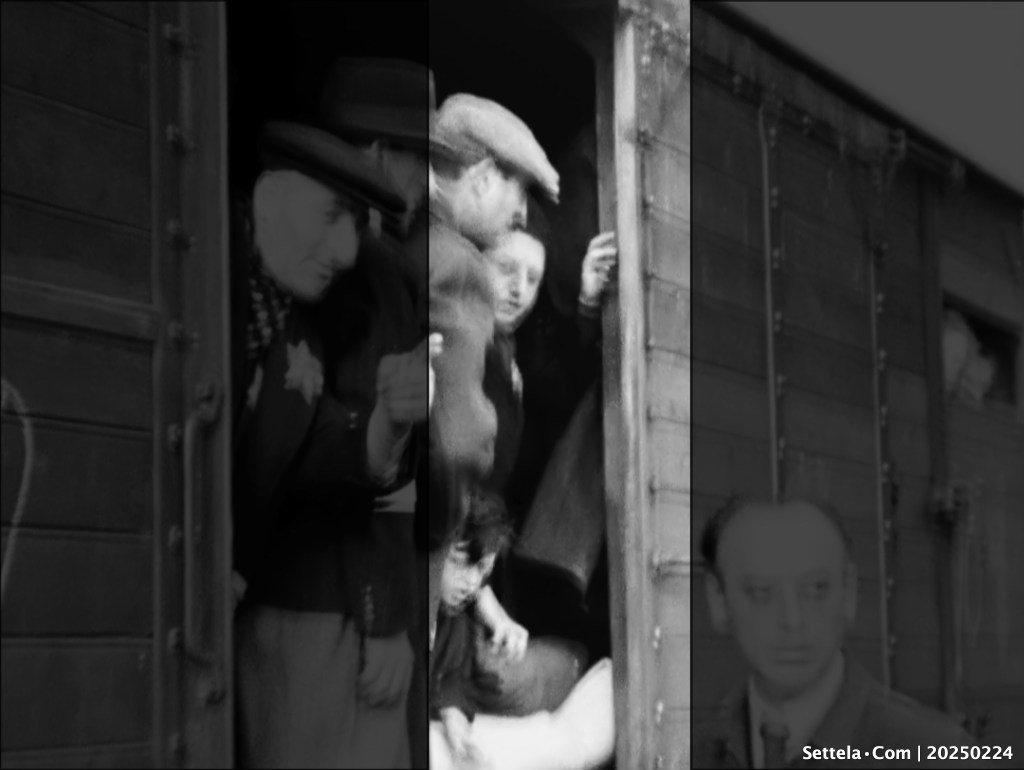
Discoveries Deportation Westerbork Film • 20250224 • The boy, the man, and the woman selected in this edited still of the linked video clip (15 s) URL https://youtube.com/clip/UgkxBw3eso6Bi3vIaR25h_bDWRHSx5EfMylN

Utrecht family identification , almost complete…

Almost certainly, three Jewish people have been recognized in the unique Westerbork film from 1944 (1). This time it concerns the 9-year-old boy Israël Wijnschenk, his father Max Wijnschenk, and his grandmother Betje Kokernoot-van Furth, who all lived in Utrecht (Holland).

Last week, the Dutch public broadcaster NOS (2) reported the news from the Utrecht (Dutch) news site Nieuws030 (3) that it is very likely that three people were recognized again in this film made by the Jewish prisoner and filmmaker Rudolf Breslauer showing the deportation of Jews, Roma and Sinti by train in Camp Westerbork on May 19, 1944.

Image researcher Koen Hulsbos — who previously identified an Amsterdam couple in this deportation train (4) — thought he recognized the young Israël Wijnschenk, a pupil at the time of the Joodse (Jewish) School Utrecht, and presented this to Victor Frederik, researcher of the Joodse School (5,6). The boy, the man, and the woman seem to belong together, and were recognized from family photos, also by family members.

It is certain that Max and his wife Chel (not in the images) returned to Utrecht after the war, their children Israël and his sister Kitty were murdered. Grandma Betje was also gassed in Auschwitz.

A portrait of Israël Wijnschenk is shown at the site of Joods Monument (7).

According to the transport list, there were two other children in that wagon, Joseph Beugeltas (11 years old) and Manfred Studzinsky (7 years old). Joseph Beugeltas appeared to have blond hair, and could not have been it (6). To be completely sure, the researchers are still looking for a photo of Manfred Studzinsky, for comparison…

Notes

1) Deportation Westerbork Film • Edition 2021 | 20210719 | Settela•Com | ISSN 2949-9313 | Footage filmed by Rudolf Breslauer in 1944, courtesy of NIOD | Sound and Vision . URL https://settela.com/2021/07/19/deportation-westerbork-film-20210719/

2) Utrechters ‘vrijwel zeker’ herkend op Westerborkfilm uit 1944. NOS Nieuws Feb 22, 2025. URL https://nos.nl/l/2556858

3) Nieuwe herkenningen in Westerborkfilm ‘bijna zeker’. Jim Terlingen | Nieuws030 . URL https://www.nieuws030.nl/hist030rie/drie-nieuwe-herkenningen-in-westerborkfilm-zo-goed-als-zeker/

4) Amsterdam couple found in Westerbork film • 20241223 | Settela•Com | ISSN 2949-9313 | URL https://settela.com/2024/12/23

5) Joodse school Utrecht. Website. URL https://joodseschoolutrecht.nl

6) Israël op Westerborkfilm? Victor Frederik- Web site Joodse school Utrecht. (Accessed 20250224). URL https://joodseschoolutrecht.nl/nl/Verhalen-over-leerlingen/Kitty-en-Israel-Wijnschenk/Israel-op-Westerborkfilm/

7) Portrait of Israël Wijnschenk. Site Joods Monument. URL https://www.joodsmonument.nl/nl/page/122045/israël-wijnschenk

Citation info : Discoveries Deportation Westerbork Film • 20250224 | Settela•Com | ISSN 2949-9313 | URL https://settela.com/2025/02/24/

Amsterdam couple found in Westerbork film • 20241223

The Dutch national broadcaster NOS (1) and the local RTV Drenthe (2) reported this morning (23 Dec 2024) that 2 more people have been recognized in the Westerbork film.

It is the Amsterdam couple Marcus Pels and Hendrika Brandon. They were identified by the image researcher Koen Hulsbos – volunteer worker at the Behind the Star project of the NIOD Institute for War, Holocaust and Genocide Studies .

The Jewish photographer and filmmaker Rudolf Breslauer, while a prisoner in the Westerbork transit camp in the Netherlands, was commissioned by camp commander Albert Gemmeker to make film recordings for the Westerbork film in the spring of 1944, featuring images of a deportation train.

The NOS broadcast referred to images in the first published Westerbork film (3) :

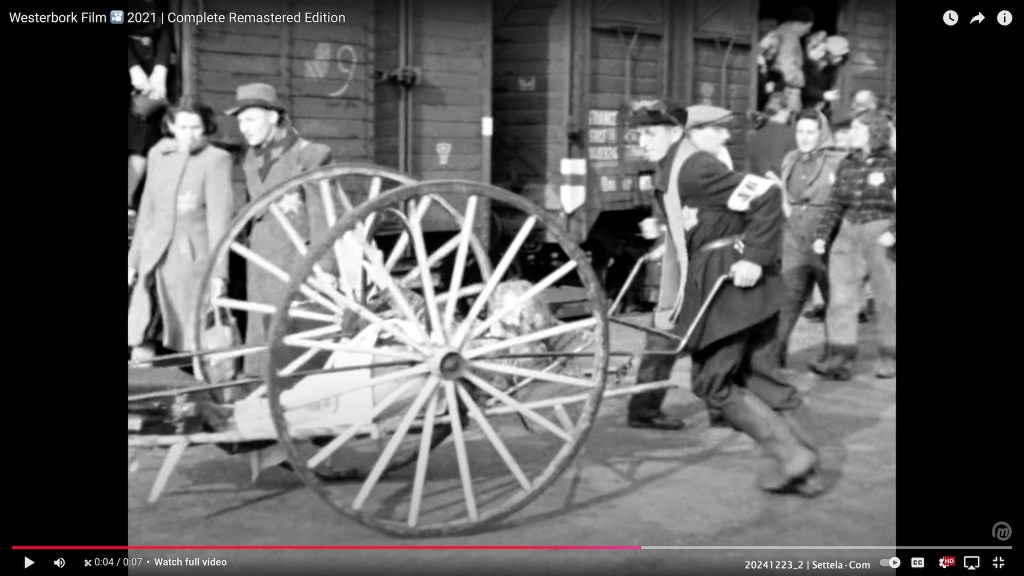
The film can be viewed in its entirety on YouTube. After just under 5 minutes 🔗 a man with a hat can be seen looking into the camera with a smile, and next to him a woman with black, slightly wavy hair can be seen from behind. The same couple appears again at 6 minutes 🔗. It turned out to be the Amsterdam couple Marcus Pels and Hendrika Brandon.

Pels & Brandon Clip 1 & 2

Also available on YouTube is the more recent second Westerborkfilm (4). This 2021 edition has the recently found original camera rolls of the deportation transport (Reel E198), with higher quality images of the couple.

20241223_1 | Settela•Com | Pels & Brandon Clip 1 after 20 min 🔗


20241223_2 | Settela•Com | Pels & Brandon Clip 2 after 21 min 🔗

That’s it

Hulsbos had already had photos of Marcus Pels and Hendrika Brandon in his collection of images of prisoners who were transported on that day – May 19, 1944 – when Breslauer films the deportation of Jews, Roma and Sinti to Bergen-Belsen and Auschwitz.

“I’ve seen the film many times, but at one point I thought, ‘Hey, this couple is on screen twice.’ I had never really noticed that before,” says Hulsbos.

Hulsbos then compared the film footage with his photos. “And then I thought: that’s it,” says the amateur film historian.

Marcus Pels was murdered immediately after arriving in Auschwitz. Hendrika Brandon survived the war, as did their daughter and son, who were in hiding with a foster family. Katy (Keetje, 86 years old) and Philip (83) are still alive and live in Canada. They were shown the film footage and confirmed that they were their parents.

“They don’t remember their father. So to actually see images of him, to see him just walking around alive, there are no words to describe it,” granddaughter Lisa Kaufman said as a family spokesperson. “It was very special to see my grandmother, who I grew up with.”

Anonym | Girl with the headscarf …

In the Westerbork film, Hendrika looks at the woman on the stretcher, who was recognized in the 1990s through her suitcase as Frouwke Kroon, and thus was the key to identifying this transport and thus also to the name of the anonymous girl with the headscarf between the wagon doors – Settela (5,6).

Deportation Breslauer family

Earlier this year it was reported that filmmaker Rudolf Breslauer had also filmed two of his children , Stefan , and Ursula Breslauer in the Westerborkfilm at the farm (7).

Werner Rudolf Breslauer , his wife Bella Weihsmann, sons Stefan and Max Michael (Mischa), and daughter Ursula were deported later in 1944 from Westerbork to Theresienstadt and Auschwitz. Only Ursula survived.

Notes

1) Twee mensen herkend in Westerborkfilm: ‘Kan niet missen’ | NOS Nieuws • Dec 23, 2024 09:45 | URL https://nos.nl/artikel/2549390-twee-mensen-herkend-in-westerborkfilm-kan-niet-missen

2) Nieuwe ontdekking in Westerbork-film: Amsterdams echtpaar krijgt gezicht | RTV Drenthe • Dec 23, 2024 07:10 | URL https://www.rtvdrenthe.nl/nieuws/17091818/nieuwe-ontdekking-in-westerbork-film-amsterdams-echtpaar-krijgt-gezicht

3) Westerbork Film | Full version RVD 1986 | 20190605 | Michel van der Burg | Settela•Com | ISSN 2949-9313 | URL https://settela.com/2019/06/05/westerbork-film-full-version-rvd/

4) Westerbork Film 🎦 2021 | 20220302 | Michel van der Burg | Settela•Com | ISSN 2949-9313 | URL https://settela.com/2022/03/02/westerbork-film-🎦-2021-complete-remastered-edition-20220302/

5) ANONYM | Girl with the headscarf … | 20210416 | Michel van der Burg | Settela•Com | ISSN 2949-9313 | URL https://settela.com/2021/04/16/anonym-girl-with-the-headscarf-20210416/

6) ANONIEM | Meisje met hoofddoekje … | 20210417 | Michel van der Burg | Settela•Com | ISSN 2949-9313 | URL https://settela.com/2021/04/17/anoniem-meisje-met-hoofddoekje-20210417/

7) Stefan & Ursula Breslauer in Westerborkfilm | 20240305 | Settela•Com | ISSN 2949-9313 | URL https://settela.com/2024/03/05

Citation info : Amsterdam couple found in Westerbork film • 20241223 | Settela•Com | ISSN 2949-9313 | URL https://settela.com/2024/12/23

In Memoriam Ward Adriaens • 20241119

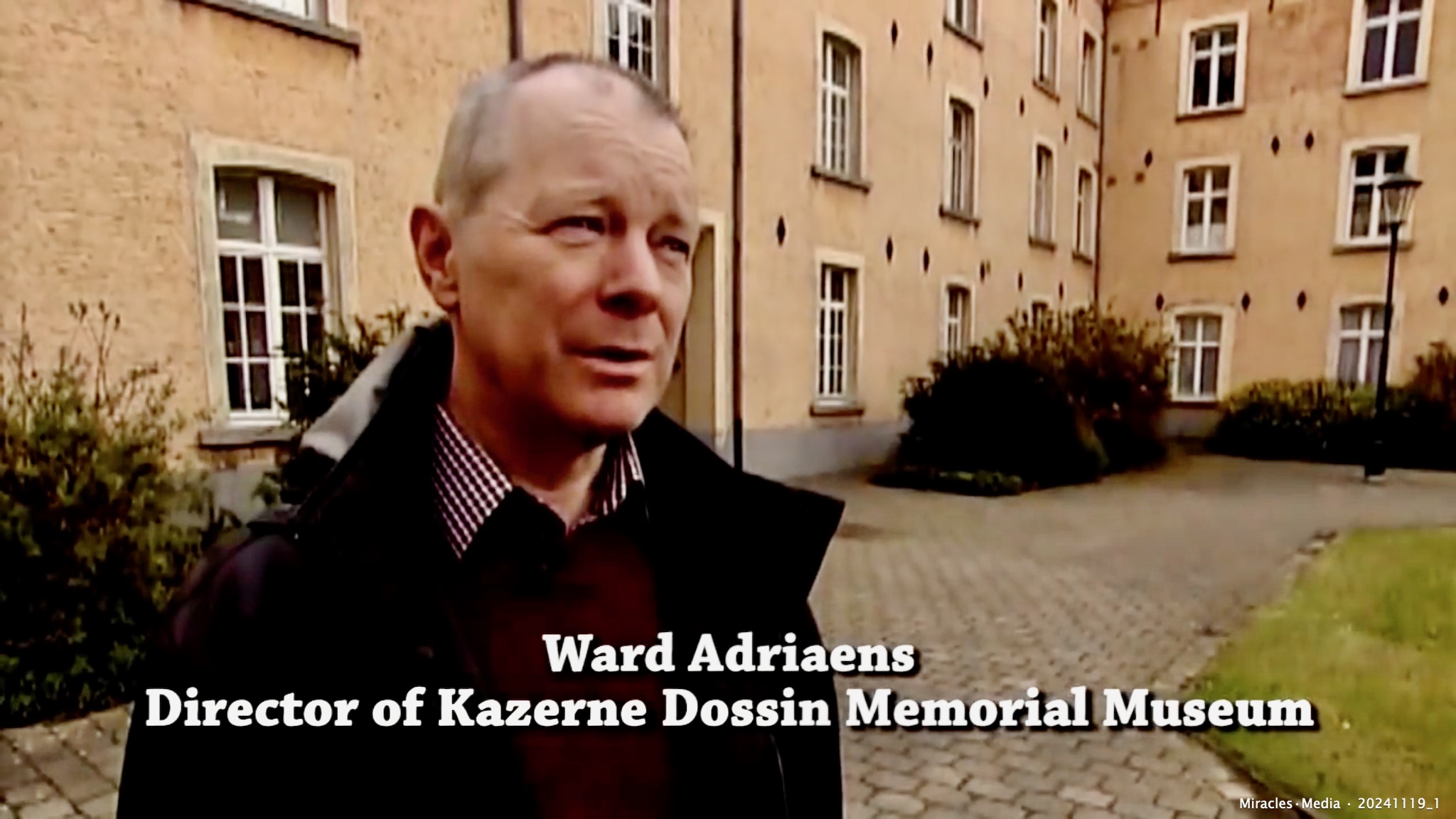
Ward Adriaens, Kazerne Dossin, ca 2005 • Still from the 2012 film ‘Transport XX to Auschwitz’ • Miracles•Media • 20241119_1 • URL https://michelvanderburg.com/2013/04/19/transport-xx-to-auschwitz/

November 2024. Ward Adriaens Passed Away

by Michel van der Burg • Miracles•Media

Ward Adriaens (Mechelen, Belgium) passed away suddenly on the evening of November 15th, 2024. A wonderful man, a freethinker, author, with a passion for living history, especially the resistance, partisans, in World War II, and the founding director in 1995 of the Jewish Museum of Deportation and Resistance (JMDR) that opened its doors in 1996. In 2012 the JMDR became the Kazerne Dossin museum, with Ward Adriaens as honorary curator. In 2005 Ward Adriaens launched the Give Them a Face archival project. The portraits of all Jewish, Roma and Sinti deportees which passed through the SS-Sammellager Mecheln (Dossin barracks, transit camp, Mechelen) in 1942-1944, were scanned to create the “Give Them a Face” portrait collection. All around 20,000 photos in the Give Them a Face portrait collection are now part of the commemoration wall – a permanent exhibition – at the Kazerne Dossin museum.

In 2009 , I first encountered the Transport XX installation in Brussels, and met Ward Adriaens’ team of the Give Them a Face project in the Jewish Museum of Deportation and Resistance in Mechelen, Belgium (1,2).

Next , Ward Adriaens participated in our 2012 documentary Transport XX to Auschwitz (3).

Recently, May 2024, Ward Adriaens’ opening speech at the TRANSPORT XX installation in Mechelen in 2007, was posted in the ‘Miracles’ project at Miracles•Media (4).

Quote

“…Let us clearly understand that this is the fundamental basis of racism: persecuted because we have a mother. We all have parents and many amongst us have children. In order to protect them it is essential that we do not give an inch to racism. Everyone of us will come under threat should the policy makers be influenced by racism…”

We lost Ward Adriaens… way too soon…

Michel van der Burg • Miracles•Media


Notes

1. Encounter • Miracles Docs #1 • Miracles•Media • 20240419 • URL https://miracles.media/2024/04/19/20240419/

2. Faces • Miracles Photo Story #1 • Miracles•Media • 20240419 • URL https://miracles.media/2024/04/19/faces-miracles-photo-story-1-20240419/

3. Ward Adriaens’ interview by the dutch reporters Piet de Blaauw & Aart Zeeman (Dutch NCRV-Netwerk broadcast, 13 April 2005, NL1) from the documentary ‘Transport XX to Auschwitz’ – a film by Karen Lynne & Richard Bloom and Michel van der Burg • In : Documentary film “Transport XX to Auschwitz” • Miracles•Media • 20130419 • URL (retrieved 20241119) https://michelvanderburg.com/2013/04/19/transport-xx-to-auschwitz/


Ward Adriaens • Film clip ‘Transport XX to Auschwitz’ • Miracles•Media • 20241119_2 • URL (retrieved 20241119) https://youtube.com/clip/UgkxBThndqEFjIk8Oq0-bbKzia9mF-kBe-2N

4. Speech by Ward Adriaens, Curator of The JMDR, Friday 20th April 2007. In : TRANSPORT XX installation Mechelen • Miracles•Media • 20240518

Citation info : In Memoriam Ward Adriaens • 20241119 • Settela•Com • ISSN 2949-9313

Visit Transport Z | 20240528

Simon Gronowski and Maria Baumeister at “Transport Z” canvases | Open Memory, May 8, 2010, Cologne

Open Memory in Cologne (Köln) , Germany, May 8, 2010. Photo at the opening of the Open Memory installation with Simon Gronowski (survivor Transport XX to Auschwitz) together with Maria Baumeister (Cologne Initiative ‘Die Bahn erinnern’) and, seen from behind, Gitta R. (Lovara group of Roma) in front of one of the canvases with photographs and silhouettes of 351 Sinti and Roma from Northern France and Belgium, deported with “Transport Z” in January 1944 from Kazerne Dossin in Mechelen, Belgium to the Auschwitz-Birkenau extermination camp.

Notes

Documentary ‘Open Memory’ in :
Open Memory | 20240523 | Settela•Com | ISSN 2949-9313 | URL https://settela.com/2024/05/23/open-memory-20240523/

Edited image (anonymous photographer) selected from web gallery photos by Bahn erinnern , and S. Grollmuss at the Open Memory site open-memory.info – retrieved on Apr 13 , 2017.

Citation info : Visit Transport Z | 20240528 | Settela•Com | ISSN 2949-9313 | TakeNode 85faa3e6-5168-4909-9c02-fd233fa4a1bd

Open Memory | 20240523

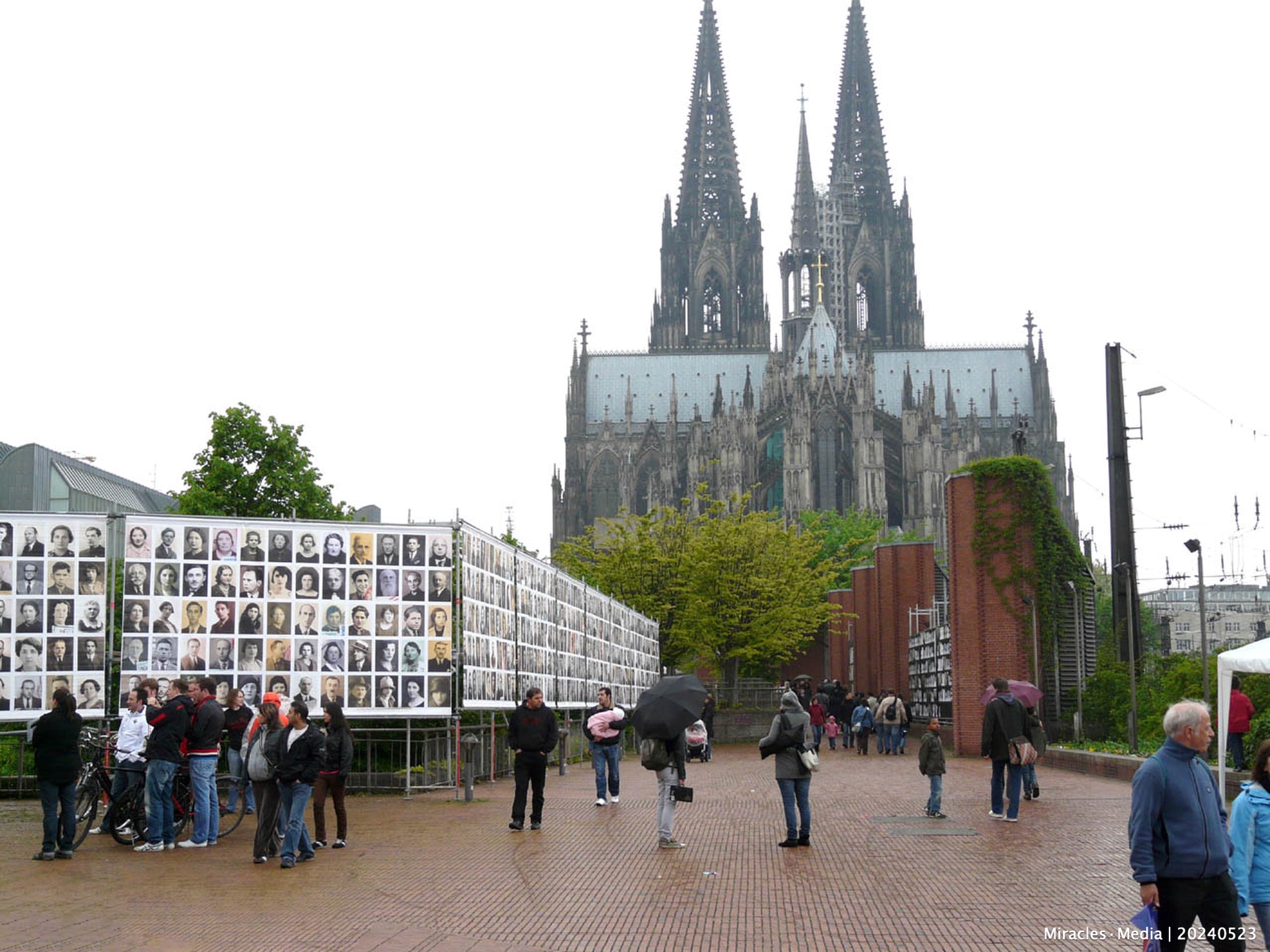
Open Memory , Cologne, May 2010. Transport XX (left) and Transport Z (right) in front of the with Cologne Cathedral. Still : Open Memory | Miracles Docs #3 | Miracles•Media | 20240523

From May 8th to May 24th, 2010, the memorial installation “Open Memory” was on display in a prominent location in Köln (Cologne, Germany) — in front of the Hohenzollern Bridge, at the left bank of the Rhine river, parallel to the railway tracks of the Cologne Central Station (Köln Hauptbahnhof), with the Cologne Cathedral (Kölner Dom) in the background.

It consisted of 26 large canvases on which portraits of more than 1,500 people were depicted. This open-air exhibition was intended to commemorate three events that occurred during this period: the end of the Second World War in Europe on May 8th and 9th, 1945, the 70th anniversary of the attack by the German Wehrmacht on the Benelux countries and France, and the 70th anniversary of the deportation of the Sinti and Roma from Cologne and the Rhineland (Western Germany).

The Museum La Coupole had created six canvases with photographs or silhouettes of 351 Sinti and Roma from Northern France and Belgium, deported with “Transport Z” in January 1944 from Kazerne Dossin in Mechelen, Belgium to the Auschwitz-Birkenau extermination camp.

On 20 other canvases were the portraits of 1,200 Jewish people deported with “Transport XX” in April 1943 from Kazerne Dossin in Mechelen to Auschwitz. This exhibition was created by the Jewish Deportation and Resistance Museum (Kazerne Dossin) in Mechelen. “Transport XX” is the only deportation train in Europe that was stopped by a resistance group.

The exhibition lined the route Roma and Sinti from Köln had to take from May 1940 en route across the Rhine via the Hohenzollern Bridge to the Cologne Fair (Köln Messe) transit camp for deportation to the extermination camps. The route was marked May 6, 1990, by the artist Gunter Demnig (later known for his Stolperstein project) by printing the writing “May 1940 – 1000 Sinti and Roma” on the streets in Cologne, using a wheel for painting with white paint.

The Open Memory installation was presented by : the Jewish Deportation and Resistance Museum (Kazerne Dossin) in Mechelen, Belgium • La Coupole – History Centre in Wizernes, France • NS Documentation Center Cologne • AK Memorial Centers NRW • Yavne Memorial and Educational Center • EL-DE-Haus Cologne.

Film by : Michel van der Burg, thanks to an amateur (2010) slide presentation by A. Lototsky

Citation info : Open Memory | 20240523 | Settela•Com | ISSN 2949-9313 | TakeNode 4e398109-d461-4a41-84d7-8d74756c82d8

First Stolperstein | 20240520

First Stolperstein. Installed on 16 Dec 1992 in front of the City Hall in Cologne , Germany.

Over the past 30 years the team of German artist Gunter Demnig installed over 100,000 Stumbling Stones – ‘Stolpersteine’ – across 26 countries in Europe – the world’s largest memorial.

Demnig’s Stolpersteine are small, cobblestone-sized brass memorials for the victims of National Socialism. Set into the pavement of sidewalks in front of the buildings where Nazi victims once lived or worked, they call attention both to the individual victim and the scope of the Nazi war crimes.

The very first Stolperstein, was installed on 16 December 1992 in front of Cologne City Hall , with Heinrich Himmler’s order for the initiation of deportations of all Roma (Gypsies) :

„Auf Befehl des Reichsführers SS vom 16.12.42 – Tgb. Nr. I 2652/42 Ad./RF/V. – sind Zigeunermischlinge, Rom-Zigeuner und nicht deutschblütige Angehörige zigeunerischer Sippen balkanischer Herkunft nach bestimmten Richtlinien auszuwählen und in einer Aktion von wenigen Wochen in ein Konzentrationslager einzuweisen. Dieser Personenkreis wird im nachstehenden kurz als ‚zigeunerische Personen‘ bezeichnet. Die Einweisung erfolgt ohne Rücksicht auf den Mischlingsgrad familienweise in das Konzentrationslager (Zigeunerlager) Auschwitz.“

Notes

Photo : First Stolperstein at the Cologne City Hall, Germany. Photo Jan. 1, 2008, by Willy Horsch, CC-BY .

Citation info : First Stolperstein | 20240520 | Settela•Com | ISSN 2949-9313 | URL https://settela.com/2024/05/20

Stefan & Ursula Breslauer in Westerborkfilm | 20240305

Stefan & Ursula Breslauer in Westerborkfilm | 20240305 – Clip from : Westerbork Film 🎦 2021 | 20220302 | Settela•Com | URL https://youtube.com/clip/UgkxdcMjzZQcH8jOtp1j2xFwrPxyAoHMcdFr

Filmmaker Rudolf Breslauer also filmed two of his children in the Westerborkfilm…

Stefan (left) & Ursula Breslauer, children of Rudolf Breslauer, the filmmaker of the Westerbork film at the farm of Camp Westerbork in 1944 – identified by the dutch photographer Sake Elzinga, who received Breslauer’s family photo albums last year when the family of Ursula – the only survivor – visited an expo on Breslauer in the Westerbork museum in the Netherlands.

Camp commander (SS-Obersturmführer) Albert Gemmeker ordered the Westerbork film , made by the German Jewish prisoner, photographer, Rudolf Breslauer in the spring of 1944.

Today 80 years ago – March 5, 1944 – the camp is an ‘Arbeitslager’ – a work camp – when Rudolf Breslauer starts filming the daily life of the Westerbork prisoners — inside : in the barracks, for example a religious service, cabaret, workshops, factories, aircraft and battery recycling, medical care, and outside the barracks : construction of a greenhouse, a football match, women working out, chopping wood, incoming transports, and eventually also the departure of a deportation train. After Breslauer films the deportation of Jews, Roma and Sinti to Bergen-Belsen and Auschwitz on May 19, 1944 the filming stops.
The haunting image of the 9-year-old dutch Sinti-girl Settela, standing in the closing doors of the goods train, and the unique footage of that deportation train that leaves the Westerbork camp, became iconic after the war.

Deportation Breslauer family

Werner Rudolf Breslauer , his wife Bella Weihsmann, sons Stefan and Max Michael (Mischa), and daughter Ursula were deported autumn 1944 from Westerbork to Theresienstadt and Auschwitz. Only Ursula survived.

Stefan & Ursula Breslauer in Westerborkfilm | 20240305 | Settela•Com | Frame 127475 from Westerbork Film 🎦 2021 | 20220302 | Settela•Com | ISSN 2949-9313 | Footage filmed by Rudolf Breslauer in 1944, courtesy of NIOD | Sound and Vision

Notes

Clip from : Westerbork Film 🎦 2021 | Complete Remastered Edition | YouTube https://youtu.be/ZiLNDziwEtc

Westerbork Film 🎦 2021 | 20220302 | Settela•Com | URL https://settela.com/2022/03/02/westerbork-film-🎦-2021-complete-remastered-edition-20220302/

Kinderen van filmmaker Breslauer herkend in historische Westerborkfilm. Dutch national news broadcaster NOS Nieuws, in cooperation with RTV Drenthe, 13:18 Monday 4 March 2024 | URL https://nos.nl/artikel/2511414-kinderen-van-filmmaker-breslauer-herkend-in-historische-westerborkfilm

Scene with Stefan & Ursula Breslauer, starting at 56:13 in the 1986 RVD edition of the Westerborkfilm:
Stefan & Ursula Breslauer in Westerbork Film RVD | 20240305 | Settela•Com | URL https://youtube.com/clip/UgkxfNzA72JeGgVoOFp_VTI4EQQr3yTwXu6_

Settela Film | 20220630 | Michel van der Burg | Settela•Com

Deportation Westerbork Film | 20210719 | Michel van der Burg | Settela•Com

English introduction to Westerborkfilm :
Westerborkfilm Introduction | 20220507 | Michel van der Burg | Settela•Com | URL https://settela.com/2022/05/07/westerborkfilm-introduction-20220507/

Citation info : Stefan & Ursula Breslauer in Westerborkfilm | 20240305 | Settela•Com | ISSN 2949-9313 | URL https://settela.com/2024/03/05

News

March 5, 2024 : Updated 21:21